Mahadeo Shannice, Narain Keshmika, Mhlongo Lungelo, Chetty Desmaine, Masondo Lindelani, Zungu Mandla, Suleman Fatima, Perumal-Pillay Velisha Ann
Discipline of Pharmaceutical Sciences, University of KwaZulu-Natal, Private Bag X54001, Durban, 4000, South Africa.
J Pharm Policy Pract. 2022 Jan 5;15(1):2. doi: 10.1186/s40545-021-00402-y.
Globally, an estimated 8.1 million children under 5 years die annually in developing countries. Ensuring essential medicines are accessible and affordable to the population is key to saving lives. This study investigated accessibility, availability and affordability of a basket of priority medicines for children under 5 years in public and private healthcare sector pharmacies in the eThekwini Metropolitan area in Durban, South Africa.
The WHO/HAI survey tool for assessing medicine prices, availability and affordability was adapted and employed for a basket of WHO Priority life-saving medicines for children under 5 years. Six district hospitals in the north, south and central eThekwini Metropolitan were selected as major facility reference points and for data collection and pharmacies within a 5 km radius from each major facility were also invited to participate in the study, as outlined in the WHO/HAI tool methodology. Of the 58 pharmacies selected, a total of 27 pharmacies from both private and public healthcare sectors agreed to participate and were surveyed, representing a 47% response rate. Data was analysed using Microsoft excel.
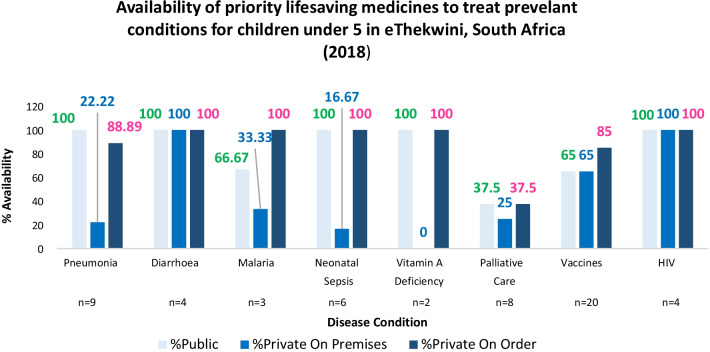
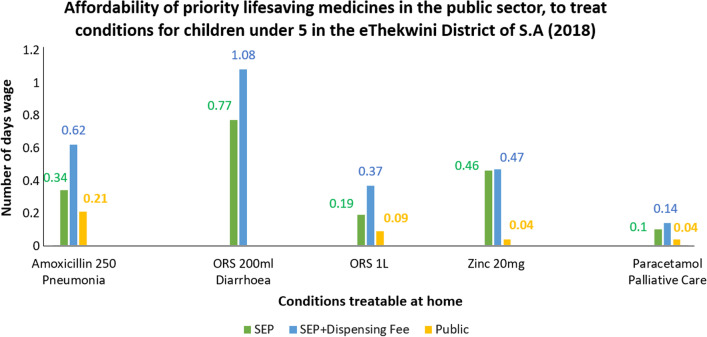
All participating pharmacies (and hence the selected basket of priority medicines at these facilities) were deemed accessible. Overall the public sector had more medicines available on the shelf (averaging 64%) than the private sector (48%) which had more medicines available on order (84%). At least one medicine for each of the eight (8) conditions was available at both sectors which meant patients could be treated for these conditions. Medicines for priority conditions (except HIV, which was a 28-day course) were deemed affordable as these regimens were obtainable within a day's wage for the lowest paid unskilled worker. Priority medicines for children under 5 years were more available and more affordable in the public sector.
The basket of WHO essential medicines for priority conditions for children under 5 years were accessible, available and affordable in the eThekwini Metropolitan areas. This was the first study in eThekwini to determine access to the WHO basket of priority medicines for children and can be scaled-up to a national study to provide a holistic comparison of these medicines in the country, and also for global comparison.
全球范围内,发展中国家估计每年有810万5岁以下儿童死亡。确保民众能够获取并负担得起基本药物是挽救生命的关键。本研究调查了南非德班伊泰夸尼都会区公立和私立医疗保健机构药房中一篮子5岁以下儿童优先药物的可及性、可得性和可负担性。
采用并改编了世界卫生组织/卫生行动信息中心用于评估药品价格、可得性和可负担性的调查工具,用于一篮子世界卫生组织5岁以下儿童优先救命药物。在伊泰夸尼都会区的北部、南部和中部选择了6家区级医院作为主要设施参考点并用于数据收集,并且按照世界卫生组织/卫生行动信息中心工具方法的概述,邀请了距离每个主要设施半径5公里范围内的药房参与研究。在选定的58家药房中,共有来自私立和公立医疗保健部门的27家药房同意参与并接受了调查,回复率为47%。使用微软Excel对数据进行分析。
所有参与调查的药房(以及这些机构中选定的一篮子优先药物)均被认为具有可及性。总体而言,公立部门货架上的药品更多(平均为64%),而私立部门订购的药品更多(84%)。两个部门均有至少一种用于8种病症中每种病症的药物,这意味着患者可以针对这些病症接受治疗。优先病症的药物(艾滋病毒治疗疗程为28天的除外)被认为具有可负担性,因为这些治疗方案可以在最低薪非技术工人一天的工资范围内获得。5岁以下儿童的优先药物在公立部门更易获取且更具可负担性。
伊泰夸尼都会区5岁以下儿童优先病症的世界卫生组织基本药物篮子具有可及性、可得性和可负担性。这是伊泰夸尼首次确定获取世界卫生组织5岁以下儿童优先药物篮子情况的研究,可扩大为全国性研究,以全面比较该国这些药物的情况,也可用于全球比较。