Department of Neurosurgery, Xinqiao Hospital, Third Military Medical University (Army Medical University), Chongqing, China.
Institute of Pathology and Southwest Cancer Center, Southwest Hospital, Third Military Medical University (Army Medical University), Chongqing, China.
Theranostics. 2022 Jan 1;12(1):459-473. doi: 10.7150/thno.65739. eCollection 2022.
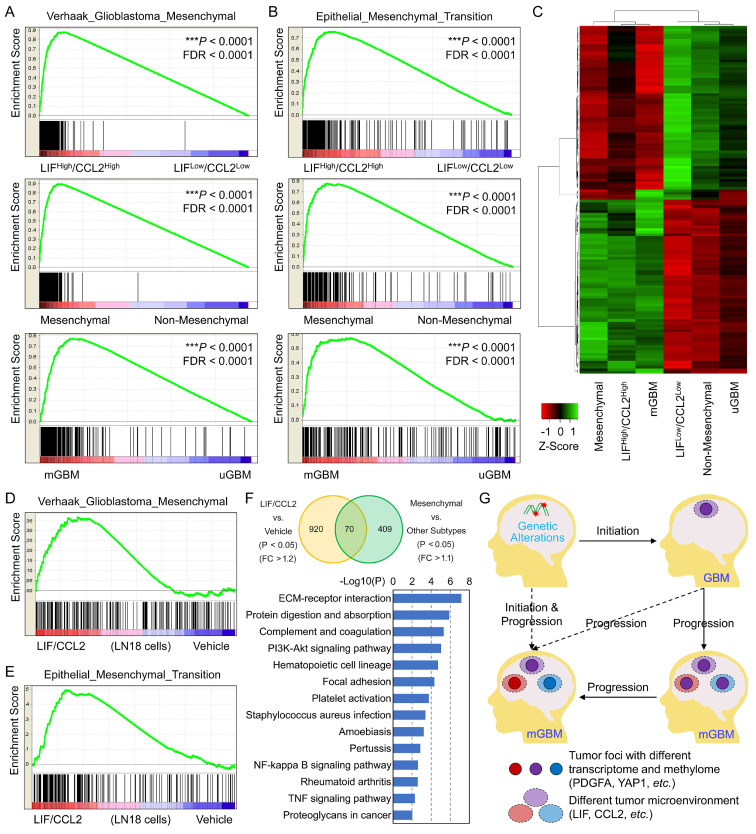
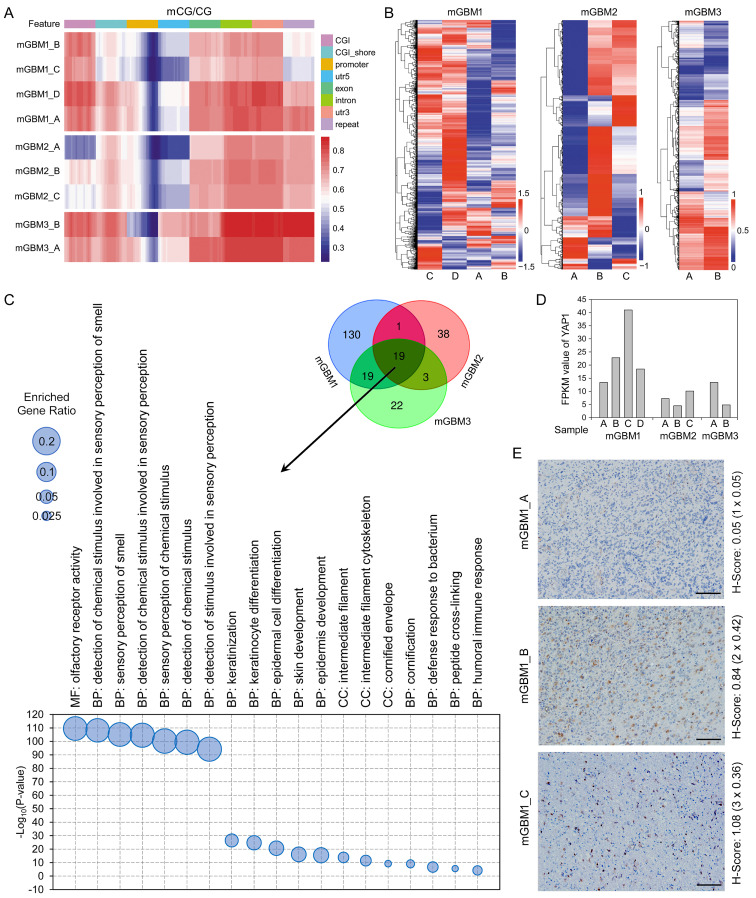
Around 10%-20% patients with glioblastoma (GBM) are diagnosed with more than one tumor lesions or multifocal GBM (mGBM). However, the understanding on genetic, DNA methylomic, and transcriptomic characteristics of mGBM is still limited. In this study, we collected nine tumor foci from three mGBM patients followed by whole genome sequencing, whole genome bisulfite sequencing, RNA sequencing, and immunohistochemistry. The data were further examined using public GBM databases and GBM cell line. Analysis on genetic data confirmed common features of GBM, including gain of chr.7 and loss of chr.10, loss of critical tumor suppressors, high frequency of PDGFA and EGFR amplification. Through profiling DNA methylome of individual tumor foci, we found that promoter methylation status of genes involved in detection of chemical stimulus, immune response, and Hippo/YAP1 pathway was significantly changed in mGBM. Although both CNV and promoter methylation alteration were involved in heterogeneity of different tumor foci from same patients, more CNV events than promoter hypomethylation events were shared by different tumor foci, implying CNV were relatively earlier than promoter methylation alteration during evolution of different tumor foci from same mGBM. Moreover, different tumor foci from same mGBM assumed different molecular subtypes and mesenchymal subtype was prevalent in mGBM, which might explain the worse prognosis of mGBM than single GBM. Interestingly, we noticed that LIF and CCL2 was tightly correlated with mesenchymal subtype tumor focus in mGBM and predicted poor survival of GBM patients. Treatment with LIF and CCL2 produced mesenchymal-like transcriptome in GBM cells. Together, our work herein comprehensively profiled multi-omics features of mGBM and emphasized that components of extracellular microenvironment, such as LIF and CCL2, contributed to the evolution and prognosis of tumor foci in mGBM patients.
约 10%-20%的胶质母细胞瘤(GBM)患者被诊断为存在多个肿瘤病灶或多灶性 GBM(mGBM)。然而,对于 mGBM 的遗传、DNA 甲基化组学和转录组学特征的理解仍然有限。在这项研究中,我们从三名 mGBM 患者中收集了九个肿瘤病灶,随后进行了全基因组测序、全基因组亚硫酸氢盐测序、RNA 测序和免疫组织化学检测。我们还进一步利用公共 GBM 数据库和 GBM 细胞系分析了这些数据。遗传数据分析结果证实了 GBM 的常见特征,包括 chr.7 的增益和 chr.10 的缺失、关键肿瘤抑制基因的丢失、PDGFA 和 EGFR 扩增的高频发生。通过对个体肿瘤病灶的 DNA 甲基化组进行分析,我们发现 mGBM 中涉及化学刺激检测、免疫反应和 Hippo/YAP1 通路的基因启动子甲基化状态发生了显著变化。虽然 CNV 和启动子低甲基化改变都参与了同一患者不同肿瘤病灶的异质性,但不同肿瘤病灶之间共享的 CNV 事件多于启动子低甲基化事件,这表明在同一 mGBM 中不同肿瘤病灶的进化过程中,CNV 比启动子低甲基化改变更早发生。此外,同一 mGBM 中的不同肿瘤病灶表现出不同的分子亚型,间充质亚型在 mGBM 中更为常见,这可能解释了 mGBM 比单个 GBM 预后更差的原因。有趣的是,我们注意到 LIF 和 CCL2 与 mGBM 中的间充质亚型肿瘤病灶紧密相关,并预测了 GBM 患者的不良预后。LIF 和 CCL2 的治疗可使 GBM 细胞产生间充质样转录组。总之,我们的工作全面分析了 mGBM 的多组学特征,并强调细胞外微环境成分(如 LIF 和 CCL2)对 mGBM 患者肿瘤病灶的进化和预后有贡献。