Department of Neurosurgery, Graduate School of Biomedical Sciences, Tokushima University, 3-18-15, Kuramoto-cho, Tokushima, 770-8503, Japan.
Division of Gene Regulation, Institute for Advanced Medical Research, School of Medicine, Keio University, Shinjuku-ku, Tokyo, 160-8582, Japan.
Sci Rep. 2020 Sep 17;10(1):15286. doi: 10.1038/s41598-020-71857-3.
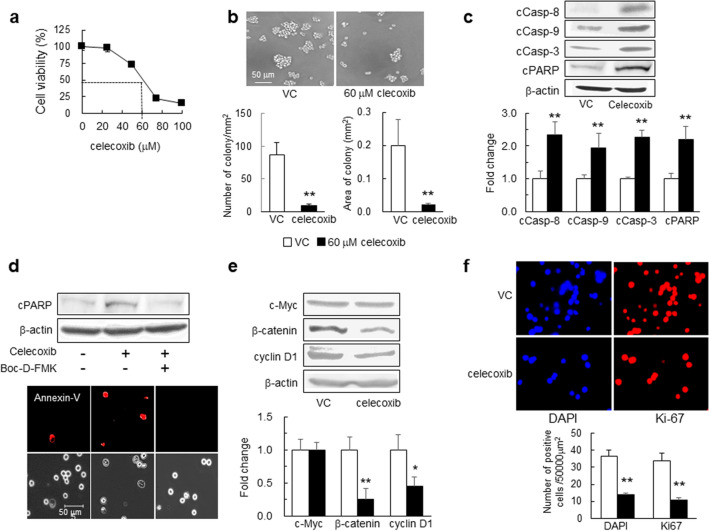
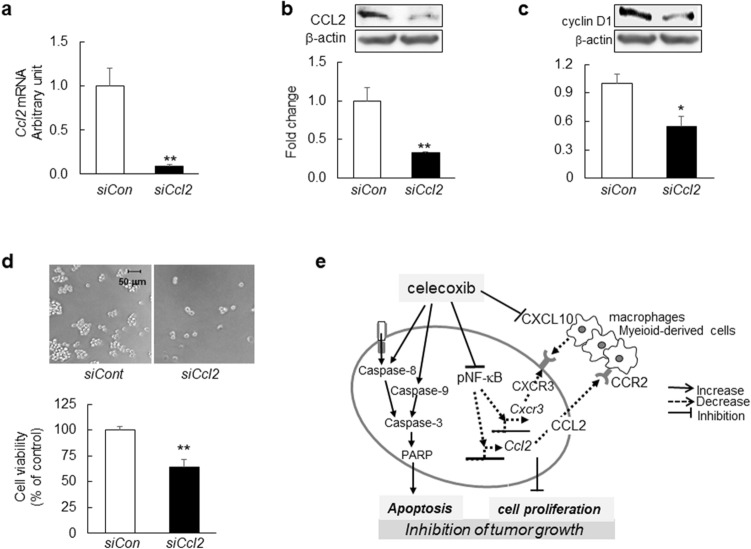
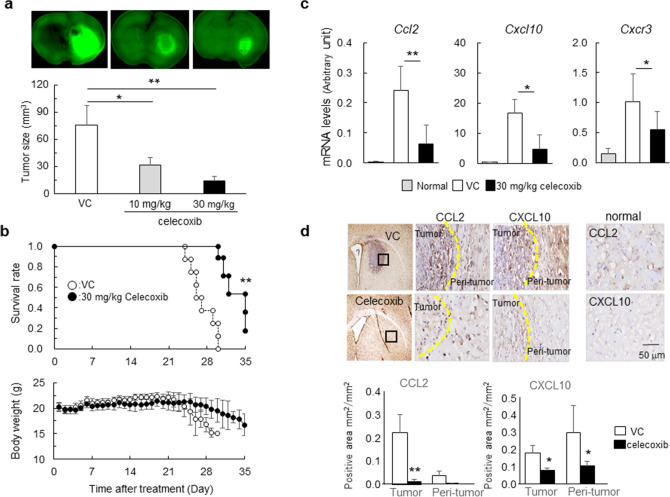
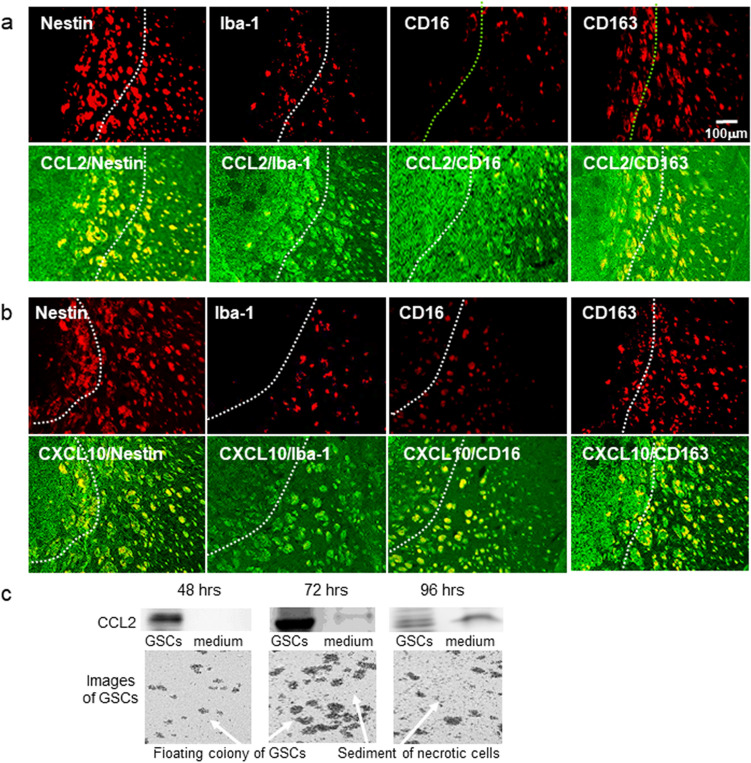
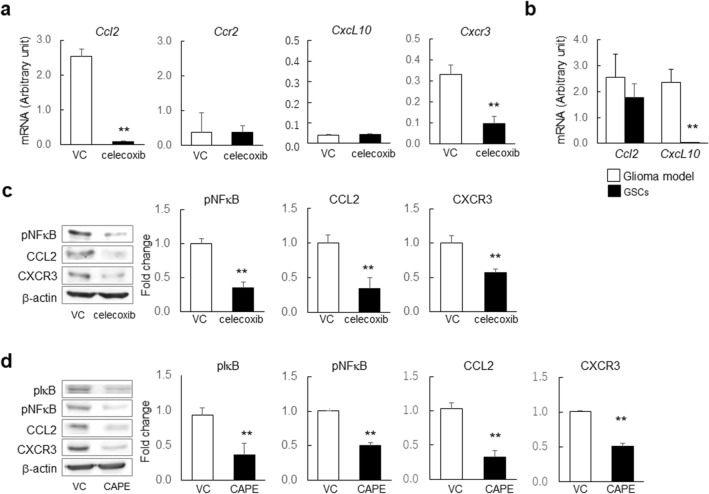
Glioblastoma multiforme involves glioma stem cells (GSCs) that are resistant to various therapeutic approaches. Here, we studied the importance of paracrine signaling in the glioma microenvironment by focusing on the celecoxib-mediated role of chemokines C-C motif ligand 2 (CCL2), C-X-C ligand 10 (CXCL10), and their receptors, CCR2 and CXCR3, in GSCs and a GSC-bearing malignant glioma model. C57BL/6 mice were injected with orthotopic GSCs intracranially and divided into groups administered either 10 or 30 mg/kg celecoxib, or saline to examine the antitumor effects associated with chemokine expression. In GSCs, we analyzed cell viability and expression of chemokines and their receptors in the presence/absence of celecoxib. In the malignant glioma model, celecoxib exhibited antitumor effects in a dose dependent manner and decreased protein and mRNA levels of Ccl2 and CxcL10 and Cxcr3 but not of Ccr2. CCL2 and CXCL10 co-localized with Nestin stem cells, CD16 or CD163 macrophages and Iba-1 microglia. In GSCs, celecoxib inhibited Ccl2 and Cxcr3 expression in a nuclear factor-kappa B-dependent manner but not Ccr2 and CxcL10. Moreover, Ccl2 silencing resulted in decreased GSC viability. These results suggest that celecoxib-mediated regulation of the CCL2/CCR2 and CXCL10/ CXCR3 axes may partially contribute to glioma-specific antitumor effects.
多形性胶质母细胞瘤涉及对各种治疗方法具有抗性的神经胶质瘤干细胞(GSCs)。在这里,我们通过关注塞来昔布介导的趋化因子 C-C 基序配体 2(CCL2)、C-X-C 配体 10(CXCL10)及其受体 CCR2 和 CXCR3 在 GSCs 和 GSC 携带的恶性神经胶质瘤模型中的旁分泌信号作用,研究了神经胶质瘤微环境的重要性。C57BL/6 小鼠被颅内注射原位 GSCs,并分为接受 10 或 30mg/kg 塞来昔布或生理盐水的组,以检查与趋化因子表达相关的抗肿瘤作用。在 GSCs 中,我们分析了存在/不存在塞来昔布时细胞活力和趋化因子及其受体的表达。在恶性神经胶质瘤模型中,塞来昔布呈剂量依赖性抗肿瘤作用,并降低 Ccl2 和 CxcL10 和 Cxcr3 的蛋白和 mRNA 水平,但不降低 Ccr2 的水平。CCL2 和 CXCL10 与巢蛋白干细胞、CD16 或 CD163 巨噬细胞和 Iba-1 小胶质细胞共定位。在 GSCs 中,塞来昔布以核因子-κB 依赖性方式抑制 Ccl2 和 Cxcr3 的表达,但不抑制 Ccr2 和 CxcL10。此外,Ccl2 沉默导致 GSC 活力降低。这些结果表明,塞来昔布介导的 CCL2/CCR2 和 CXCL10/CXCR3 轴的调节可能部分有助于神经胶质瘤特异性抗肿瘤作用。