Jiao Zhiming, Feng Zhanchun, Yan Ziqi, Zhang Jinwen, Li Gang, Wang Ganyi, Wang Qianyu, Feng Da
School of Medicine and Health Management, Tongji Medical College, Huazhong University of Science and Technology, Wuhan, China.
Department of Pharmacy, Tongji Hospital, Tongji Medical College, Huazhong University of Science and Technology, Wuhan, China.
Front Oncol. 2021 Dec 20;11:807171. doi: 10.3389/fonc.2021.807171. eCollection 2021.
Adverse drug reactions (ADRs) in pediatric cancer patients have not yet received due attention in the world. Antineoplastic drugs are frequently related to ADRs. Few studies focus on the ADR and the intervention measures in pediatric cancer patients.
ADR reports submitted to Henan Adverse Drug Reaction Monitoring Center from 2016 to 2020 for individuals aged from birth to 17 years (including 17 years) were included. Data were analyzed with respect to gender, age, disease types, past history of ADR, occurrence time of ADR, polypharmacy, route of administration, off-label drug use, name of suspected drugs per ADR report, and severity of ADR reports.
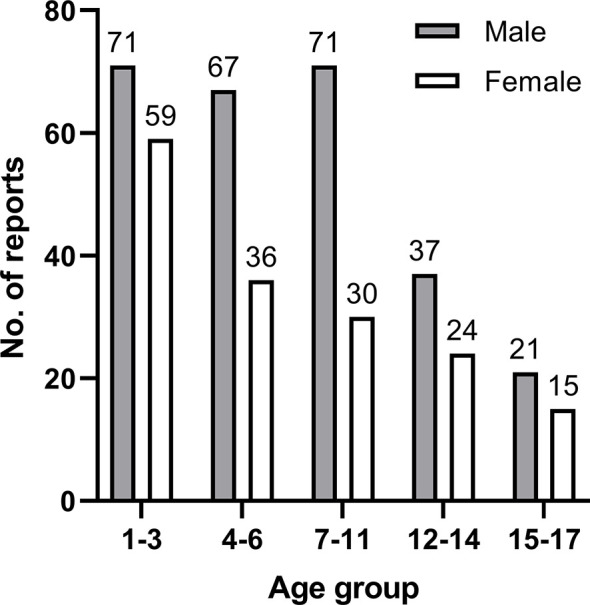
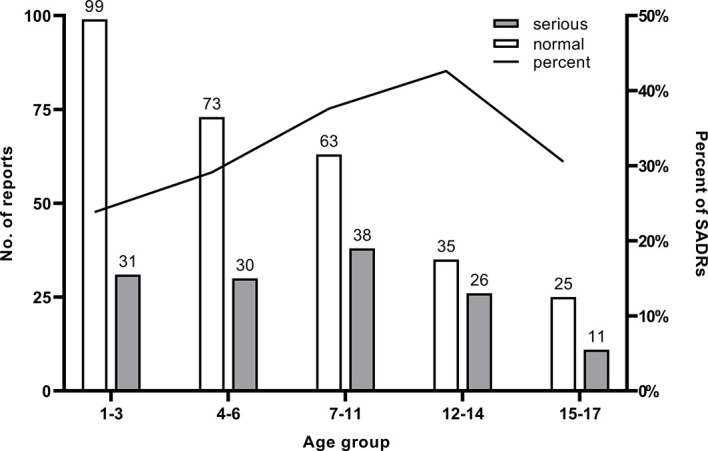
A total of 431 ADR reports related to antineoplastic drugs in pediatric patients were collected, 31.55% were serious ADRs (SADRs). The median age of patients was six years (inter quartile range, IQR: 3-11), the age groups with higher reporting rates were concentrated in 1-3-year-olds (130). Past history of ADR, occurrence time of ADR and polypharmacy were statistically associated with SADR. Myelosuppression was the most frequent ADR (15.55%), cytarabine was the most frequent drug (26.22%). The signal mining method produced 14 signals, three signals were off-label ADRs.
This study described the characteristics of ADRs in pediatric cancer patients. By conducting signal mining method, three off-label ADRs need further study. We should pay more attention to these ADRs and develop relative management strategies. More researches are needed to achieve a better understanding of the characteristics of ADRs in pediatric cancer patients of China.
儿童癌症患者的药物不良反应在全球范围内尚未得到应有的重视。抗肿瘤药物常与药物不良反应相关。很少有研究关注儿童癌症患者的药物不良反应及干预措施。
纳入2016年至2020年提交至河南省药品不良反应监测中心的出生至17岁(含17岁)个体的药品不良反应报告。对性别、年龄、疾病类型、既往药物不良反应史、药物不良反应发生时间、联合用药、给药途径、超说明书用药、每份药品不良反应报告的可疑药物名称以及药品不良反应报告的严重程度进行数据分析。
共收集到431份儿童患者抗肿瘤药物相关的药品不良反应报告,其中31.55%为严重药品不良反应。患者的中位年龄为6岁(四分位间距,IQR:3 - 11),报告率较高的年龄组集中在1 - 3岁(130例)。既往药物不良反应史、药物不良反应发生时间和联合用药与严重药品不良反应在统计学上相关。骨髓抑制是最常见的药物不良反应(15.55%),阿糖胞苷是最常见的药物(26.22%)。信号挖掘方法产生了14个信号,其中3个信号为超说明书用药的药品不良反应。
本研究描述了儿童癌症患者药物不良反应的特征。通过信号挖掘方法,3种超说明书用药的药品不良反应需要进一步研究。我们应更加关注这些药物不良反应并制定相关管理策略。需要更多研究以更好地了解中国儿童癌症患者药物不良反应的特征。