Horvath Jaqueline Driemeyer Correia, Bessel Marina, Kops Natália Luiza, Souza Flávia Moreno Alves, Pereira Gerson Mendes, Wendland Eliana Marcia
Escritório de Projetos, Programa de Apoio ao Desenvolvimento Institucional do Sistema Único de Saúde, Hospital Moinhos de Vento, Porto Alegre, Brazil.
Department of Chronic Conditions Diseases and Sexually Transmitted Infections, Health Surveillance Secretariat, Ministry of Health, Brasília, Brazil.
JMIR Res Protoc. 2022 Jan 5;11(1):e31365. doi: 10.2196/31365.
The credibility of a study and its internal and external validity depend crucially on the quality of the data produced. An in-depth knowledge of quality control processes is essential as large and integrative epidemiological studies are increasingly prioritized.
This study aimed to describe the stages of quality control in the POP-Brazil study and to present an analysis of the quality indicators.
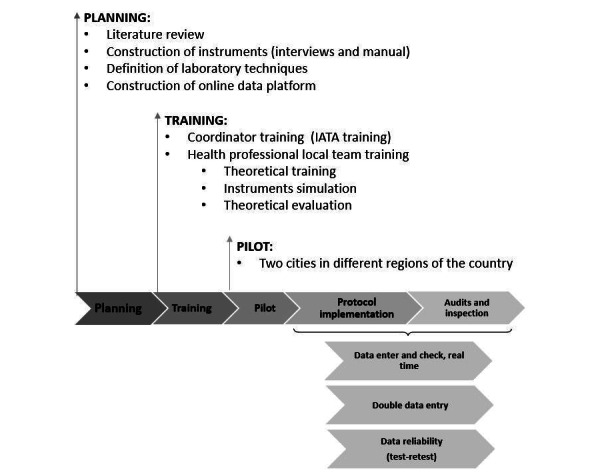
Quality assurance and control were initiated with the planning of this nationwide, multicentric study and continued through the development of the project. All quality control protocol strategies, such as training, protocol implementation, audits, and inspection, were discussed one by one. We highlight the importance of conducting a pilot study that provides the researcher the opportunity to refine or modify the research methodology and validating the results through double data entry, test-retest, and analysis of nonresponse rates.
This cross-sectional, nationwide, multicentric study recruited 8628 sexually active young adults (16-25 years old) in 119 public health units between September 2016 and November 2017. The Human Research Ethics Committee of the Moinhos de Vento Hospital approved this project.
Quality control processes are a continuum, not restricted to a single event, and are fundamental to the success of data integrity and the minimization of bias in epidemiological studies. The quality control steps described can be used as a guide to implement evidence-based, valid, reliable, and useful procedures in most observational studies to ensure data integrity.
INTERNATIONAL REGISTERED REPORT IDENTIFIER (IRRID): RR1-10.2196/31365.
一项研究的可信度及其内部和外部效度关键取决于所产生数据的质量。随着大型综合性流行病学研究日益受到重视,深入了解质量控制流程至关重要。
本研究旨在描述巴西人口研究(POP-Brazil study)中的质量控制阶段,并对质量指标进行分析。
在这项全国性多中心研究的规划阶段就启动了质量保证和控制工作,并贯穿项目开展过程。逐一讨论了所有质量控制方案策略,如培训、方案实施、审核和检查。我们强调了开展预试验的重要性,预试验为研究人员提供了完善或修改研究方法的机会,并通过双数据录入、重测以及无应答率分析来验证结果。
这项横断面、全国性、多中心研究于2016年9月至2017年11月期间在119个公共卫生单位招募了8628名性活跃的年轻成年人(16 - 25岁)。风磨坊医院的人类研究伦理委员会批准了该项目。
质量控制流程是一个连续统一体,不限于单个事件,对于流行病学研究中数据完整性的成功以及偏差最小化至关重要。所描述的质量控制步骤可作为指南,用于在大多数观察性研究中实施基于证据、有效、可靠且有用的程序,以确保数据完整性。
国际注册报告识别码(IRRID):RR1-10.2196/31365