Department of Joint Surgery, Chengdu Second People's Hospital, Chengdu, 610021, P.R. China.
Department of Joint Surgery, The Affiliated Traditional Chinese Medical Hospital of Southwest Medical University, Luzhou, 646000, P.R. China.
BMC Geriatr. 2022 Jan 6;22(1):28. doi: 10.1186/s12877-021-02728-3.
Postoperative ischemic stroke is a devastating complication following total hip arthroplasty (THA). The purpose of the current study was to investigate the incidence of postoperative acute ischemic stroke (AIS) in patients ≥70 years old with THA for hip fracture after 90 days and independent risk factors associated with 90-day AIS.
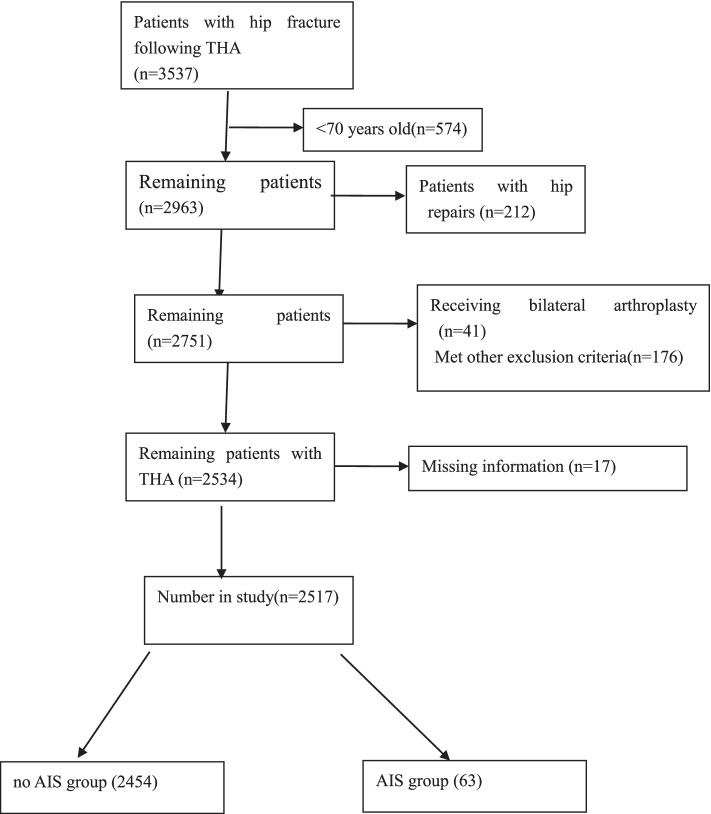
A multicenter retrospective study was conducted, patients ≥70 years old with THA for hip fracture under general anesthesia were included from February 2017 to March 2020. Patients with AIS within 90 days after THA were identified as AIS group; patients with no AIS were identified as no AIS group. The baseline characteristics and risk factors were collected, multivariable logistic regression was used to identify independent risk factors of 90-dayAIS.
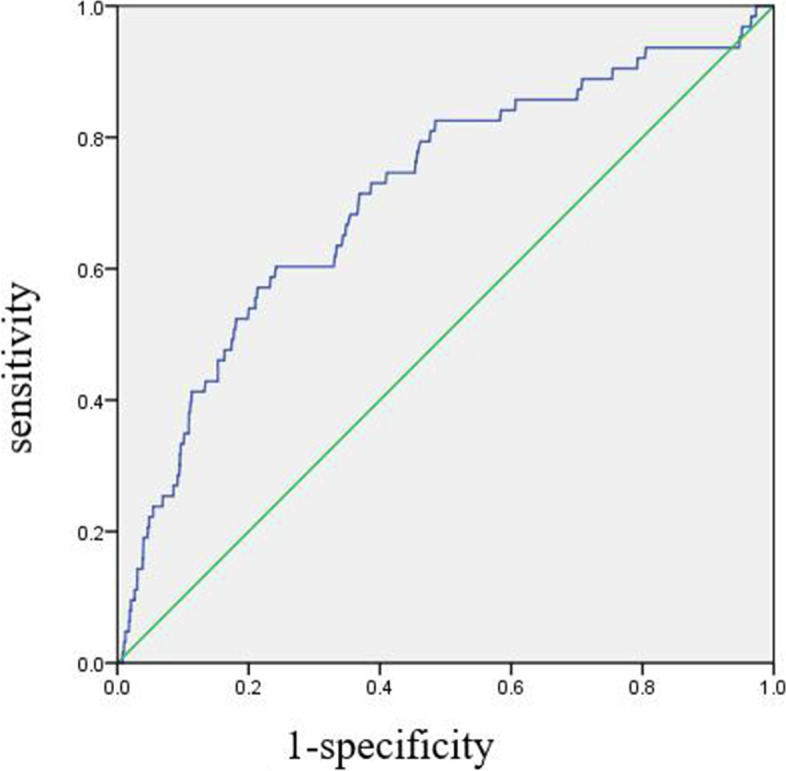
2517 patients (mean age 76.18 ± 6.01) were eligible for inclusion in the study. 2.50% (63/2517) of patients had 90-day AIS. Compared with no AIS, older age, diabetes, hyperlipidemia, atrial fibrillation (AF) and higher D-dimer value were more likely in patients with AIS (P < 0.05), and anticoagulant use was fewer in patients with AIS. ROC curve analysis showed that the optimal cut point of D-dimer for AIS was D-dimer≥4.12 μg/ml. Multivariate logistic regression analysis showed that D-dimer≥4.12 μg/ml [adjusted odds ratio (aOR), 4.44; confidence interval (CI), 2.50-7.72; P < 0.001], older age (aOR, 1.08; 95%CI, 1.03-1.12; P < 0.001), hyperlipidemia (aOR, 2.28; 95%CI, 1.25-4.16; P = 0.007), atrial fibrillation (aOR, 5.84; 95% CI, 1.08-15.68; P = 0.001), and diabetes (aOR, 2.60; 95% CI, 1.56-4.39; P < 0.001) were associated with increased risk of 90-day AIS after THA.
In conclusion, we found that the incidence of 90-day AIS in patients≥70 years old with THA for hip fracture was 2.5%. Older age, diabetes, hyperlipidemia, AF and higher D-dimer value were independent risk factors for 90-day AIS in patients≥70 years old with THA for hip fracture.
全髋关节置换术后(THA)缺血性中风是髋关节骨折后THA 的一种毁灭性并发症。本研究的目的是调查≥70 岁髋关节骨折行 THA 后 90 天内发生急性缺血性中风(AIS)的发生率和与 90 天 AIS 相关的独立危险因素。
进行了一项多中心回顾性研究,纳入 2017 年 2 月至 2020 年 3 月期间接受全身麻醉下 THA 的≥70 岁髋关节骨折患者。将 THA 后 90 天内发生 AIS 的患者确定为 AIS 组;无 AIS 的患者确定为无 AIS 组。收集基线特征和危险因素,多变量逻辑回归用于确定髋关节骨折行 THA 的≥70 岁患者 90 天 AIS 的独立危险因素。
2517 例(平均年龄 76.18±6.01)患者符合纳入研究标准。63/2517(2.50%)例患者发生 90 天 AIS。与无 AIS 相比,AIS 患者年龄较大、患有糖尿病、高脂血症、心房颤动(AF)和 D-二聚体值较高(P<0.05),且 AIS 患者抗凝治疗较少。ROC 曲线分析显示,D-二聚体对 AIS 的最佳截断值为 D-二聚体≥4.12μg/ml。多变量逻辑回归分析显示,D-二聚体≥4.12μg/ml [调整后的优势比(aOR),4.44;95%置信区间(CI),2.50-7.72;P<0.001]、年龄较大(aOR,1.08;95%CI,1.03-1.12;P<0.001)、高脂血症(aOR,2.28;95%CI,1.25-4.16;P=0.007)、心房颤动(aOR,5.84;95%CI,1.08-15.68;P=0.001)和糖尿病(aOR,2.60;95%CI,1.56-4.39;P<0.001)与 THA 后 90 天内发生 AIS 的风险增加相关。
综上所述,我们发现≥70 岁髋关节骨折行 THA 患者 90 天 AIS 的发生率为 2.5%。年龄较大、糖尿病、高脂血症、AF 和较高的 D-二聚体值是髋关节骨折行 THA 的≥70 岁患者发生 90 天 AIS 的独立危险因素。