Department of Biomedical Data Science, Geisel School of Medicine at Dartmouth, Hanover, NH, USA.
Department of Epidemiology, Geisel School of Medicine at Dartmouth, Hanover, NH, USA.
Int J Obes (Lond). 2022 Mar;46(3):669-675. doi: 10.1038/s41366-021-01024-9. Epub 2022 Jan 7.
BACKGROUND/OBJECTIVES: Obesity is a pressing health concern within the United States (US). Obesity medicine "diplomates" receive specialized training, yet it is unclear if their accessibility and availability adequately serves the need. The purpose of this research was to understand how accessibility has evolved over time and assess the practicality of serving an estimated patient population with the current distribution and quantity of diplomates.
Population-weighted Census tracts in US counties were mapped to the nearest facility on a road network with at least one diplomate who specialized in adult (including geriatric) care between 2011 and 2019. The median travel time for all Census tracts within a county represented the primary geographic access measure. Availability was assessed by estimating the number of diplomates per 100 000 patients with obesity and the number of facilities able to serve assigned patients under three clinical guidelines.
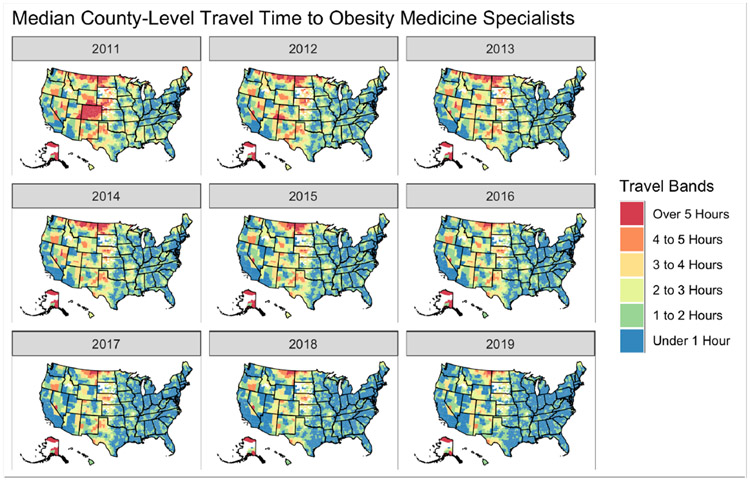
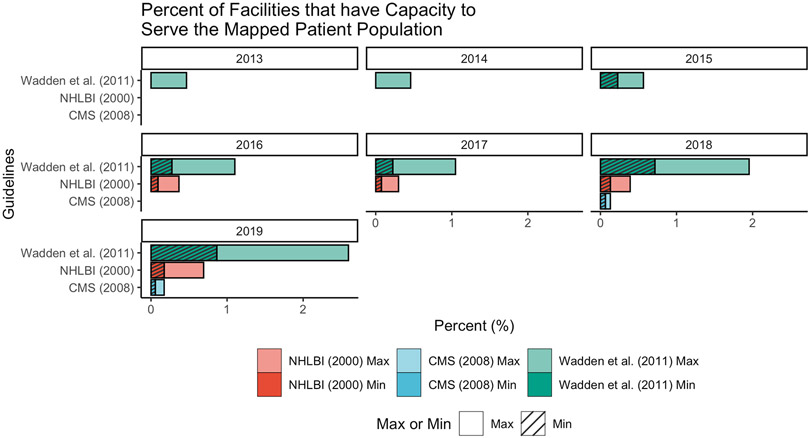
Of the 3371 diplomates certified since 2019, 3036 were included. The median travel time (weighted for county population) fell from 28.5 min [IQR: 13.7, 68.1] in 2011 to 9.95 min [IQR: 7.49, 18.1] in 2019. There were distinct intra- and inter-year travel time variations by race, ethnicity, education, median household income, rurality, and Census region (all P < 0.001). The median number of diplomates per 100 000 with obesity grew from 1 [IQR: 0.39, 1.59] in 2011 to 5 [IQR: 2.74, 11.4] in 2019. In 2019, an estimated 1.7% of facilities could meet the recommended number of visits for all mapped patients with obesity, up from 0% in 2011.
Diplomate geographic access and availability have improved over time, yet there is still not a high enough supply to serve the potential patient demand. Future studies should quantify patient-level associations between travel time and health outcomes, including whether the number of available diplomates impacts utilization.
背景/目的:肥胖是美国(美国)面临的一个紧迫的健康问题。接受过肥胖医学“外交官”专门培训的人,但尚不清楚他们的可及性和可用性是否足以满足需求。这项研究的目的是了解可及性随时间的演变,并评估在当前分布和数量的外交官的情况下,为估计的患者人群提供服务的实际情况。
将美国县的人口加权普查区映射到至少有一名专门从事成人(包括老年)护理的 2011 年至 2019 年的网络道路设施上。该县内所有普查区的平均旅行时间代表主要的地理访问措施。通过估计每 100,000 名肥胖患者的外交官人数以及根据三项临床指南为指定患者提供服务的设施数量来评估可用性。
自 2019 年以来,已有 3371 名认证的外交官,其中 3036 名被纳入研究。(按县人口加权)的平均旅行时间从 2011 年的 28.5 分钟[IQR:13.7,68.1]下降到 2019 年的 9.95 分钟[IQR:7.49,18.1]。种族、族裔、教育程度、家庭中位数收入、农村和人口普查地区(均 P<0.001)的年内和年内旅行时间差异明显。每 100,000 名肥胖患者的外交官人数中位数从 2011 年的 1 [IQR:0.39,1.59]增加到 2019 年的 5 [IQR:2.74,11.4]。2019 年,估计有 1.7%的设施可以满足所有肥胖患者推荐的就诊次数,高于 2011 年的 0%。
随着时间的推移,外交官的地理可及性和可用性有所提高,但仍不足以满足潜在的患者需求。未来的研究应量化旅行时间与健康结果之间的患者水平关联,包括可用外交官人数是否会影响利用率。