Egan Thomas M, Haithcock Benjamin E, Lobo Jason, Mody Gita, Love Robert B, Requard John Jacob, Espey John, Ali Mir Hasnain
Department of Surgery, UNC at Chapel Hill, Chapel Hill, NC, USA.
Department of Medicine, UNC at Chapel Hill, Chapel Hill, NC, USA.
J Thorac Dis. 2021 Nov;13(11):6536-6549. doi: 10.21037/jtd-2021-13.
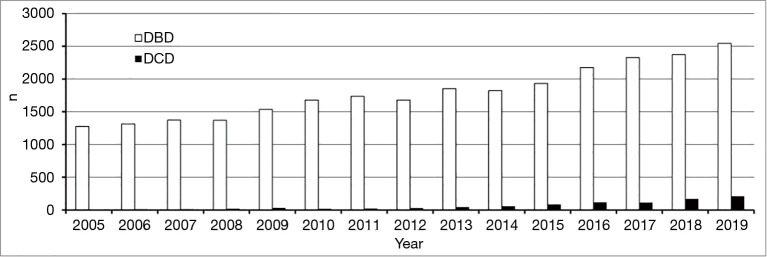
Transplantation of any organ into a recipient requires a donor. Lung transplant has a long history of an inadequate number of suitable donors to meet demand, leading to deaths on the waiting list annually since national data was collected, and strict listing criteria. Before the Uniform Determination of Death Act (UDDA), passed in 1980, legally defined brain death in the U.S., all donors for lung transplant came from sudden death victims [uncontrolled Donation after Circulatory Death donors (uDCDs)] in the recipient's hospital emergency department. After passage of the UDDA, uDCDs were abandoned to Donation after Brain Death donors (DBDs)-perhaps prematurely. Compared to livers and kidneys, many DBDs have lungs that are unsuitable for transplant, due to aspiration pneumonia, neurogenic pulmonary edema, trauma, and the effects of brain death on lung function. Another group of donors has become available-patients with a devastating irrecoverable brain injury that do not meet criteria for brain death. If a decision is made by next-of-kin (NOK) to withdraw life support and allow death to occur by asphyxiation, with NOK consent, these individuals can have organs recovered if death occurs relatively quickly after cessation of mechanical ventilation and maintenance of their airway. These are known as controlled Donation after Circulatory Death donors (cDCDs). For a variety of reasons, in the U.S., lungs are recovered from cDCDs at a much lower rate than kidneys and livers. Ex-vivo lung perfusion (EVLP) in the last decade has had a modest impact on increasing the number of lungs for transplant from DBDs, but may have had a larger impact on lungs from cDCDs, and may be indispensable for safe transplantation of lungs from uDCDs. In the next decade, DCDs may have a substantial impact on the number of lung transplants performed in the U.S. and around the world.
将任何器官移植到受体体内都需要供体。肺移植的历史由来已久,合适供体数量不足,无法满足需求,自收集全国数据以来,每年都有患者在等待名单上死亡,且肺移植的列入标准严格。1980年美国通过《统一死亡判定法案》(UDDA),在法律上定义脑死亡之前,所有肺移植供体均来自受体所在医院急诊科的猝死受害者[循环死亡后非受控供体(uDCD)]。UDDA通过后,uDCD被弃用,转而采用脑死亡后供体(DBD)——或许有些过早。与肝脏和肾脏相比,许多DBD的肺因吸入性肺炎、神经源性肺水肿、创伤以及脑死亡对肺功能的影响而不适用于移植。另一类供体出现了——患有严重不可恢复性脑损伤但不符合脑死亡标准的患者。如果近亲(NOK)决定撤掉生命支持,在近亲同意的情况下,让患者因窒息死亡,且在停止机械通气并维持气道后死亡相对迅速,那么这些个体的器官可以被摘取。这些被称为循环死亡后受控供体(cDCD)。出于各种原因,在美国,从cDCD获取肺的比例远低于肾脏和肝脏。过去十年中,体外肺灌注(EVLP)对增加DBD肺移植数量的影响不大,但对cDCD肺的影响可能更大,对于安全移植uDCD肺可能不可或缺。在未来十年,DCD可能会对美国及全球肺移植的数量产生重大影响。