Nylund Marjo, Sucksdorff Marcus, Matilainen Markus, Polvinen Eero, Tuisku Jouni, Airas Laura
Turku PET Centre, Turku, Finland.
Clinical Neurosciences, University of Turku, Turku, Finland.
Brain Commun. 2021 Dec 22;4(1):fcab301. doi: 10.1093/braincomms/fcab301. eCollection 2022 Feb.
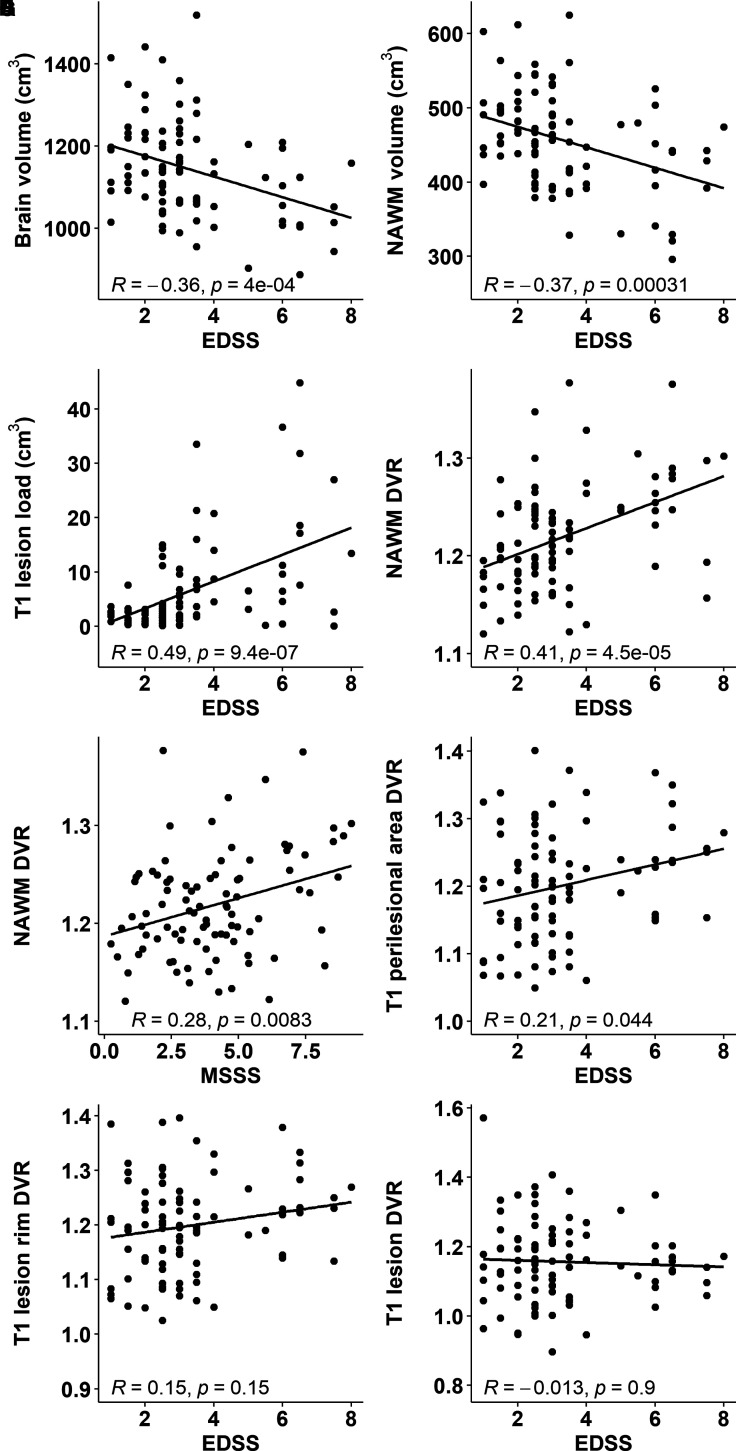
Chronic active lesions are promotors of neurodegeneration and disease progression in multiple sclerosis. They harbour a dense rim of activated innate immune cells at the lesion edge, which promotes lesion growth and thereby induces damage. Conventional MRI is of limited help in identifying the chronic active lesions, so alternative imaging modalities are needed. Objectives were to develop a PET-based automated analysis method for phenotyping of chronic lesions based on lesion-associated innate immune cell activation and to comprehensively evaluate the prevalence of these lesions in the various clinical subtypes of multiple sclerosis, and their association with disability. In this work, we use 18 kDa translocator protein-PET imaging for phenotyping chronic multiple sclerosis lesions at a large scale. For this, we identified 1510 white matter T1-hypointense lesions from 91 multiple sclerosis patients (67 relapsing-remitting patients and 24 secondary progressive patients). Innate immune cell activation at the lesion rim was measured using PET imaging and the 18 kDa translocator protein-binding radioligand C-PK11195. A T1-hypointense lesion was classified as rim-active if the distribution volume ratio of C-PK11195-binding was low in the plaque core and considerably higher at the plaque edge. If no significant ligand binding was observed, the lesion was classified as inactive. Plaques that had considerable ligand binding both in the core and at the rim were classified as overall-active. Conventional MRI and disability assessment using the Expanded Disability Status Scale were performed at the time of PET imaging. In the secondary progressive cohort, an average of 19% (median, interquartile range: 11-26) of T1 lesions were rim-active in each individual patient, compared to 10% (interquartile range: 0-20) among relapsing-remitting patients ( = 0.009). Secondary progressive patients had a median of 3 (range: 0-11) rim-active lesions, versus 1 (range: 0-18) among relapsing-remitting patients ( = 0.029). Among those patients who had rim-active lesions ( = 63), the average number of active voxels at the rim was higher among secondary progressive compared to relapsing-remitting patients (median 158 versus 74; = 0.022). The number of active voxels at the rim correlated significantly with the Expanded Disability Status Scale ( = 0.43, < 0.001), and the volume of the rim-active lesions similarly correlated with the Expanded Disability Status Scale ( = 0.45, < 0.001). Our study is the first to report phenotyping of chronic lesions at large scale, based on 18 kDa translocator protein-PET. Patients with higher disability displayed a higher proportion of rim-active lesions. The lesion phenotyping methodology offers a new tool for individual assessment of smouldering (rim-active) lesion burden.

慢性活动性病灶是多发性硬化症中神经退行性变和疾病进展的促进因素。它们在病灶边缘有一层密集的活化固有免疫细胞,这会促进病灶生长,从而导致损伤。传统的磁共振成像在识别慢性活动性病灶方面帮助有限,因此需要其他成像方式。目的是开发一种基于正电子发射断层扫描(PET)的自动分析方法,用于基于病灶相关固有免疫细胞活化对慢性病灶进行表型分析,并全面评估这些病灶在多发性硬化症各种临床亚型中的患病率及其与残疾的关联。在这项研究中,我们使用18 kDa转位蛋白PET成像对慢性多发性硬化症病灶进行大规模表型分析。为此,我们从91例多发性硬化症患者(67例复发缓解型患者和24例继发进展型患者)中识别出1510个白质T1低信号病灶。使用PET成像和18 kDa转位蛋白结合放射性配体C-PK11195测量病灶边缘的固有免疫细胞活化情况。如果C-PK11195结合的分布容积比在斑块核心较低而在斑块边缘显著较高,则T1低信号病灶被分类为边缘活化。如果未观察到明显的配体结合,则该病灶被分类为非活化。在核心和边缘均有相当数量配体结合的斑块被分类为整体活化。在PET成像时进行传统的磁共振成像以及使用扩展残疾状态量表进行残疾评估。在继发进展型队列中,每位患者平均有19%(中位数,四分位间距:11%-26%)的T1病灶为边缘活化,而复发缓解型患者中这一比例为10%(四分位间距:0%-20%)(P = 0.009)。继发进展型患者边缘活化病灶的中位数为3个(范围:0-11个),而复发缓解型患者为1个(范围:0-18个)(P = 0.029)。在那些有边缘活化病灶的患者中(n = 63),继发进展型患者边缘活化体素的平均数高于复发缓解型患者(中位数分别为158和74;P = 0.022)。边缘活化体素的数量与扩展残疾状态量表显著相关(P = 0.43,P < 0.001),边缘活化病灶的体积与扩展残疾状态量表同样显著相关(P = 0.45,P < 0.001)。我们的研究首次报告了基于18 kDa转位蛋白PET对慢性病灶进行大规模表型分析。残疾程度较高的患者边缘活化病灶的比例更高。这种病灶表型分析方法为个体评估隐匿性(边缘活化)病灶负担提供了一种新工具。