Department of Population Health Sciences, University of Wisconsin School of Medicine and Public Health, Madison.
Institute for Research on Poverty, University of Wisconsin-Madison, Madison.
JAMA Netw Open. 2022 Jan 4;5(1):e2142688. doi: 10.1001/jamanetworkopen.2021.42688.
The transition from prison to community is characterized by elevated morbidity and mortality, particularly owing to drug overdose. However, most formerly incarcerated adults with substance use disorders do not use any health care, including treatment for substance use disorders, during the initial months after incarceration.
To evaluate whether a prerelease Medicaid enrollment assistance program is associated with increased health care use within 30 days after release from prison.
DESIGN, SETTING, AND PARTICIPANTS: This retrospective cohort study included 16 307 adults aged 19 to 64 years with a history of substance use who were released from state prison between April 1, 2014, and December 31, 2016. The Wisconsin Department of Corrections implemented prerelease Medicaid enrollment assistance in January 2015. Statistical analysis was performed from January 1 to August 31, 2021.
A statewide Medicaid prerelease enrollment assistance program.
The main outcome was Medicaid-reimbursed health care, associated with substance use disorders and for any cause, within 30 days of prison release, including outpatient, emergency department, and inpatient care. Mean outcomes were compared for those released before and after implementation of prerelease Medicaid enrollment assistance using an intention-to-treat analysis and person-level data from the Wisconsin Department of Corrections and Medicaid.
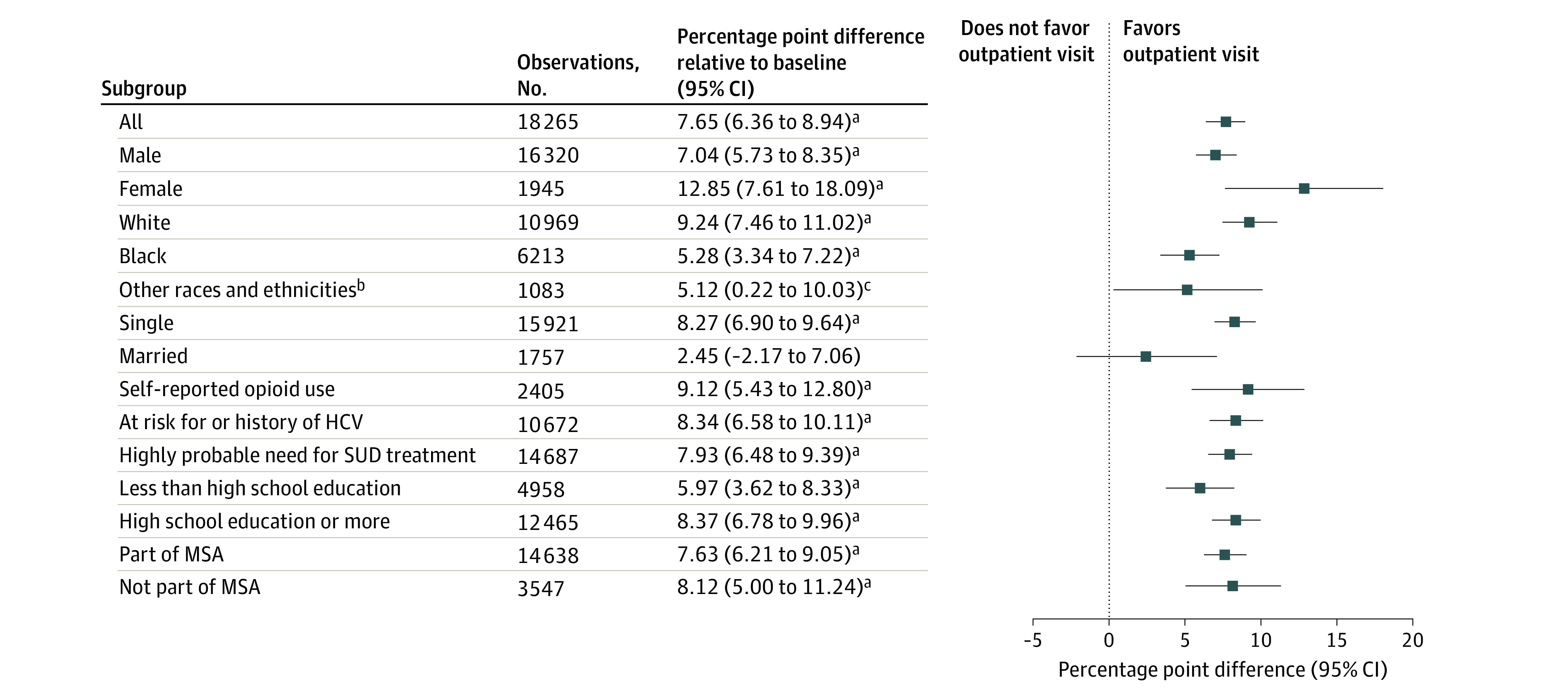
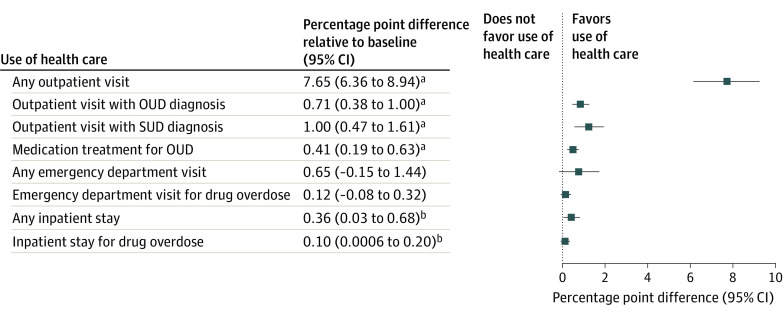
The sample included 16 307 individuals with 18 265 eligible releases (men accounted for 16 320 of 18 265 total releases, and 6213 of 18 265 releases were among Black individuals; mean [SD] age at release, 35.5 [10.7] years). The likelihood of outpatient care use within 30 days of release increased after implementation of enrollment assistance relative to baseline by 7.7 percentage points for any visit (95% CI, 6.4-8.9 percentage points; P < .001), by 0.7 percentage points for an opioid use disorder visit (95% CI, 0.4-1.0 percentage points; P < .001), by 1.0 percentage point for any substance use disorder visit (95% CI, 0.5-1.6 percentage points; P < .001), and by 0.4 percentage points for receipt of medication for opioid use disorder (95% CI, 0.2-0.6 percentage points; P < .001). There was no significant change in use of the emergency department (0.7 percentage points [95% CI, -0.15 to 1.4 percentage points]). The probability of an inpatient stay increased by 0.4 percentage points (95% CI, 0.03-0.7 percentage points; P = .03).
The results of this cohort study suggest that prerelease Medicaid enrollment assistance was associated with increased use of outpatient health care after incarceration and highlights the value of making this assistance universally available within correctional settings. More tailored interventions may be needed to increase the receipt of treatment for substance use disorders.
从监狱过渡到社区的过程中,发病率和死亡率都很高,特别是由于药物过量。然而,大多数有药物使用障碍的前囚犯在入狱后的最初几个月内并不使用任何医疗保健,包括药物使用障碍的治疗。
评估在从监狱获释后的 30 天内,预先获得医疗补助(Medicaid)注册援助计划是否与增加医疗保健的使用有关。
设计、设置和参与者:本回顾性队列研究包括 16307 名年龄在 19 至 64 岁之间、有药物使用史的成年人,他们在 2014 年 4 月 1 日至 2016 年 12 月 31 日期间从州立监狱获释。威斯康星州惩教署于 2015 年 1 月实施了预先获得医疗补助的注册援助。统计分析于 2021 年 1 月 1 日至 8 月 31 日进行。
一项全州范围的医疗补助预先注册援助计划。
主要结果是在监狱释放后 30 天内与物质使用障碍相关的医疗补助报销的医疗保健,包括门诊、急诊和住院护理。使用意向治疗分析和来自威斯康星州惩教署和医疗补助的个人层面数据,比较了实施预先获得医疗补助注册援助前后释放的人的平均结果。
样本包括 16307 名符合条件的 18265 人(男性占 16320 人,占 18265 人总释放人数,黑人占 6213 人,占 18265 人释放人数);释放时的平均(SD)年龄为 35.5(10.7)岁。与基线相比,在实施注册援助后,释放后 30 天内门诊护理的使用可能性增加了 7.7 个百分点(95%CI,6.4-8.9 个百分点;P <.001),阿片类药物使用障碍就诊增加了 0.7 个百分点(95%CI,0.4-1.0 个百分点;P <.001),任何物质使用障碍就诊增加了 1.0 个百分点(95%CI,0.5-1.6 个百分点;P <.001),接受阿片类药物使用障碍药物治疗增加了 0.4 个百分点(95%CI,0.2-0.6 个百分点;P <.001)。急诊室的使用没有明显变化(0.7 个百分点[95%CI,-0.15 至 1.4 个百分点])。住院率增加了 0.4 个百分点(95%CI,0.03-0.7 个百分点;P =.03)。
这项队列研究的结果表明,预先获得医疗补助注册援助与监禁后门诊医疗保健使用的增加有关,并强调了在惩教机构内普遍提供这种援助的价值。可能需要更有针对性的干预措施来增加对物质使用障碍治疗的接受。