Division of General Internal Medicine, Department of Medicine, Massachusetts General Hospital, Boston.
Harvard Medical School, Boston, Massachusetts.
JAMA Netw Open. 2022 Jan 4;5(1):e2142676. doi: 10.1001/jamanetworkopen.2021.42676.
Despite high rates of drug overdose death among people experiencing homelessness, patterns in drug overdose mortality, including the types of drugs implicated in overdose deaths, remain understudied in this population.
To describe the patterns in drug overdose mortality among a large cohort of people experiencing homelessness in Boston vs the general adult population of Massachusetts and to evaluate the types of drugs implicated in overdose deaths over a continuous 16-year period of observation.
DESIGN, SETTING, AND PARTICIPANTS: This cohort study analyzed adults aged 18 years or older who received care at Boston Health Care for the Homeless Program (BHCHP) between January 1, 2003, and December 31, 2017. Individuals were followed up from the date of their initial BHCHP encounter during the study period until the date of death or December 31, 2018. Data were analyzed from December 1, 2020, to June 6, 2021.
Drug overdose deaths and the types of drugs involved in each overdose death were ascertained by linking the BHCHP cohort to the Massachusetts Department of Public Health death records.
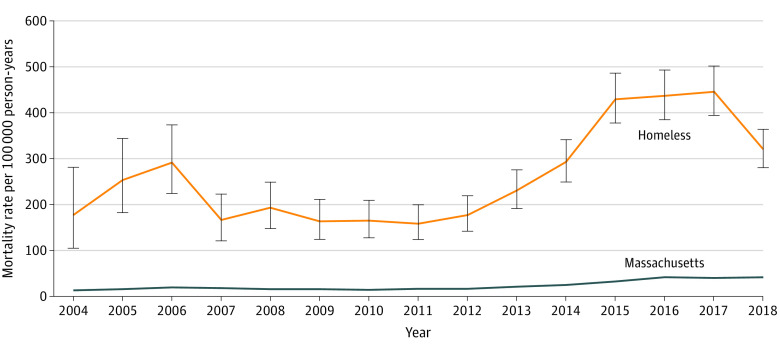
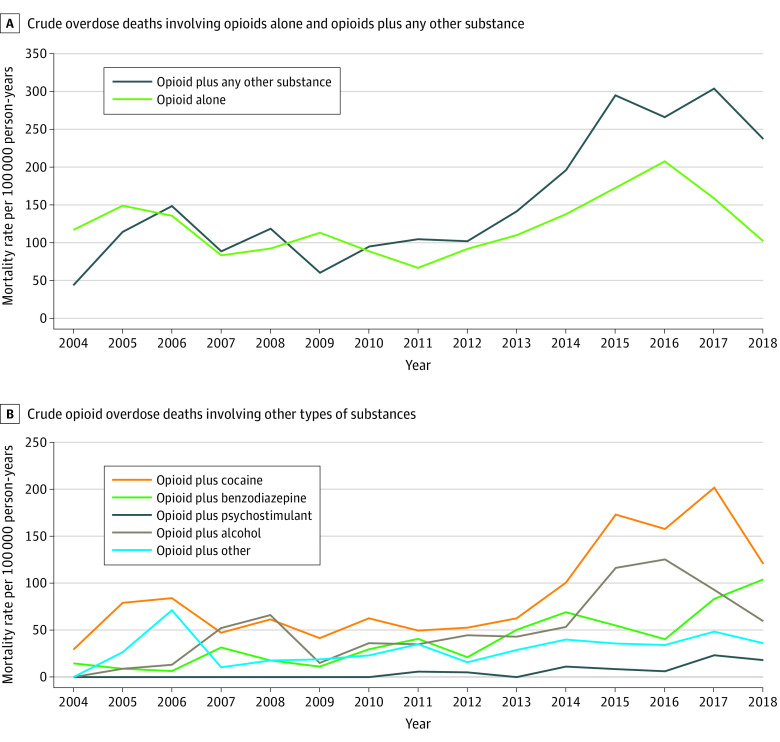
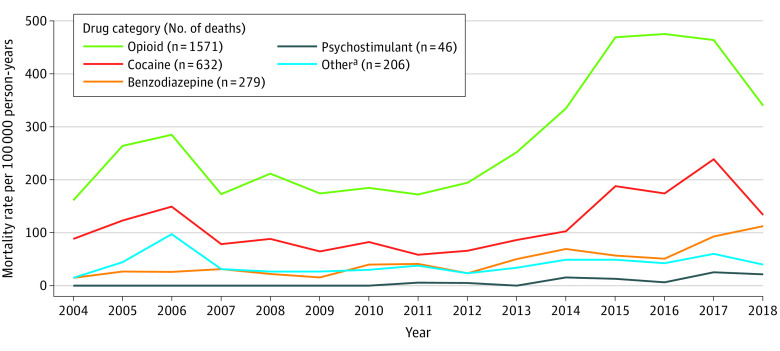
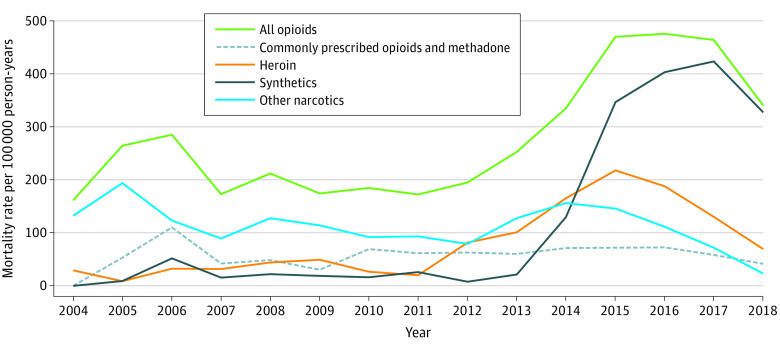
In this cohort of 60 092 adults experiencing homelessness (mean [SD] age at entry, 40.4 [13.1] years; 38 084 men [63.4%]), 7130 individuals died by the end of the study period. A total of 1727 individuals (24.2%) died of a drug overdose. Of the drug overdose decedents, 456 were female (26.4%), 194 were Black (11.2%), 202 were Latinx (11.7%), and 1185 were White (68.6%) individuals, and the mean (SD) age at death was 43.7 (10.8) years. The age- and sex-standardized drug overdose mortality rate in the BHCHP cohort was 278.9 (95% CI, 266.1-292.3) deaths per 100 000 person-years, which was 12 times higher than the Massachusetts adult population. Opioids were involved in 91.0% of all drug overdose deaths. Between 2013 and 2018, the synthetic opioid mortality rate increased from 21.6 to 327.0 deaths per 100 000 person-years. Between 2004 and 2018, the opioid-only overdose mortality rate decreased from 117.2 to 102.4 deaths per 100 000 person-years, whereas the opioid-involved polysubstance mortality rate increased from 44.0 to 237.8 deaths per 100 000 person-years. Among opioid-involved polysubstance overdose deaths, cocaine-plus-opioid was the most common substance combination implicated throughout the study period, with Black individuals having the highest proportion of cocaine-plus-opioid involvement in death (0.72 vs 0.62 in Latinx and 0.53 in White individuals; P < .001).
In this cohort study of people experiencing homelessness, drug overdose accounted for 1 in 4 deaths, with synthetic opioid and polysubstance involvement becoming predominant contributors to mortality in recent years. These findings emphasize the importance of increasing access to evidence-based opioid overdose prevention strategies and opioid use disorder treatment among people experiencing homelessness, while highlighting the need to address both intentional and unintentional polysubstance use in this population.
尽管无家可归者的药物过量死亡率很高,但在这一人群中,药物过量死亡模式(包括与过量死亡相关的药物类型)仍有待研究。
描述波士顿大量无家可归者与马萨诸塞州普通成年人群相比,药物过量死亡模式,并评估在连续 16 年的观察中涉及的药物类型。
设计、地点和参与者:本队列研究分析了 2003 年 1 月 1 日至 2017 年 12 月 31 日期间在波士顿卫生保健为无家可归者项目(BHCHP)接受治疗的年龄在 18 岁或以上的成年人。从研究期间他们首次 BHCHP 就诊之日起,对个人进行随访,直至死亡或 2018 年 12 月 31 日。数据于 2020 年 12 月 1 日至 2021 年 6 月 6 日进行分析。
通过将 BHCHP 队列与马萨诸塞州公共卫生部死亡记录相链接,确定药物过量死亡和涉及的药物类型。
在这一队列中,有 60092 名无家可归的成年人(进入队列时的平均[标准差]年龄为 40.4[13.1]岁;38484 名男性[63.4%]),在研究期末有 7130 人死亡。共有 1727 人(24.2%)死于药物过量。在药物过量死亡者中,456 人为女性(26.4%),194 人为黑人(11.2%),202 人为拉丁裔(11.7%),1185 人为白人(68.6%),死亡时的平均(标准差)年龄为 43.7(10.8)岁。BHCHP 队列的年龄和性别标准化药物过量死亡率为每 10 万人中有 278.9(95%置信区间,266.1-292.3)人死亡,是马萨诸塞州成年人的 12 倍。所有药物过量死亡中有 91.0%涉及阿片类药物。在 2013 年至 2018 年期间,合成阿片类药物的死亡率从每 10 万人 21.6 人增加到 327.0 人。在 2004 年至 2018 年期间,阿片类药物单一药物过量死亡率从每 10 万人 117.2 人减少到 102.4 人,而阿片类药物涉及的多种物质过量死亡率从每 10 万人 44.0 人增加到 237.8 人。在涉及阿片类药物的多种物质过量死亡中,可卡因加阿片类药物是整个研究期间最常见的药物组合,黑人在死亡中涉及可卡因加阿片类药物的比例最高(0.72 比拉丁裔的 0.62 和白人的 0.53;P<0.001)。
在这项无家可归者的队列研究中,药物过量导致 1/4 的死亡,合成阿片类药物和多种物质的参与成为近年来导致死亡的主要原因。这些发现强调了在无家可归者中增加获得基于证据的阿片类药物过量预防策略和阿片类药物使用障碍治疗的重要性,同时强调了需要解决这一人群中故意和非故意的多种物质使用问题。