Neonatal Research Group, Health Research Institute and University and Polytechnic Hospital La Fe, Valencia, Spain.
Newborn Research Center and Neonatal Services, The Royal Women´s Hospital, Melbourne, VIC, Australia.
Pediatr Res. 2024 Aug;96(3):604-609. doi: 10.1038/s41390-021-01805-y. Epub 2022 Jan 7.
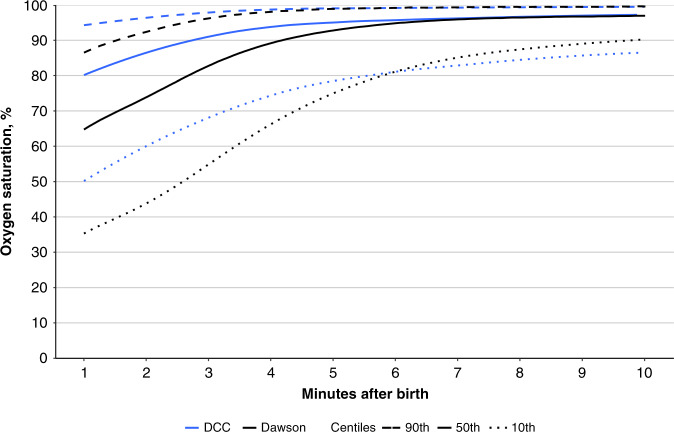
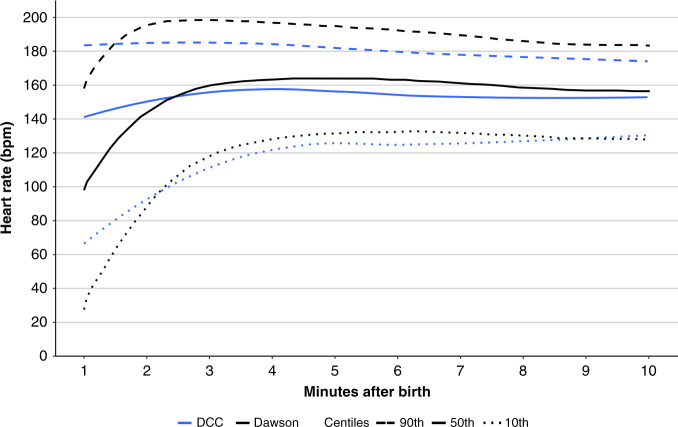
Blood oxygen in the fetus is substantially lower than in the newborn infant. In the minutes after birth, arterial oxygen saturation rises from around 50-60% to 90-95%. Initial respiratory efforts generate negative trans-thoracic pressures that drive liquid from the airways into the lung interstitium facilitating lung aeration, blood oxygenation, and pulmonary artery vasodilatation. Consequently, intra- (foramen ovale) and extra-cardiac (ductus arteriosus) shunting changes and the sequential circulation switches to a parallel pulmonary and systemic circulation. Delaying cord clamping preserves blood flow through the ascending vena cava, thus increasing right and left ventricular preload. Recently published reference ranges have suggested that delayed cord clamping positively influenced the fetal-to-neonatal transition. Oxygen saturation in babies with delayed cord clamping plateaus significantly earlier to values of 85-90% than in babies with immediate cord clamping. Delayed cord clamping may also contribute to fewer episodes of brady-or-tachycardia in the first minutes after birth, but data from randomized trials are awaited. IMPACT: Delaying cord clamping during fetal to neonatal transition contributes to a significantly earlier plateauing of oxygen saturation and fewer episodes of brady-and/or-tachycardia in the first minutes after birth. We provide updated information regarding the changes in SpO and HR during postnatal adaptation of term and late preterm infants receiving delayed compared with immediate cord clamping. Nomograms in newborn infants with delayed cord clamping will provide valuable reference ranges to establish target SpO and HR in the first minutes after birth.
胎儿的血氧含量明显低于新生儿。出生后几分钟内,动脉血氧饱和度从 50-60%上升到 90-95%。最初的呼吸努力会产生负的胸内压力,将液体从气道驱动到肺间质,促进肺通气、血氧和肺动脉扩张。因此,心内(卵圆孔)和心外(动脉导管)分流发生变化,连续循环切换到并行的肺和体循环。延迟脐带夹闭可保持升主静脉的血流,从而增加左右心室的前负荷。最近发表的参考范围表明,延迟脐带夹闭对胎儿向新生儿的过渡有积极影响。延迟脐带夹闭的婴儿的氧饱和度显著更早地达到 85-90%,而立即脐带夹闭的婴儿则达到这一水平。延迟脐带夹闭也可能有助于减少出生后最初几分钟的心动过缓或心动过速发作,但仍有待随机试验的数据。影响:在胎儿向新生儿过渡期间延迟脐带夹闭有助于氧饱和度更早达到稳定水平,并且在出生后最初几分钟内心动过缓或心动过速发作的次数更少。我们提供了关于接受延迟与立即脐带夹闭的足月和晚期早产儿在接受延迟与立即脐带夹闭时,在接受延迟与立即脐带夹闭时,在接受延迟与立即脐带夹闭时,SpO 和 HR 在出生后适应期间的变化的最新信息。在接受延迟脐带夹闭的新生儿中,列线图将为建立出生后最初几分钟的目标 SpO 和 HR 提供有价值的参考范围。