Harada Kazuhiro
Active Aging Research Hub, Graduate School of Human Development and Environment, Kobe University, 3-11 Tsurukabuto, Nada, Kobe, 657-8501, Japan.
Int J Behav Med. 2022 Oct;29(5):659-675. doi: 10.1007/s12529-021-10049-3. Epub 2022 Jan 7.
Although self-regulation interventions are effective in promoting exercise behaviors, moderators and mediators of interventions among older adults are not well established. This study aimed to examine whether (1) self-regulation intervention promoted exercise behavior, (2) health literacy and habit strength moderated the intervention effect, and (3) self-regulation and habit strength mediated the intervention effect among older adults.
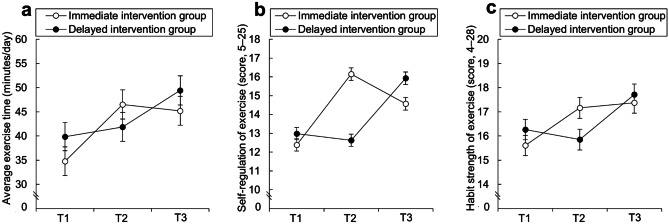
This study was a randomized, non-blinded, controlled crossover trial. The baseline questionnaire survey assessed the average amount of exercise time per day, self-regulation, habit strength, health literacy, and socio-demographic factors. After the baseline survey, 393 community-dwelling older adults were randomly assigned to either the immediate intervention or the delayed intervention group. For the immediate group, print-based materials were provided once a week for 7 weeks before a second questionnaire survey. For the delayed group, the materials were provided only after the second survey. Finally, a third survey was conducted for both groups.
The mixed models showed that the average exercise time was increased after the intervention in both groups. Multiple regression analyses revealed that no factor moderated the intervention effect. From the path analyses, the mediating effect of self-regulation on the relationship between intervention and changes in average exercise time was supported, but the mediating role of habit strength was not clearly indicated.
Although the mediating roles of habit strength for the intervention effects are still inconclusive, self-regulation intervention can promote exercise behavior among older adults, regardless of their health literacy level, habit strength, and socio-demographic characteristics.
尽管自我调节干预措施在促进运动行为方面有效,但针对老年人的干预措施的调节因素和中介因素尚未完全明确。本研究旨在探讨:(1)自我调节干预是否能促进运动行为;(2)健康素养和习惯强度是否会调节干预效果;(3)自我调节和习惯强度是否在老年人中中介干预效果。
本研究为随机、非盲、对照交叉试验。基线问卷调查评估了每天的平均运动时间、自我调节、习惯强度、健康素养和社会人口学因素。基线调查后,393名社区居住的老年人被随机分配到立即干预组或延迟干预组。对于立即干预组,在第二次问卷调查前7周每周提供一次印刷材料。对于延迟干预组,材料仅在第二次调查后提供。最后,对两组进行第三次调查。
混合模型显示两组干预后平均运动时间均增加。多元回归分析表明没有因素调节干预效果。路径分析支持自我调节在干预与平均运动时间变化之间关系的中介作用,但习惯强度的中介作用未明确显示。
尽管习惯强度对干预效果的中介作用仍无定论,但自我调节干预可以促进老年人的运动行为,无论其健康素养水平、习惯强度和社会人口学特征如何。