Center for Health Promotion, International Life Sciences Institute Japan, Nishikawa Bldg, 3-5-19 Kojimachi, Chiyoda-ku, Tokyo 102-0083, Japan.
BMC Geriatr. 2013 Jan 23;13:8. doi: 10.1186/1471-2318-13-8.
The fastest growing age group globally is older adults, and preventing the need for long-term nursing care in this group is important for social and financial reasons. A population approach to diet and physical activity through the use of social services can play an important role in prevention. This study examined the effectiveness of a social health program for community-dwelling older adults aimed at introducing and promoting physical activity in the home at each individual's pace, helping participants maintain good dietary habits by keeping self-check sheets, and determining whether long-standing unhealthy or less-than-ideal physical and dietary habits can be changed.
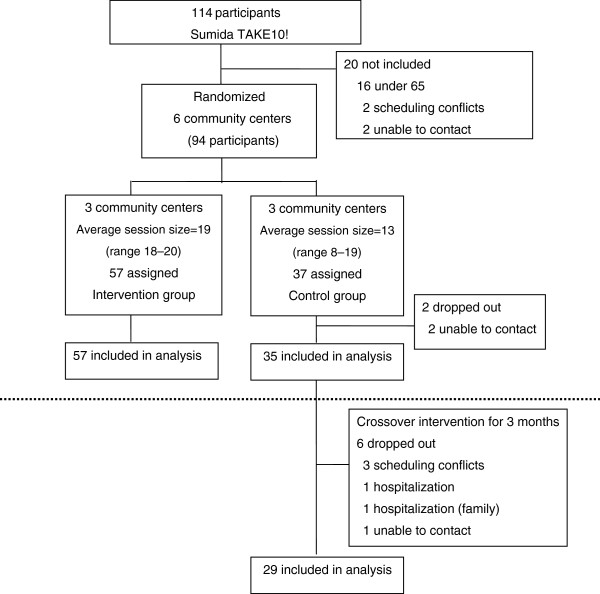
This cluster randomized trial conducted at 6 community centers in an urban community involved 92 community-dwelling older adults aged 65-90 years. The intervention group (3 community centers; n = 57) participated in the social health program "Sumida TAKE10!" which is an educational program incorporating the "TAKE10!® for Older Adults" program, once every 2 weeks for 3 months. The control group (3 community centers; n=35) was subsequently provided with the same program as a crossover intervention group. The main outcome measures were changes in food intake frequency, food frequency score (FFS), dietary variety score (DVS), and frequency of walking and exercise. The secondary outcome measures were changes in self-rated health, appetite, and the Tokyo Metropolitan Institute of Gerontology (TMIG) Index of Competence score.
Compared to baseline, post-intervention food intake frequency for 6 of 10 food groups (meat, fish/shellfish, eggs, potatoes, fruits, and seaweed), FFS, and DVS were significantly increased in the intervention group, and interaction effects of FFS and DVS were seen between the two groups. No significant differences were observed between baseline and post-intervention in the control group. Frequency of walking and exercise remained unchanged in both groups, and no significant difference in improvement rate was seen between the groups. Self-rated health was significantly increased in the intervention group. Appetite and TMIG Index of Competence score were unchanged in both groups.
The social health program resulted in improved dietary habits, as measured by food intake frequency, FFS, and DVS, and may improve self-rated health among community-dwelling older adults.
UMIN000007357.
全球增长最快的年龄组是老年人,出于社会和经济原因,预防这一群体需要长期护理至关重要。通过社会服务对饮食和体育活动采取的人群方法可以在预防方面发挥重要作用。本研究考察了一项针对社区居住老年人的社会健康计划的效果,该计划旨在以个人的速度在家中引入和促进体育活动,通过保持自我检查表帮助参与者保持良好的饮食习惯,并确定是否可以改变长期存在的不健康或不理想的身体和饮食习惯。
这项在城市社区的 6 个社区中心进行的聚类随机试验涉及 92 名 65-90 岁的社区居住老年人。干预组(3 个社区中心;n=57)参加了社会健康计划“Sumida TAKE10!”,这是一个将“TAKE10!® for Older Adults”计划纳入其中的教育计划,每 2 周进行一次,持续 3 个月。对照组(3 个社区中心;n=35)随后作为交叉干预组接受了相同的方案。主要结局指标是食物摄入频率、食物频率评分(FFS)、饮食多样性评分(DVS)以及步行和运动频率的变化。次要结局指标是自我评估健康状况、食欲和东京都立老人综合研究所(TMIG)能力指数评分的变化。
与基线相比,干预组的 10 种食物组中的 6 种(肉、鱼/贝类、蛋、土豆、水果和海藻)、FFS 和 DVS 的食物摄入频率显著增加,两组之间的 FFS 和 DVS 存在交互效应。对照组在干预前后无显著差异。两组的步行和运动频率均无变化,两组的改善率无显著差异。干预组的自我评估健康状况显著增加。两组的食欲和 TMIG 能力指数评分均无变化。
社会健康计划改善了社区居住老年人的饮食习惯,通过食物摄入频率、FFS 和 DVS 来衡量,并且可能改善了自我评估健康状况。
UMIN000007357。