Department of Engineering Science and MRC Brain Network Dynamics Unit, University of Oxford, Oxford, UK.
Department of Engineering Science and MRC Brain Network Dynamics Unit, University of Oxford, Oxford, UK.
J Neurol Sci. 2022 Mar 15;434:120121. doi: 10.1016/j.jns.2021.120121. Epub 2021 Dec 28.
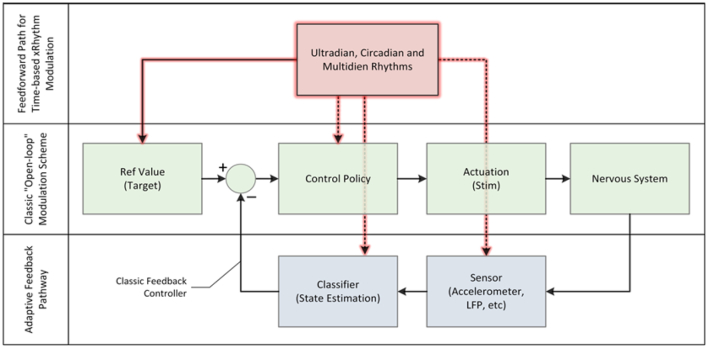
The rapid evolution of neuromodulation techniques includes an increasing amount of research into stimulation paradigms that are guided by patients' neurophysiology, to increase efficacy and responder rates. Treatment personalisation and target engagement have shown to be effective in fields such as Parkinson's disease, and closed-loop paradigms have been successfully implemented in cardiac defibrillators. Promising avenues are being explored for physiologically informed neuromodulation in psychiatry. Matching the stimulation frequency to individual brain rhythms has shown some promise in transcranial magnetic stimulation (TMS). Matching the phase of those rhythms may further enhance neuroplasticity, for instance when combining TMS with electroencephalographic (EEG) recordings. Resting-state EEG and event-related potentials may be useful to demonstrate connectivity between stimulation sites and connected areas. These techniques are available today to the psychiatrist to diagnose underlying sleep disorders, epilepsy, or lesions as contributing factors to the cause of depression. These technologies may also be useful in assessing the patient's brain network status prior to deciding on treatment options. Ongoing research using invasive recordings may allow for future identification of mood biomarkers and network structure. A core limitation is that biomarker research may currently be limited by the internal heterogeneity of psychiatric disorders according to the current DSM-based classifications. New approaches are being developed and may soon be validated. Finally, care must be taken when incorporating closed-loop capabilities into neuromodulation systems, by ensuring the safe operation of the system and understanding the physiological dynamics. Neurophysiological tools are rapidly evolving and will likely define the next generation of neuromodulation therapies.
神经调节技术的快速发展包括越来越多的研究关注基于患者神经生理学的刺激模式,以提高疗效和应答率。治疗个性化和靶点结合已在帕金森病等领域得到证实,闭环模式已成功应用于心脏除颤器。在精神病学中,生理导向的神经调节也有许多有前途的途径正在探索中。将刺激频率与个体脑节律匹配已在经颅磁刺激(TMS)中显示出一些希望。匹配这些节律的相位可能会进一步增强神经可塑性,例如当 TMS 与脑电图(EEG)记录结合使用时。静息态 EEG 和事件相关电位可用于证明刺激部位与连接区域之间的连通性。这些技术现在可用于精神科医生诊断潜在的睡眠障碍、癫痫或病变,这些因素可能是导致抑郁的原因。这些技术也可用于在决定治疗方案之前评估患者的大脑网络状态。使用侵入性记录的正在进行的研究可能允许未来识别情绪生物标志物和网络结构。一个核心限制是,根据当前基于 DSM 的分类,生物标志物研究可能目前受到精神障碍内在异质性的限制。新的方法正在开发中,并可能很快得到验证。最后,在将闭环功能纳入神经调节系统时必须小心,要确保系统的安全运行并理解生理动态。神经生理学工具正在迅速发展,可能会定义下一代神经调节疗法。