Siron Guillaume, Fukuda Kohei, Kimura Makoto, Kita Noriko T
WiscSIMS, Department of Geoscience, University of Wisconsin-Madison, Madison, WI 53706, USA.
National Institute of Polar Research, Meteorite Research Center, Midoricho 10-3, Tachikawa, Tokyo 190-8518, Japan.
Geochim Cosmochim Acta. 2021 Jan 15;293:103-126. doi: 10.1016/j.gca.2020.10.025. Epub 2020 Nov 1.
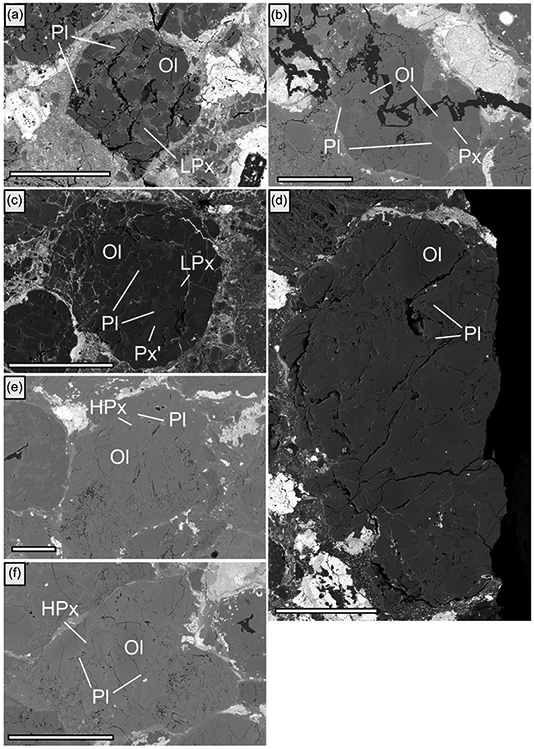
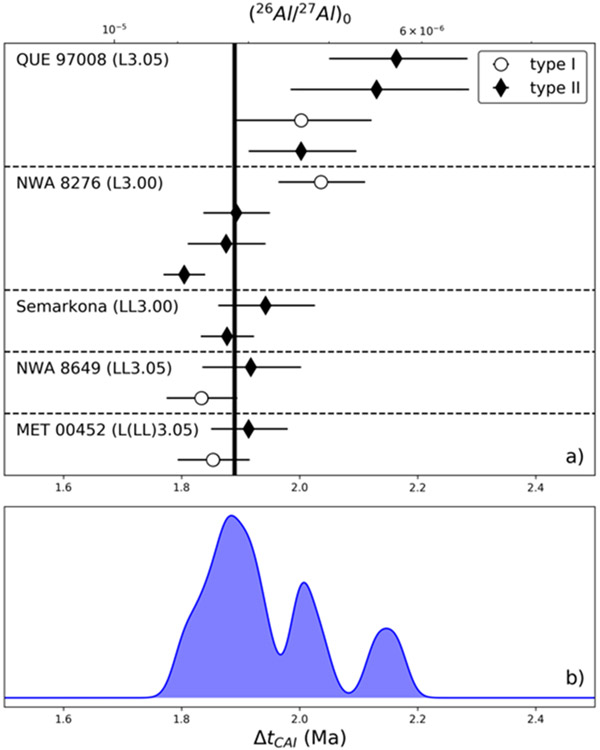
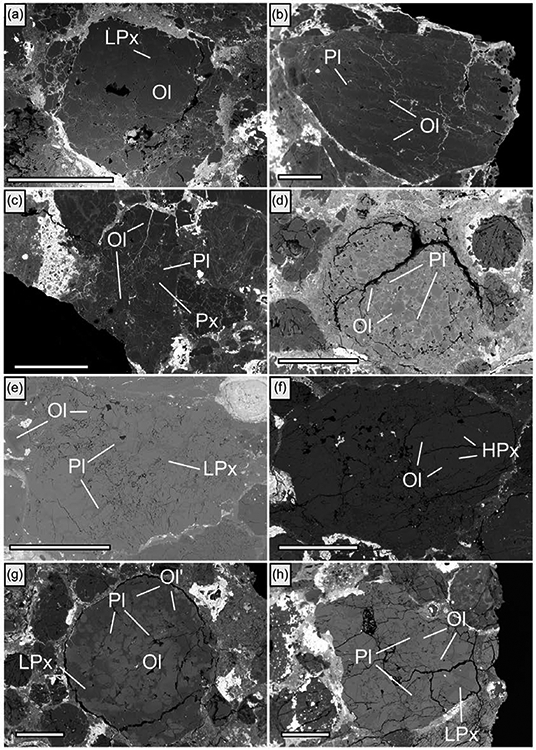
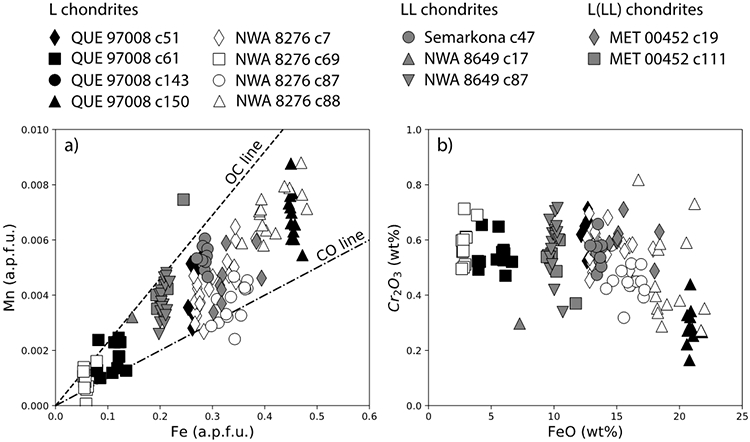
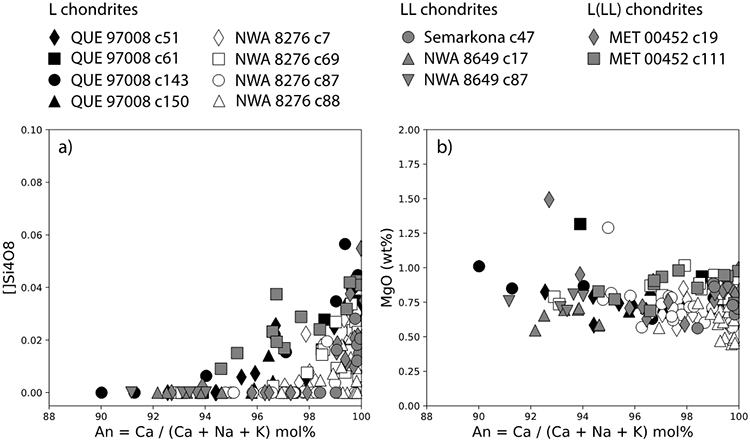
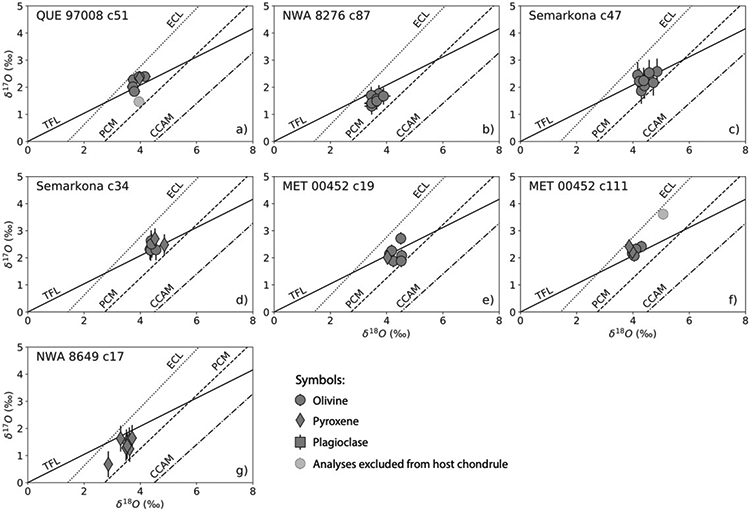
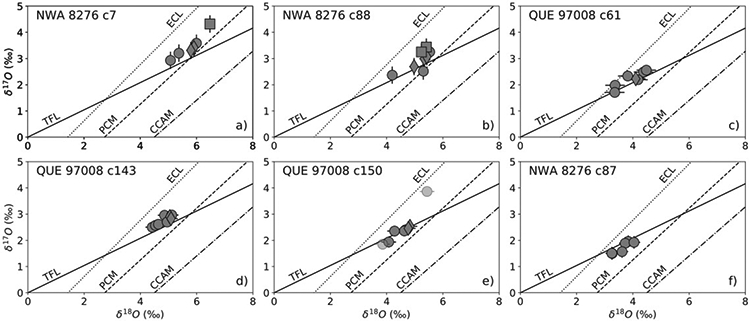
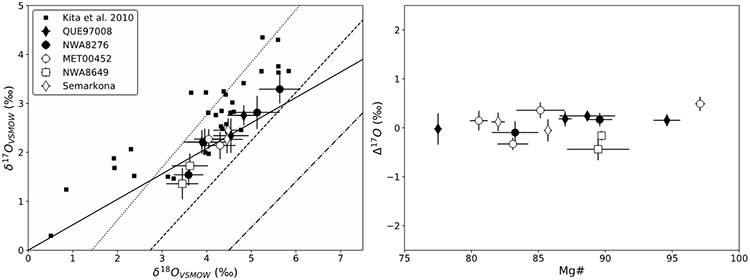
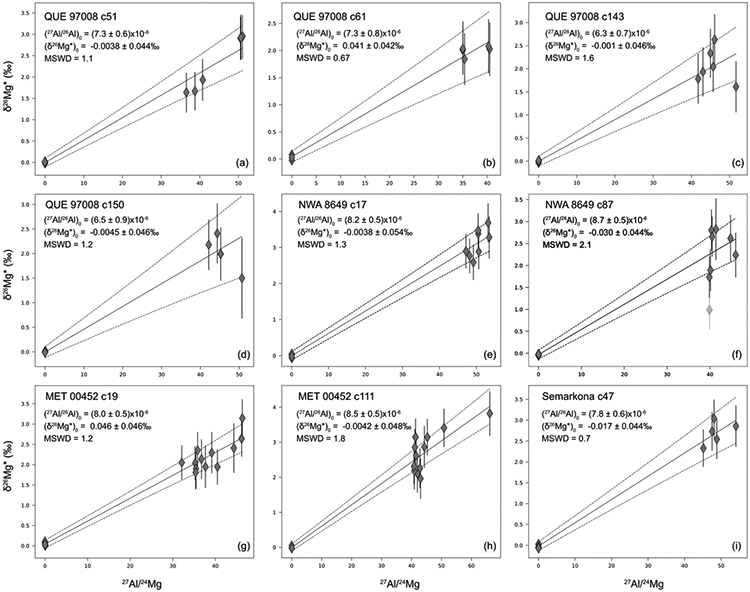
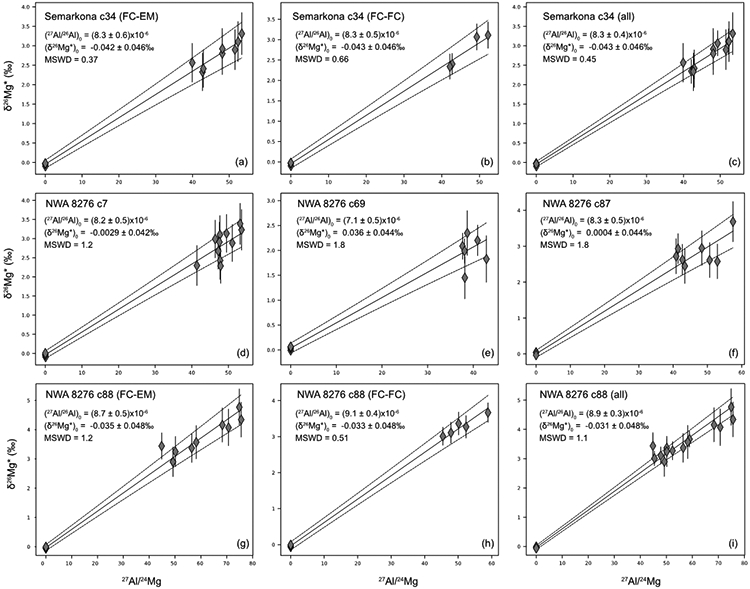
Al-Mg ages were determined for 14 anorthite-bearing chondrules from five different unequilibrated ordinary chondrites (UOCs) with low petrologic subtypes (3.00-3.05). In addition, oxygen three isotopes of these chondrules were also measured. The selected chondrules are highly depleted in alkali elements, and anorthite is the only mesostasis phase, though they show a range of mafic mineral compositions (Mg# 76-97 mole%) that are representative of chondrules in UOCs. The mean ∆O values in these chondrules range from -0.44 ± 0.23‰ to 0.49 ± 0.15‰, in good agreement with previous studies of plagioclase-bearing chondrules from UOCs. Anorthite in all chondrules exhibit resolvable excess Mg (> 1.0 ± 0.4‰). Their inferred (Al/Al) range from (6.3 ± 0.7)×10 to (8.9 ± 0.3)×10 corresponding to a timescale for chondrule formation of 1.8 ± 0.04 Ma to 2.16 ± / Ma after CAIs using a canonical (Al/Al) value of 5.25×10. The ages from six chondrules in LL chondrites are restricted to between 1.8 Ma and 1.9 Ma, whereas eight chondrules in L chondrites show ages from 1.8 Ma to 2.2 Ma, including three chondrules at ~2.0 Ma and two chondrules at ~2.15 Ma. The inferred chondrule formation ages from this study are at the peak of those previously determined for UOC chondrules, though with much shorter durations. This is potentially due to the time difference between formation of anorthite-bearing chondrules and typical UOC chondrules with alkali-rich compositions. Alternatively, younger chondrules ages in previous studies could have been the result of disturbance to the Al-Mg system in glassy mesostasis even at the low degree of thermal metamorphism in the parent bodies. Nevertheless, the high precision ages from this study (with uncertainties from 0.04 Ma to 0.15 Ma) indicate that there was potentially more than one chondrule forming event represented in the studied population. Considering data from LL chondrites only, the restricted duration (≤0.1 Ma) of chondrule formation ages suggests an origin in high density environments that subsequently lead to parent body formation. However, the unusually low alkali contents of the studied chondrules compared to common alkali-rich chondrules could also represent earlier chondrule formation events under relatively lower dust densities in the disk. Major chondrule forming events for UOCs might have postdated or concurrent with the younger anorthite-bearing chondrule formation at 2.15 Ma after CAIs, which are very close to the timing of accretion of ordinary chondrite parent bodies that are expected from thermal evolution of ordinary chondrite parent bodies.
测定了来自5个不同的低岩石学亚型(3.00 - 3.05)的非平衡普通球粒陨石(UOCs)中14个含钙长石球粒的铝镁年龄。此外,还测量了这些球粒的氧三种同位素。所选球粒的碱元素高度亏损,钙长石是唯一的基质相,尽管它们显示出一系列镁铁质矿物成分(Mg# 76 - 97摩尔%),这些成分代表了UOCs中的球粒。这些球粒中的平均∆O值范围为-0.44 ± 0.23‰至0.49 ± 0.15‰,与先前对UOCs中含斜长石球粒的研究结果吻合良好。所有球粒中的钙长石都表现出可分辨的过量镁(> 1.0 ± 0.4‰)。它们推断的(Al/Al)范围为(6.3 ± 0.7)×10至(8.9 ± 0.3)×10,对应于使用5.25×10的标准(Al/Al)值,在钙铝包体之后球粒形成的时间尺度为1.8 ± 0.04 Ma至2.16 ± / Ma。LL球粒陨石中6个球粒的年龄限制在1.8 Ma至1.9 Ma之间,而L球粒陨石中的8个球粒显示年龄在1.8 Ma至2.2 Ma之间,包括3个约2.0 Ma的球粒和2个约2.15 Ma的球粒。本研究推断的球粒形成年龄处于先前为UOC球粒确定的年龄峰值,但持续时间短得多。这可能是由于含钙长石球粒与典型的富含碱成分的UOC球粒形成时间的差异。或者,先前研究中较年轻的球粒年龄可能是由于即使在母体中低热变质程度下,玻璃质基质中铝镁系统受到干扰的结果。然而,本研究的高精度年龄(不确定性为0.04 Ma至0.15 Ma)表明,在所研究的群体中可能存在不止一次球粒形成事件。仅考虑LL球粒陨石的数据,球粒形成年龄的受限持续时间(≤0.1 Ma)表明其起源于高密度环境,随后导致母体形成。然而,与常见的富含碱球粒相比,所研究球粒异常低的碱含量也可能代表了盘中相对较低尘埃密度下更早的球粒形成事件。UOCs的主要球粒形成事件可能在钙铝包体之后2.15 Ma的较年轻含钙长石球粒形成之后或与之同时发生,这与普通球粒陨石母体热演化预期的普通球粒陨石母体吸积时间非常接近。