Department of Veterinary Pathobiology, University of Missouri, Columbia, MO, United States.
The First Affiliated Hospital, Zhejiang University, Hangzhou, China.
Front Endocrinol (Lausanne). 2021 Dec 23;12:808526. doi: 10.3389/fendo.2021.808526. eCollection 2021.
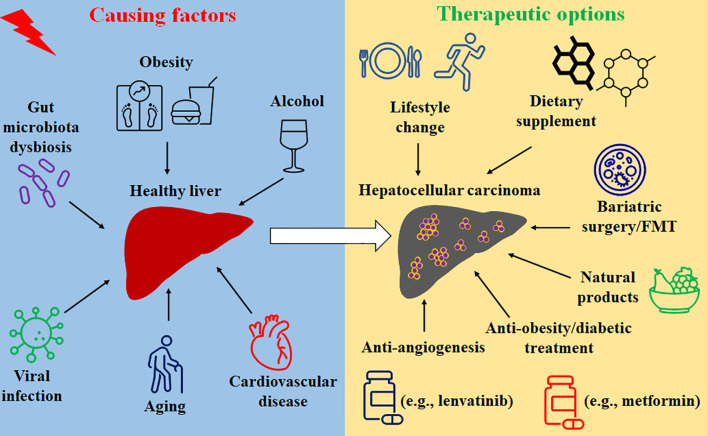
Hepatocellular carcinoma (HCC) is the most common type of primary liver cancer, which will affect more than a million people by the year 2025. However, current treatment options have limited benefits. Nonalcoholic fatty liver disease (NAFLD) is the fastest growing factor that causes HCC in western countries, including the United States. In addition, NAFLD co-morbidities including obesity, type 2 diabetes mellitus (T2DM), and cardiovascular diseases (CVDs) promote HCC development. Alteration of metabolites and inflammation in the tumor microenvironment plays a pivotal role in HCC progression. However, the underlying molecular mechanisms are still not totally clear. Herein, in this review, we explored the latest molecules that are involved in obesity, T2DM, and CVDs-mediated progression of HCC, as they share some common pathologic features. Meanwhile, several therapeutic options by targeting these key factors and molecules were discussed for HCC treatment. Overall, obesity, T2DM, and CVDs as chronic metabolic disease factors are tightly implicated in the development of HCC and its progression. Molecules and factors involved in these NAFLD comorbidities are potential therapeutic targets for HCC treatment.
肝细胞癌(HCC)是最常见的原发性肝癌,到 2025 年,全球将有超过 100 万人受其影响。然而,目前的治疗选择获益有限。非酒精性脂肪性肝病(NAFLD)是导致包括美国在内的西方国家 HCC 发病率增长最快的因素。此外,NAFLD 的合并症,如肥胖、2 型糖尿病(T2DM)和心血管疾病(CVDs),也会促进 HCC 的发展。肿瘤微环境中代谢物和炎症的改变在 HCC 进展中起着关键作用。然而,其潜在的分子机制尚不完全清楚。在本综述中,我们探讨了参与肥胖、T2DM 和 CVD 介导的 HCC 进展的最新分子,因为它们具有一些共同的病理特征。同时,还讨论了针对这些关键因素和分子的几种治疗选择,以用于 HCC 的治疗。总之,肥胖、T2DM 和 CVD 等慢性代谢性疾病因素与 HCC 的发生和发展密切相关。涉及这些非酒精性脂肪性肝病合并症的分子和因素可能成为 HCC 治疗的潜在靶点。