Lovo Eduardo E, Moreira Alejandra, Barahona Kaory C, Caceros Victor, Cruz Claudia, Arias Juan
Neuro-radiosurgery, International Cancer Center, Diagnostic Hospital, San Salvador, SLV.
Neurosurgery, International Cancer Center, Diagnostic Hospital, San Salvador, SLV.
Cureus. 2022 Jan 5;14(1):e20971. doi: 10.7759/cureus.20971. eCollection 2022 Jan.
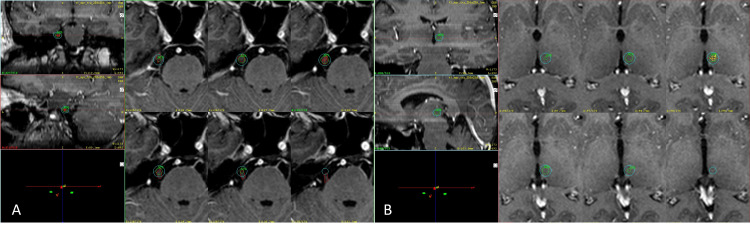
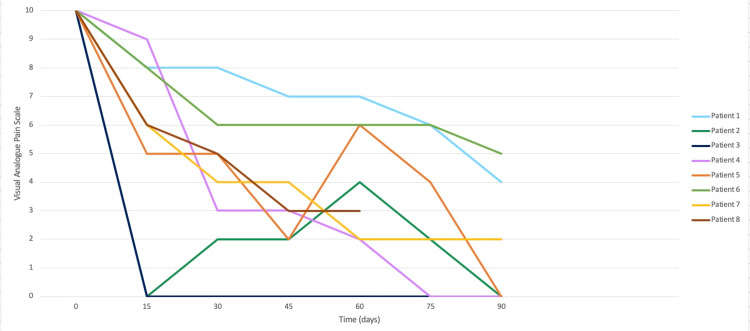
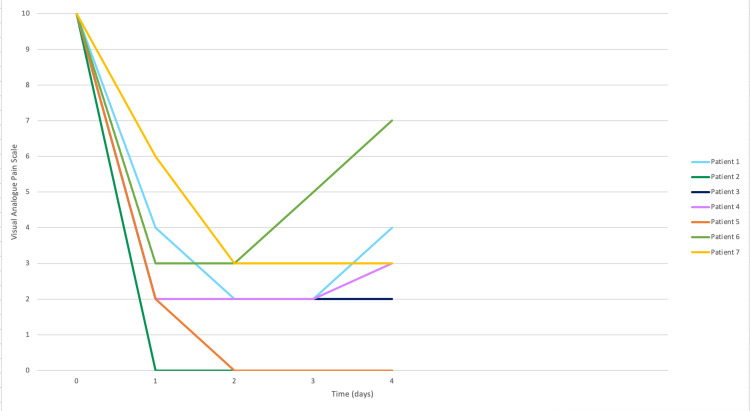
Background Radioneuromodulation (RNM) can explain the immediate pain relief experienced by a subgroup of patients after stereotactic radiosurgery (SRS) for trigeminal neuralgia (TN). In this study, our main objective was to demonstrate that a minimum of a 50% reduction in TN pain can be achieved consistently in under 72 hours by targeting the affected nerve, the contralateral centromedian nucleus, and parafascicular complex in patients experimenting a prolonged refractory pain crisis. Methodology We treated eight patients experiencing severe TN pain crisis in whom percutaneous procedures had failed or were unwanted with SRS with an intention to procure pain relief in under 72 hours. The affected trigeminal nerve was targeted using a 4-mm collimator with an 80 to 90-Gy dose; an additional target was defined in the mesial portions of the thalamus and irradiated using the 4-mm collimator with a 120 to 140-Gy dose. Results The median duration of TN was 60 months, the median duration of pain crisis was 10.7 weeks despite the best medical treatment, and the mean presenting visual analogue score (VAS) was 10 at the time of treatment. The median follow-up was 135 days (range, 65-210). Twenty-four hours after treatment, two (25%) patients had no pain (VAS 0), three (37.5%) had mild pain (VAS 1 to 3), and three (37.5%) had moderate pain (VAS 4 to 7). Forty-eight hours after treatment, all patients reported pain relief, seven (87.5%) reported >50%, and one (12.5%) patients reported 30% relief. The three-month median VAS score was 3 (range, 0 to 5). At the last follow-up, there were no adverse events to report. Conclusions Dual irradiation to the affected trigeminal nerve and contralateral mesial structures of the thalamus may provide fast pain relief for patients experiencing a prolonged pain crisis from TN, which veers away from the concept that the SRS pain relief effect is generally delayed and holds no place in the management of such patients. Although this is a small series with a limited follow-up duration, no adverse effects were noted. RNM can be defined as the capacity to alter neuronal activity through targeted delivery of a stimulus of radiation at a duration too brief to be explained by the development of a focal lesion. The immediate pain relief and its habitual oscillatory nature of lesser pain recurrence in most patients until enough time elapses for pain stabilization clinically demonstrates that the pain circuitry is altered and remains functional, thus accomplishing a neuromodulation effect even at the face of an apparent doses suspected to be ablative. Further research is needed to understand if this clinical effect is achieved with a suspected sub-ablative dose.
背景 放射神经调节(RNM)可以解释三叉神经痛(TN)患者在立体定向放射外科治疗(SRS)后部分患者立即出现的疼痛缓解。在本研究中,我们的主要目的是证明,对于经历长期难治性疼痛发作的患者,通过靶向患侧神经、对侧中央中核和束旁复合体,可在72小时内持续实现TN疼痛至少减轻50%。方法 我们治疗了8例经历严重TN疼痛发作的患者,这些患者经皮治疗失败或不愿意接受经皮治疗,采用SRS以期在72小时内缓解疼痛。使用4毫米准直器,以80至90 Gy的剂量靶向患侧三叉神经;在丘脑内侧部分定义另一个靶点,并使用4毫米准直器以120至140 Gy的剂量进行照射。结果 TN的中位病程为60个月,尽管进行了最佳药物治疗,疼痛发作的中位病程为10.7周,治疗时的平均视觉模拟评分(VAS)为10分。中位随访时间为135天(范围65 - 210天)。治疗后24小时,2例(25%)患者无疼痛(VAS 0),3例(37.5%)有轻度疼痛(VAS 1至3),3例(37.5%)有中度疼痛(VAS 4至7)。治疗后48小时,所有患者均报告疼痛缓解,7例(87.5%)报告疼痛减轻>50%,1例(12.5%)患者报告疼痛减轻30%。三个月时的中位VAS评分为3分(范围0至5分)。在最后一次随访时,无不良事件报告。结论 对患侧三叉神经和丘脑对侧内侧结构进行双重照射,可能为经历TN长期疼痛发作的患者提供快速疼痛缓解,这与SRS疼痛缓解效果通常延迟的概念不同,在这类患者的治疗中具有重要地位。虽然这是一个小样本且随访时间有限的系列研究,但未观察到不良反应。RNM可定义为通过靶向递送持续时间过短而无法用局灶性病变形成来解释的辐射刺激来改变神经元活动的能力。大多数患者立即出现疼痛缓解及其疼痛复发较少的习惯性振荡性质,直到临床疼痛稳定所需的足够时间过去,这表明疼痛回路发生了改变且仍有功能,因此即使面对疑似消融剂量,也能实现神经调节作用。需要进一步研究以了解这种临床效果是否是在疑似亚消融剂量下实现的。