Ketsuwan Sirima, Tanpowpong Pornthep, Ruangwattanapaisarn Nichanan, Phaopant Supatra, Suppalarkbunlue Nattanicha, Kooanantkul Chula, Anantasit Nattachai, Vaewpanich Jarin
Division of Pediatric Critical Care Medicine, Department of Pediatrics, Faculty of Medicine, Ramathibodi Hospital, Mahidol University, Bangkok, Thailand.
Division of Gastroenterology, Department of Pediatrics, Faculty of Medicine, Ramathibodi Hospital, Mahidol University, Bangkok, Thailand.
Front Pediatr. 2021 Dec 22;9:739247. doi: 10.3389/fped.2021.739247. eCollection 2021.
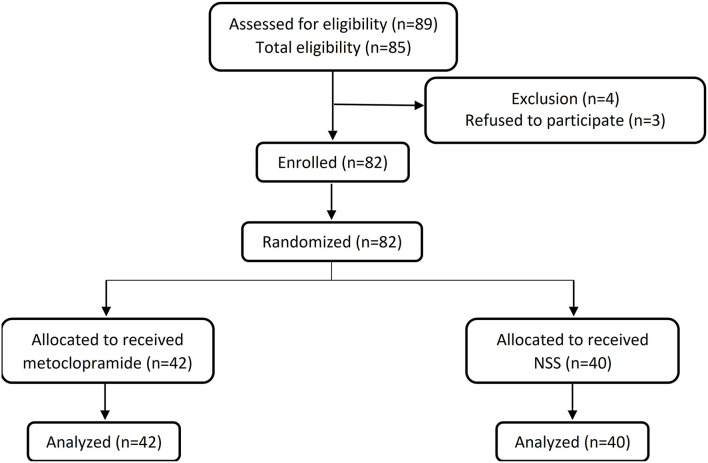
Impaired gastric emptying is a common cause of delayed feeding in critically ill children. Post-pyloric feeding may help improve feeding intolerance and nutritional status and, hence, contribute to a better outcome. However, post-pyloric feeding tube insertion is usually delayed due to a technical difficulty. Therefore, prokinetic agents have been used to facilitate blind bedside post-pyloric feeding tube insertion. Metoclopramide is a potent prokinetic agent that has also been used to improve motility in adults and children admitted to intensive care units. The objective of this study was to determine the efficacy of intravenous metoclopramide in promoting the success rate of blind bedside post-pyloric feeding tube placement in critically ill children. The design of this study is randomized, double blind, placebo controlled. The setting of the study is a single-center pediatric intensive care unit. Children aged 1 month-18 years admitted to the pediatric intensive care unit with severe illness or feeding intolerance were enrolled in this study. Patients were randomly selected to receive intravenous metoclopramide or 0.9% normal saline solution (the placebo) prior to the tube insertion. The study outcome was the success rate of post-pyloric feeding tube placement confirmed by an abdominal radiography 6-8 h after the insertion. We found that patients receiving metoclopramide had a higher success rate (37/42, 88%) of post-pyloric feeding tube placement than the placebo (28/40, 70%) = 0.04). Patients who received sedative drug or narcotic agent showed a tendency of higher success rate ( = 0.08). Intravenous metoclopramide improves the success rate of blind bedside post-pyloric placement of feeding tube in critically ill children. Thai Clinical Trial Registry TCTR20190821002. Registered 15th August 2019.
胃排空受损是危重症儿童喂养延迟的常见原因。幽门后喂养可能有助于改善喂养不耐受和营养状况,从而带来更好的预后。然而,由于技术难度,幽门后喂养管的插入通常会延迟。因此,促动力药物已被用于促进床边盲插幽门后喂养管。甲氧氯普胺是一种强效促动力药物,也被用于改善入住重症监护病房的成人和儿童的胃肠动力。本研究的目的是确定静脉注射甲氧氯普胺在提高危重症儿童床边盲插幽门后喂养管成功率方面的疗效。本研究设计为随机、双盲、安慰剂对照。研究地点为单中心儿科重症监护病房。本研究纳入了入住儿科重症监护病房、患有严重疾病或喂养不耐受的1个月至18岁儿童。在插入喂养管前,患者被随机选择接受静脉注射甲氧氯普胺或0.9%生理盐水溶液(安慰剂)。研究结果是插入喂养管6 - 8小时后通过腹部X光片确认的幽门后喂养管放置成功率。我们发现,接受甲氧氯普胺的患者幽门后喂养管放置成功率(37/42,88%)高于安慰剂组(28/40,70%)(P = 0.04)。接受镇静药物或麻醉剂的患者成功率有更高的趋势(P = 0.08)。静脉注射甲氧氯普胺可提高危重症儿童床边盲插幽门后喂养管的成功率。泰国临床试验注册中心TCTR20190821002。于2019年8月15日注册。