Diaz Alejandro, Grand Marina, Torrado Juan, Salazar Federico, Zócalo Yanina, Bia Daniel
Consejo Nacional de Investigaciones Científicas y Técnicas, Instituto de Investigación en Ciencias de la Salud (IICS), Universidad Nacional del Centro de la Provincia de Buenos Aires (UNICEN), Tandil, Argentina.
Instituto de Investigación en Ciencias de la Salud, Facultad de Ciencias de la Salud, Universidad Nacional del Centro de la Provincia de Buenos Aires, Tandil, Argentina.
Front Cardiovasc Med. 2021 Dec 23;8:772912. doi: 10.3389/fcvm.2021.772912. eCollection 2021.
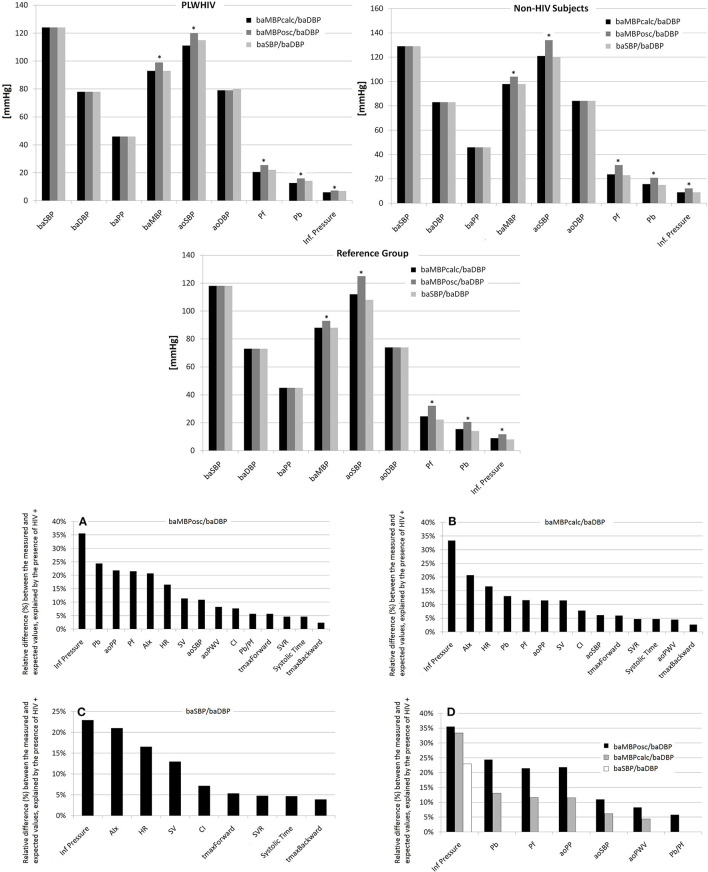
There are scarce and controversial data on whether human immunodeficiency virus (HIV) infection is associated with changes in aortic pressure (aoBP) and waveform-derived indexes. Moreover, it remains unknown whether potential differences in aoBP and waveform indexes between people living with HIV (PLWHIV) and subjects without HIV (HIV-) would be affected by the calibration method of the pressure waveform. To determine: (i) whether PLWHIV present differences in aoBP and waveform-derived indexes compared to HIV- subjects; (ii) the relative impact of both HIV infection and cardiovascular risk factors (CRFs) on aoBP and waveform-derived indexes; (iii) whether the results of the first and second aims are affected by the calibration method. Three groups were included: (i) PLWHIV (n = 86), (ii) HIV- subjects (general population; = 1,000) and (iii) a Reference Group (healthy, non-exposed to CRFs; = 398). Haemodynamic parameters, brachial pressure (baBP; systolic: baSBP; diastolic: baDBP; mean oscillometric: baMBPosc) and aoBP and waveform-derived indexes were obtained. Brachial mean calculated (baMBPcalc=baDBP+[baSBP-baDBP]/3) pressure was quantified. Three waveform calibration schemes were used: systolic-diastolic, calculated (baMBPcalc/baDBP) and oscillometric mean (baMBPosc/baDBP). Regardless of CRFs and baBP, PLWHIV presented a tendency of having lower aoBP and waveform-derived indexes which clearly reached statistical significance when using the baMBPosc/baDBP or baMBPcalc/baDBP calibration. HIV status exceeded the relative weight of other CRFs as explanatory variables, being the main explanatory variable for variations in central hemodynamics when using the baMBPosc/baDBP, followed by the baMBPcalc/baDBP calibration. The peripheral waveform calibration approach is an important determinant to reveal differences in central hemodynamics in PLWHIV.
关于人类免疫缺陷病毒(HIV)感染是否与主动脉压(aoBP)及波形衍生指标的变化相关,现有数据稀少且存在争议。此外,HIV感染者(PLWHIV)与未感染HIV者(HIV-)之间aoBP和波形指标的潜在差异是否会受到压力波形校准方法的影响,目前仍不清楚。目的是确定:(i)与HIV-受试者相比,PLWHIV在aoBP和波形衍生指标上是否存在差异;(ii)HIV感染和心血管危险因素(CRF)对aoBP和波形衍生指标的相对影响;(iii)第一个和第二个目标的结果是否受校准方法的影响。研究纳入了三组:(i)PLWHIV(n = 86),(ii)HIV-受试者(一般人群;n = 1000)和(iii)一个参考组(健康,未暴露于CRF;n = 398)。获取了血流动力学参数、肱动脉压(baBP;收缩压:baSBP;舒张压:baDBP;示波平均压:baMBPosc)以及aoBP和波形衍生指标。对计算得出的肱动脉平均压(baMBPcalc = baDBP + [baSBP - baDBP]/3)进行了量化。使用了三种波形校准方案:收缩压-舒张压、计算值(baMBPcalc/baDBP)和示波平均值(baMBPosc/baDBP)。无论CRF和baBP如何,PLWHIV都呈现出aoBP和波形衍生指标较低的趋势,当使用baMBPosc/baDBP或baMBPcalc/baDBP校准时,这种趋势明显达到统计学显著性。HIV状态作为解释变量超过了其他CRF的相对权重,在使用baMBPosc/baDBP校准时是中心血流动力学变化的主要解释变量,其次是baMBPcalc/baDBP校准。外周波形校准方法是揭示PLWHIV中心血流动力学差异的重要决定因素。