Yu Xueqing, Nakayama Masaaki, Wu Mai-Szu, Kim Yong-Lim, Mushahar Lily, Szeto Cheuk Chun, Schatell Dori, Finkelstein Fredric O, Quinn Robert R, Duddington Michelle
Division of Nephrology, Guangdong Provincial People's Hospital, Guangzhou, People's Republic of China.
Kidney Center, St. Luke's International Hospital, Tokyo, Japan.
Kidney Int Rep. 2021 Oct 30;7(1):15-27. doi: 10.1016/j.ekir.2021.10.019. eCollection 2022 Jan.
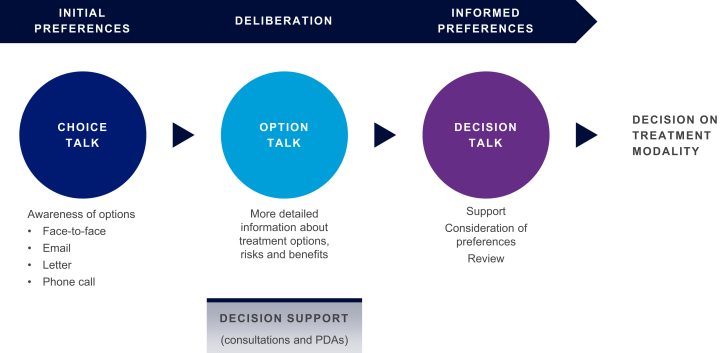
The prevalence of kidney failure continues to rise globally. Dialysis is a treatment option for individuals with kidney failure; after the decision to initiate dialysis has been made, it is critical to involve individuals in the decision on which dialysis modality to choose. This review, based on evidence arising from the literature, examines the role of shared decision-making (SDM) in helping those with kidney failure to select a dialysis modality. SDM was found to lead to more people with kidney failure feeling satisfied with their choice of dialysis modality. Individuals with kidney failure must be cognizant that SDM is an active and iterative process, and their participation is essential for success in empowering them to make decisions on dialysis modality. The educational components of SDM must be easy to understand, high quality, unbiased, up to date, and targeted to the linguistic, educational, and cultural needs of the individual. All individuals with kidney failure should be encouraged to participate in SDM and should be involved in the design and implementation of SDM approaches.
全球肾衰竭的患病率持续上升。透析是肾衰竭患者的一种治疗选择;在决定开始透析后,让患者参与选择透析方式的决策至关重要。本综述基于文献证据,探讨了共同决策(SDM)在帮助肾衰竭患者选择透析方式方面的作用。研究发现,共同决策能使更多肾衰竭患者对其透析方式的选择感到满意。肾衰竭患者必须认识到,共同决策是一个积极且反复的过程,他们的参与对于成功地让他们有能力就透析方式做出决策至关重要。共同决策的教育内容必须易于理解、质量高、无偏见、与时俱进,并针对个人的语言、教育和文化需求。应鼓励所有肾衰竭患者参与共同决策,并让他们参与共同决策方法的设计和实施。