Zhang Meng-Ze, Ou-Yang Han-Qiang, Jiang Liang, Wang Chun-Jie, Liu Jian-Fang, Jin Dan, Ni Ming, Liu Xiao-Guang, Lang Ning, Yuan Hui-Shu
Department of Radiology Peking University Third Hospital Beijing China.
Department of Orthopedics Peking University Third Hospital Beijing China.
JOR Spine. 2021 Nov 13;4(4):e1178. doi: 10.1002/jsp2.1178. eCollection 2021 Dec.
Predicting the postoperative neurological function of cervical spondylotic myelopathy (CSM) patients is generally based on conventional magnetic resonance imaging (MRI) patterns, but this approach is not completely satisfactory. This study utilized radiomics, which produced advanced objective and quantitative indicators, and machine learning to develop, validate, test, and compare models for predicting the postoperative prognosis of CSM.
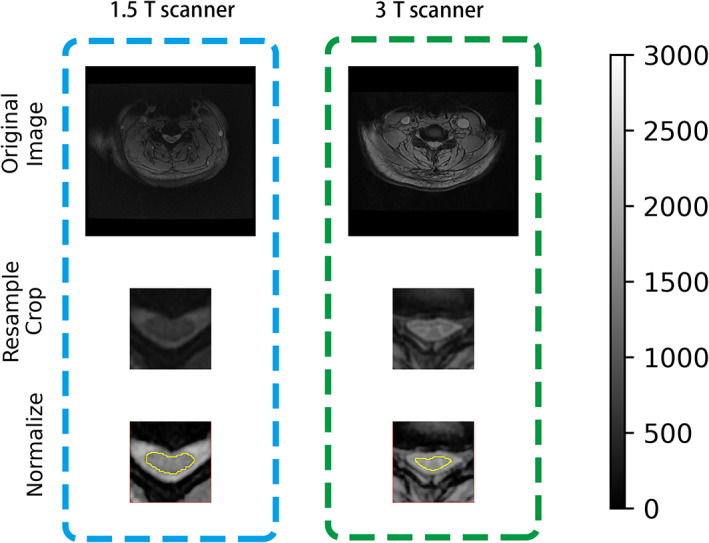
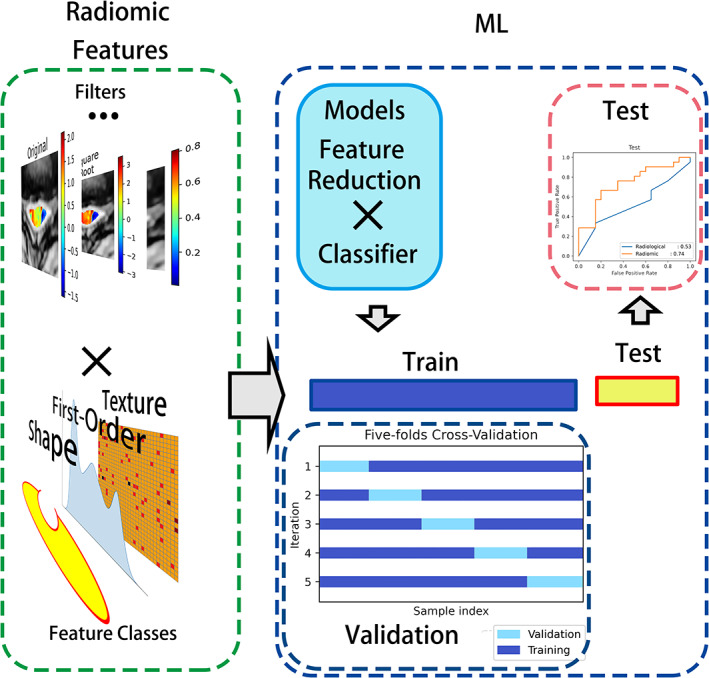
In total, 151 CSM patients undergoing surgical treatment and preoperative MRI was retrospectively collected and divided into good/poor outcome groups based on postoperative modified Japanese Orthopedic Association (mJOA) scores. The datasets obtained from several scanners (an independent scanner) for the training (testing) cohort were used for cross-validation (CV). Radiological models based on the intramedullary hyperintensity and compression ratio were constructed with 14 binary classifiers. Radiomic models based on 237 robust radiomic features were constructed with the same 14 binary classifiers in combination with 7 feature reduction methods, resulting in 98 models. The main outcome measures were the area under the receiver operating characteristic curve (AUROC) and accuracy.
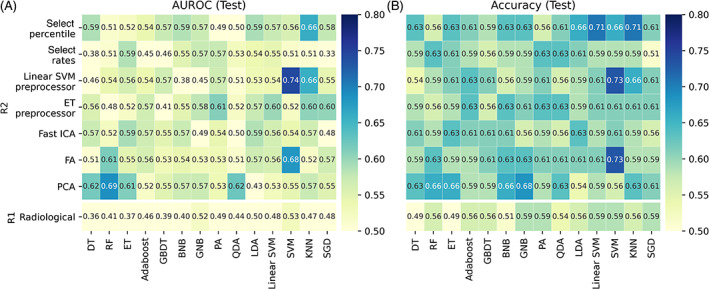
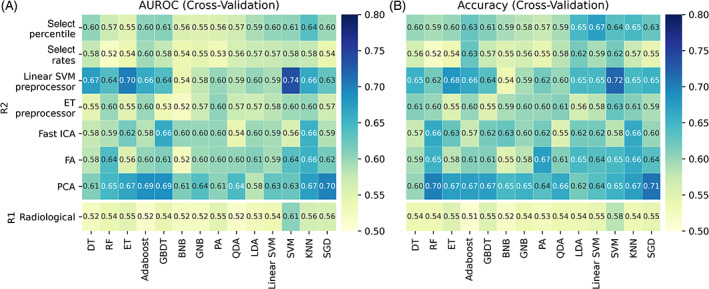
Forty-one (11) radiomic models were superior to random guessing during CV (testing), with significant increased AUROC and/or accuracy ( < .05 and/or < .05). One radiological model performed better than random guessing during CV ( < .05). In the testing cohort, the linear SVM preprocessor + SVM, the best radiomic model (AUROC: 0.74 ± 0.08, accuracy: 0.73 ± 0.07), overperformed the best radiological model ( = .048).
Radiomic features can predict postoperative spinal cord function in CSM patients. The linear SVM preprocessor + SVM has great application potential in building radiomic models.
预测脊髓型颈椎病(CSM)患者术后神经功能通常基于传统磁共振成像(MRI)模式,但这种方法并不完全令人满意。本研究利用能产生先进客观和定量指标的放射组学以及机器学习来开发、验证、测试和比较预测CSM术后预后的模型。
回顾性收集了151例接受手术治疗的CSM患者及其术前MRI,并根据术后改良日本骨科协会(mJOA)评分分为预后良好/不良组。从多个扫描仪(一台独立扫描仪)获得的数据集用于训练(测试)队列的交叉验证(CV)。基于髓内高信号和压迫率构建了14个二分类器的放射学模型。基于237个稳健放射组学特征构建了放射组学模型,同样使用14个二分类器并结合7种特征约简方法,共产生98个模型。主要结局指标为受试者工作特征曲线下面积(AUROC)和准确率。
在交叉验证(测试)期间,41个(11个)放射组学模型优于随机猜测,AUROC和/或准确率显著提高(P <.05和/或P <.05)。一个放射学模型在交叉验证期间表现优于随机猜测(P <.05)。在测试队列中,最佳放射组学模型线性支持向量机预处理器+支持向量机(AUROC:0.74±0.08,准确率:0.73±0.07)优于最佳放射学模型(P =.048)。
放射组学特征可预测CSM患者术后脊髓功能。线性支持向量机预处理器+支持向量机在构建放射组学模型方面具有很大的应用潜力。