Department of Pediatrics, Kobe University Graduate School of Medicine, Kobe, Japan.
Hyogo Prefectural Kobe Children's Hospital, Kobe, Japan.
Pediatr Nephrol. 2022 Sep;37(9):1957-1965. doi: 10.1007/s00467-021-05401-4. Epub 2022 Jan 10.
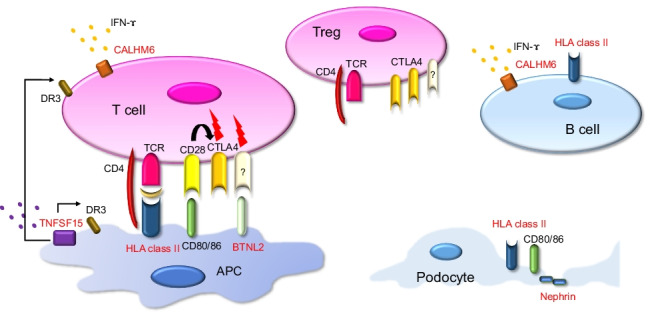
Idiopathic nephrotic syndrome is the most common childhood glomerular disease. Most forms of this syndrome respond to corticosteroids at standard doses and are, therefore, defined as steroid-sensitive nephrotic syndrome (SSNS). Immunological mechanisms and subsequent podocyte disorders play a pivotal role in SSNS and have been studied for years; however, the precise pathogenesis remains unclear. With recent advances in genetic techniques, an exhaustive hypothesis-free approach called a genome-wide association study (GWAS) has been conducted in various populations. GWASs in pediatric SSNS peaked in the human leukocyte antigen class II region in various populations. Additionally, an association of immune-related CALHM6/FAM26F, PARM1, BTNL2, and TNFSF15 genes, as well as NPHS1, which encodes nephrin expressed in podocytes, has been identified as a locus that achieves genome-wide significance in pediatric SSNS. However, the specific mechanism of SSNS development requires elucidation. This review describes an updated view of SSNS pathogenesis from immunological and genetic aspects, including interactions with infections or allergies, production of circulating factors, and an autoantibody hypothesis.
特发性肾病综合征是儿童中最常见的肾小球疾病。这种综合征的大多数形式对标准剂量的皮质类固醇有反应,因此被定义为激素敏感型肾病综合征(SSNS)。免疫机制和随后的足细胞紊乱在 SSNS 中起着关键作用,并已研究多年;然而,确切的发病机制仍不清楚。随着基因技术的最新进展,一种称为全基因组关联研究(GWAS)的无假设穷尽方法已在不同人群中进行。在不同人群的人类白细胞抗原(HLA)II 类区域,儿科 SSNS 的 GWAS 达到了高峰。此外,还发现与免疫相关的 CALHM6/FAM26F、PARM1、BTNL2 和 TNFSF15 基因以及在足细胞中表达的编码nephrin 的 NPHS1 之间存在关联,这是儿科 SSNS 达到全基因组意义的一个位点。然而,SSNS 发展的具体机制仍需阐明。本综述从免疫学和遗传学角度描述了 SSNS 发病机制的最新观点,包括与感染或过敏、循环因子的产生以及自身抗体假说的相互作用。