Division of Microbiology, Department of Laboratory Medicine and Pathology, Hamad Medical Corporation, Doha, Qatar.
Westerdijk Fungal Biodiversity Institute, Utrecht, The Netherlands.
Mycopathologia. 2022 Feb;187(1):39-52. doi: 10.1007/s11046-021-00603-8. Epub 2022 Jan 10.
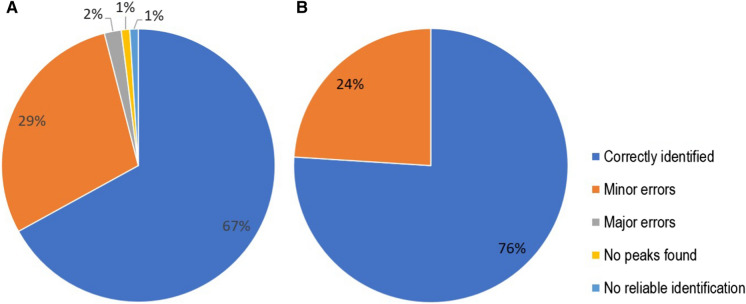
Matrix-Assisted Laser Desorption/Ionization Time-of-Flight Mass Spectrometry (MALDI-TOF MS) is widely used in clinical laboratories for routine identification of bacteria and yeasts. However, methodological difficulties are still apparent when applied to filamentous fungi. The liquid cultivation method recommended by Bruker Daltonics GmbH for identification of filamentous fungi by MALDI-TOF MS is labour intensive and time-consuming. In this study, growth of Aspergillus species on different (porous) surfaces was investigated with the aim to develop a more reliable, quicker and less laborious identification method using MALDI-TOF MS. Mycelial growth without sporulation mimicking liquid cultivation and reliable MALDI-TOF MS spectra were obtained when A. fumigatus strains were grown on and in between a polycarbonate membrane filter on Sabouraud dextrose agar. A database of in-house reference spectra was created by growing Aspergillus reference strains (mainly focusing on sections Fumigati and Flavi) under these selected conditions. A test set of 50 molecularly identified strains grown under different conditions was used to select the best growth condition for identification and to perform an initial validation of the in-house database. Based on these results, the cultivation method on top of a polycarbonate filter proved to be most successful for species identification. This method was therefore selected for the identification of two sets of clinical isolates that mainly consisted of Aspergilli (100 strains originating from Indonesia, 70 isolates from Qatar). The results showed that this cultivation method is reliable for identification of clinically relevant Aspergillus species, with 67% and 76% correct identification of strains from Indonesia and Qatar, respectively. In conclusion, cultivation of Aspergilli on top of a polycarbonate filter showed improved results compared to the liquid cultivation protocol recommended by Bruker in terms of percentage of correct identification, ease of MSP creation, time consumption, cost and labour intensity. This method can be reliably applied for identification of clinically important Aspergilli and has potential for identification of other filamentous fungi.
基质辅助激光解吸电离飞行时间质谱(MALDI-TOF MS)广泛应用于临床实验室,用于常规鉴定细菌和酵母菌。然而,当应用于丝状真菌时,仍然存在方法学上的困难。布鲁克·道尔顿公司(Bruker Daltonics GmbH)推荐的丝状真菌 MALDI-TOF MS 鉴定的液体培养方法既费力又费时。本研究旨在通过 MALDI-TOF MS 开发一种更可靠、更快、更省力的鉴定方法,因此研究了不同(多孔)表面上的曲霉属物种的生长。当烟曲霉菌株在萨布罗葡萄糖琼脂上的聚碳酸酯膜过滤器上和之间生长时,无需产孢即可模拟液体培养并获得可靠的 MALDI-TOF MS 图谱。通过在这些选定条件下生长曲霉参考菌株(主要集中在 Fumigati 和 Flavi 部分),创建了内部参考图谱数据库。使用在不同条件下生长的 50 个分子鉴定的菌株的测试集来选择最佳的鉴定生长条件并对内部数据库进行初步验证。基于这些结果,证明在聚碳酸酯过滤器顶部的培养方法最适合用于物种鉴定。因此,该方法被选择用于鉴定主要由曲霉属组成的两组临床分离株(来自印度尼西亚的 100 株和来自卡塔尔的 70 株)。结果表明,这种培养方法对于鉴定临床相关的曲霉属物种是可靠的,来自印度尼西亚和卡塔尔的菌株的正确鉴定率分别为 67%和 76%。总之,与布鲁克推荐的液体培养方案相比,在聚碳酸酯过滤器上培养曲霉属在正确鉴定率、MSP 创建的简易性、时间消耗、成本和劳动强度方面显示出了改进的结果。该方法可可靠地用于鉴定临床重要的曲霉属,并且有可能用于鉴定其他丝状真菌。