Interdisciplinary Nanoscience Center (iNANO), Aarhus University, Aarhus C, Denmark; Department of Chemistry, Aarhus University, Aarhus C, Denmark.
Interdisciplinary Nanoscience Center (iNANO), Aarhus University, Aarhus C, Denmark; Department of Molecular Biology and Genetics, Aarhus University, Aarhus C, Denmark.
J Biol Chem. 2022 Feb;298(2):101569. doi: 10.1016/j.jbc.2022.101569. Epub 2022 Jan 7.
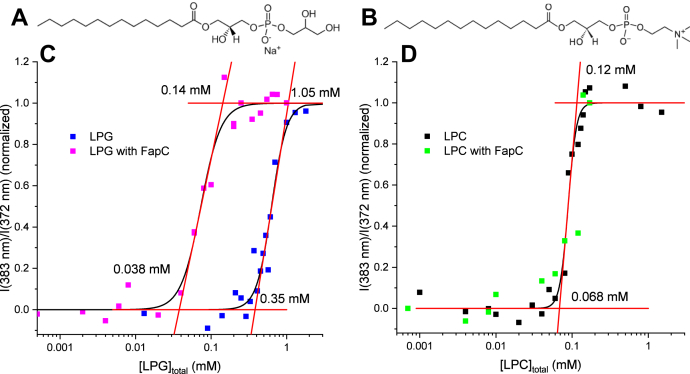
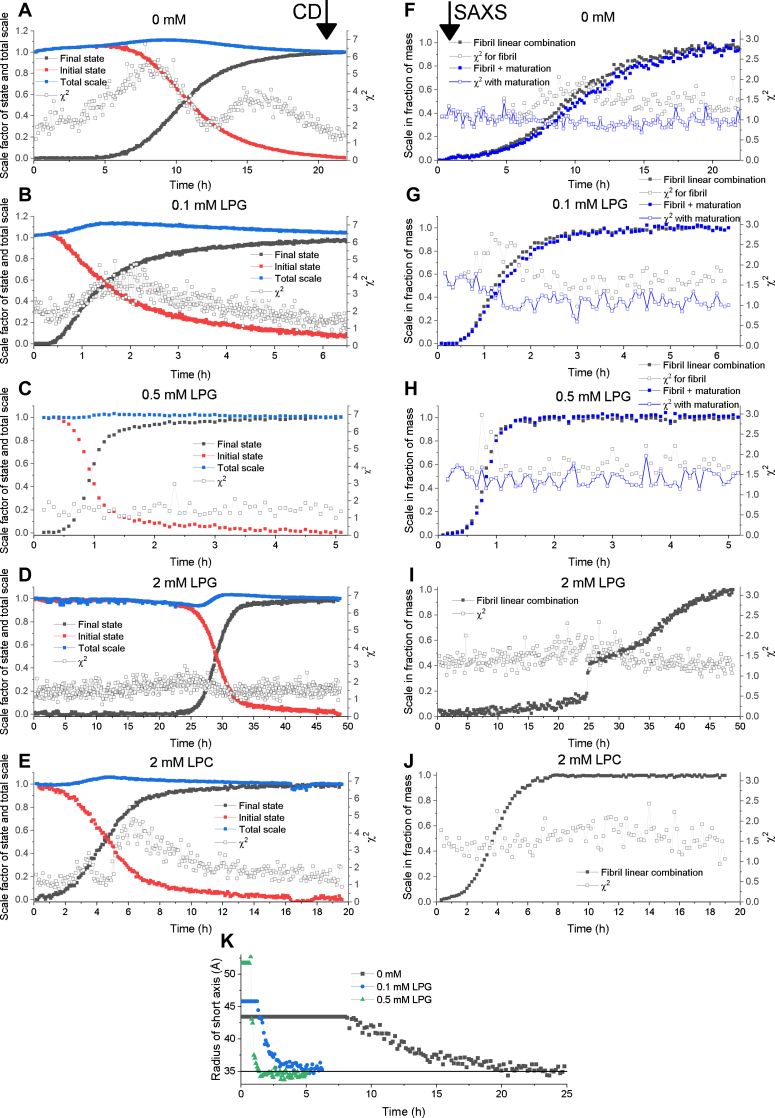
Amyloid proteins are widespread in nature both as pathological species involved in several diseases and as functional entities that can provide protection and storage for the organism. Lipids have been found in amyloid deposits from various amyloid diseases and have been shown to strongly affect the formation and structure of both pathological and functional amyloid proteins. Here, we investigate how fibrillation of the functional amyloid FapC from Pseudomonas is affected by two lysolipids, the zwitterionic lipid 1-myristoyl-2-hydroxy-sn-glycero-3-phosphocholine and the anionic lipid 1-myristoyl-2-hydroxy-sn-glycero-3-phospho-(1'-rac-glycerol) (LPG). Small-angle X-ray scattering, circular dichroism, dynamic light scattering, and thioflavin T fluorescence measurements were performed simultaneously on the same sample to ensure reproducibility and allow a multimethod integrated analysis. We found that LPG strongly induces fibrillation around its critical micelle concentration (cmc) by promoting formation of large structures, which mature via accumulation of intermediate fibril structures with a large cross section. At concentrations above its cmc, LPG strongly inhibits fibrillation by locking FapC in a core-shell complex. In contrast, lipid 1-myristoyl-2-hydroxy-sn-glycero-3-phosphocholine induces fibrillation at concentrations above its cmc, not via strong interactions with FapC but by being incorporated during fibrillation and likely stabilizing the fibrillation nucleus to reduce the lag phase. Finally, we show that LPG is not incorporated into the fibril during assembly but rather can coat the final fibril. We conclude that lipids affect both the mechanism and outcome of fibrillation of functional amyloid, highlighting a role for lipid concentration and composition in the onset and mechanism of fibrillation in vivo.
淀粉样蛋白在自然界中广泛存在,既有涉及多种疾病的病理性物种,也有作为功能实体的蛋白质,可为生物体提供保护和储存。在各种淀粉样变性疾病的淀粉样沉积物中发现了脂质,并且已经表明它们强烈影响病理性和功能性淀粉样蛋白的形成和结构。在这里,我们研究了来自假单胞菌的功能性淀粉样蛋白 FapC 的纤维化如何受到两种溶血磷脂的影响,即两性离子脂质 1-肉豆蔻酰-2-羟基-sn-甘油-3-磷酸胆碱和阴离子脂质 1-肉豆蔻酰-2-羟基-sn-甘油-3-磷酸-(1'-rac-甘油)(LPG)。同时对同一样品进行小角 X 射线散射、圆二色性、动态光散射和硫黄素 T 荧光测量,以确保重现性并允许进行多方法综合分析。我们发现,LPG 在其临界胶束浓度(cmc)附近通过促进大结构的形成强烈诱导纤维化,这些大结构通过积累具有大横截面的中间纤维结构而成熟。在其 cmc 以上的浓度下,LPG 通过将 FapC 锁定在核壳复合物中强烈抑制纤维化。相比之下,脂质 1-肉豆蔻酰-2-羟基-sn-甘油-3-磷酸胆碱在其 cmc 以上的浓度下诱导纤维化,不是通过与 FapC 强烈相互作用,而是在纤维化过程中被掺入,并可能稳定纤维化核以减少滞后期。最后,我们表明 LPG 不在组装过程中掺入纤维,而是可以涂覆最终的纤维。我们得出结论,脂质会影响功能性淀粉样蛋白的纤维化机制和结果,突出了脂质浓度和组成在体内淀粉样蛋白纤维化的起始和机制中的作用。