Lievin Raphael, Hendel-Chavez Houria, Baldé Aliou, Lancar Rémi, Algarte-Génin Michèle, Krzysiek Roman, Costagliola Dominique, Assoumou Lambert, Taoufik Yassine, Besson Caroline
Department of Hematology and Oncology, Hospital of Versailles, 78150 Le Chesnay, France.
Service d'Hématologie et Immunologie Biologique, Hôpital Bicêtre, Assistance Publique-Hôpitaux de Paris, 94270 Le Kremlin-Bicêtre, France.
Cancers (Basel). 2021 Dec 28;14(1):128. doi: 10.3390/cancers14010128.
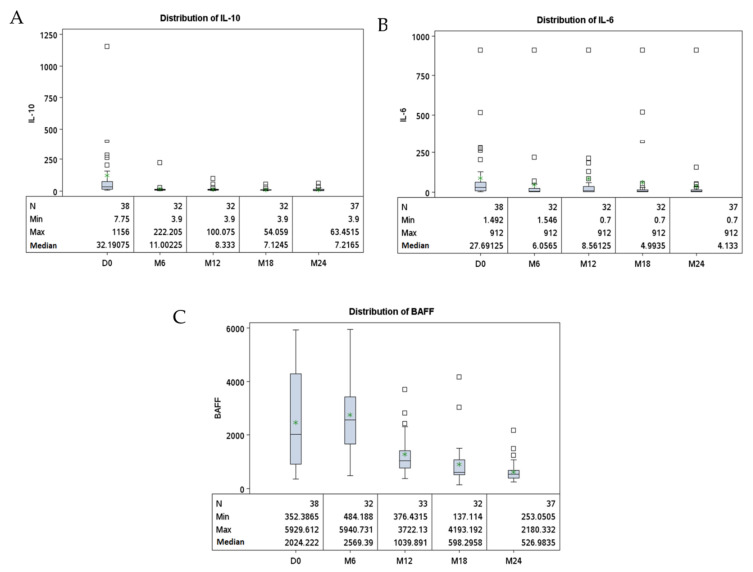
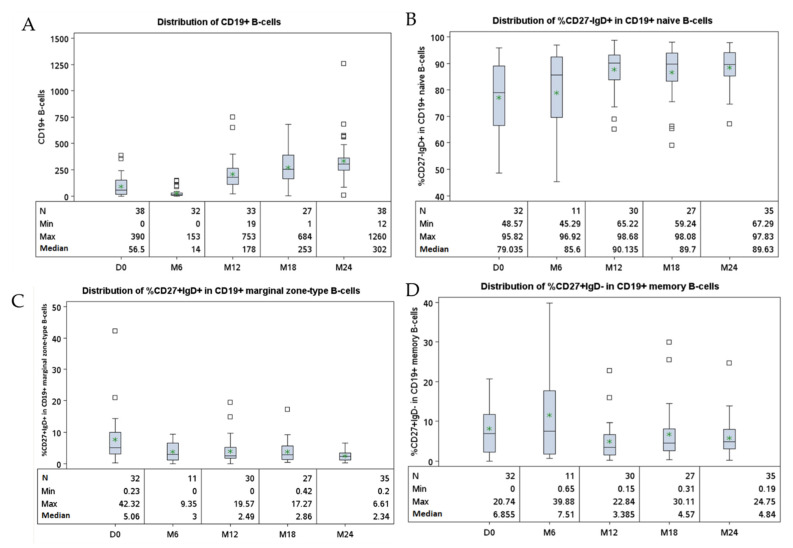
Classical Hodgkin Lymphoma incidence increases in HIV-1-infected patients (HIV-cHL). HIV infection is associated with higher B-cell activation. Here, in 38 HIV-cHL patients from the French cohort ANRS-CO16 Lymphovir, we examined longitudinally over 24 months the serum levels of the B-cell activating cytokines IL10, IL6, and BAFF, and blood distribution of B-cell subsets. Fourteen HIV-cHL patients were also compared to matched HIV-infected controls without cHL. IL10, IL6, and BAFF levels were higher in HIV-cHL patients than in controls ( < 0.0001, = 0.002, and < 0.0001, respectively). Cytokine levels increased in patients with advanced-stage lymphoma compared to those with limited-stage ( = 0.002, = 0.03, and = 0.01, respectively). Cytokine levels significantly decreased following HIV-cHL diagnosis and treatment. Blood counts of whole B-cells were similar in HIV-cHL patients and controls, but the distribution of B-cell subsets was different with higher ratios of naive B-cells over memory B-cells in HIV-cHL patients. Blood accumulation of naive B-cells was more marked in patients with advanced cHL stages ( = 0.06). During the follow-up, total B-cell counts increased ( < 0.0001), and the proportion of naive B-cells increased further ( = 0.04). Together the results suggest that in HIV-infected patients, cHL is associated with a particular B-cell-related environment that includes increased production of B-cell-activating cytokines and altered peripheral distribution of B-cell subsets. This B-cell-related environment may fuel the process of tumorigenesis.
经典型霍奇金淋巴瘤在HIV-1感染患者(HIV相关霍奇金淋巴瘤)中的发病率增加。HIV感染与更高的B细胞活化相关。在此,我们对来自法国队列ANRS-CO16 Lymphovir的38例HIV相关霍奇金淋巴瘤患者进行了为期24个月的纵向研究,检测了B细胞活化细胞因子IL10、IL6和BAFF的血清水平以及B细胞亚群的血液分布情况。还将14例HIV相关霍奇金淋巴瘤患者与匹配的未患霍奇金淋巴瘤的HIV感染对照进行了比较。HIV相关霍奇金淋巴瘤患者的IL10、IL6和BAFF水平高于对照组(分别为P<0.0001、P = 0.002和P<0.0001)。与局限性淋巴瘤患者相比,晚期淋巴瘤患者的细胞因子水平升高(分别为P = 0.002、P = 0.03和P = 0.01)。HIV相关霍奇金淋巴瘤诊断和治疗后,细胞因子水平显著下降。HIV相关霍奇金淋巴瘤患者和对照组的全B细胞计数相似,但B细胞亚群的分布不同,HIV相关霍奇金淋巴瘤患者中幼稚B细胞与记忆B细胞的比例更高。晚期霍奇金淋巴瘤患者幼稚B细胞的血液蓄积更为明显(P = 0.06)。在随访期间,总B细胞计数增加(P<0.0001),幼稚B细胞的比例进一步增加(P = 0.04)。这些结果共同表明,在HIV感染患者中,霍奇金淋巴瘤与特定的B细胞相关环境有关,该环境包括B细胞活化细胞因子产生增加和B细胞亚群外周分布改变。这种B细胞相关环境可能会推动肿瘤发生过程。