Miyasaka Yuhei, Sato Hiro, Okano Naoko, Kubo Nobuteru, Kawamura Hidemasa, Ohno Tatsuya
Department of Radiation Oncology, Gunma University Graduate School of Medicine, 3-39-22 Showa-Machi, Maebashi 371-8511, Japan.
Gunma University Heavy Ion Medical Center, 3-39-22 Showa-Machi, Maebashi 371-8511, Japan.
Cancers (Basel). 2021 Dec 31;14(1):203. doi: 10.3390/cancers14010203.
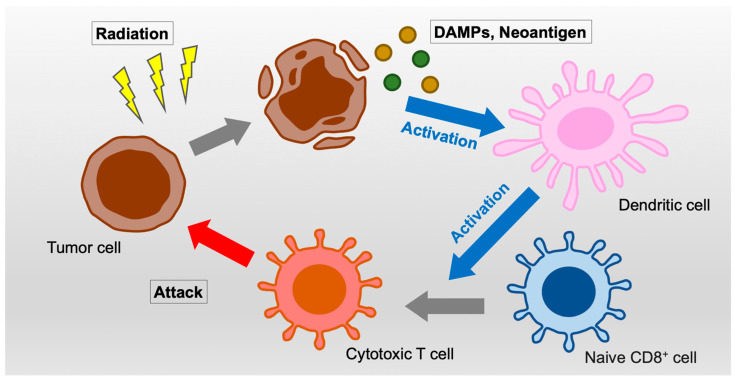
Lung cancer is a leading cause of cancer-related deaths worldwide despite advances in treatment. In the past few decades, radiotherapy has achieved outstanding technical advances and is being widely used as a definitive, prophylactic, or palliative treatment of patients with lung cancer. The anti-tumor effects of radiotherapy are considered to result in DNA damage in cancer cells. Moreover, recent evidence has demonstrated another advantage of radiotherapy: the induction of anti-tumor immune responses, which play an essential role in cancer control. In contrast, radiotherapy induces an immunosuppressive response. These conflicting reactions after radiotherapy suggest that maximizing immune response to radiotherapy by combining immunotherapy has potential to achieve more effective anti-tumor response than using each alone. Immune checkpoint molecules, such as cytotoxic T-lymphocyte-associated protein 4, programmed cell death-1/programmed death-ligand 1, and their inhibitors, have attracted significant attention for overcoming the immunosuppressive conditions in patients with cancer. Therefore, the combination of immune checkpoint inhibitors and radiotherapy is promising. Emerging preclinical and clinical studies have demonstrated the rationale for these combination strategies. In this review, we outlined evidence suggesting that combination of radiotherapy, including particle therapy using protons and carbon ions, with immunotherapy in lung cancer treatment could be a promising treatment strategy.
尽管治疗方面取得了进展,但肺癌仍是全球癌症相关死亡的主要原因。在过去几十年中,放射治疗在技术上取得了显著进展,并被广泛用作肺癌患者的根治性、预防性或姑息性治疗。放射治疗的抗肿瘤作用被认为是导致癌细胞DNA损伤。此外,最近的证据表明放射治疗还有另一个优势:诱导抗肿瘤免疫反应,这在癌症控制中起着至关重要的作用。相比之下,放射治疗会诱导免疫抑制反应。放射治疗后这些相互矛盾的反应表明,通过联合免疫疗法最大化对放射治疗的免疫反应有可能比单独使用每种疗法实现更有效的抗肿瘤反应。免疫检查点分子,如细胞毒性T淋巴细胞相关蛋白4、程序性细胞死亡蛋白1/程序性死亡配体1及其抑制剂,因克服癌症患者的免疫抑制状态而备受关注。因此,免疫检查点抑制剂与放射治疗的联合应用前景广阔。新出现的临床前和临床研究已经证明了这些联合策略的合理性。在本综述中,我们概述了证据,表明包括质子和碳离子粒子治疗在内的放射治疗与免疫疗法联合用于肺癌治疗可能是一种有前景的治疗策略。