Uttl Libor, Hložek Tomáš, Mareš Pavel, Páleníček Tomáš, Kubová Hana
Department of Experimental Neurobiology, National Institute of Mental Health, Klecany, Topolová 748, 250 67 Klecany, Czech Republic.
Laboratory of Developmental Epileptology, Institute of Physiology, Czech Academy of Sciences, Vídeňská 1083, 142 20 Prague, Czech Republic.
Int J Mol Sci. 2021 Dec 22;23(1):94. doi: 10.3390/ijms23010094.
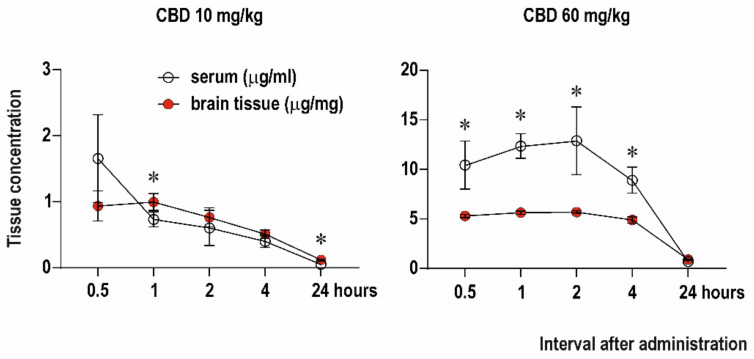
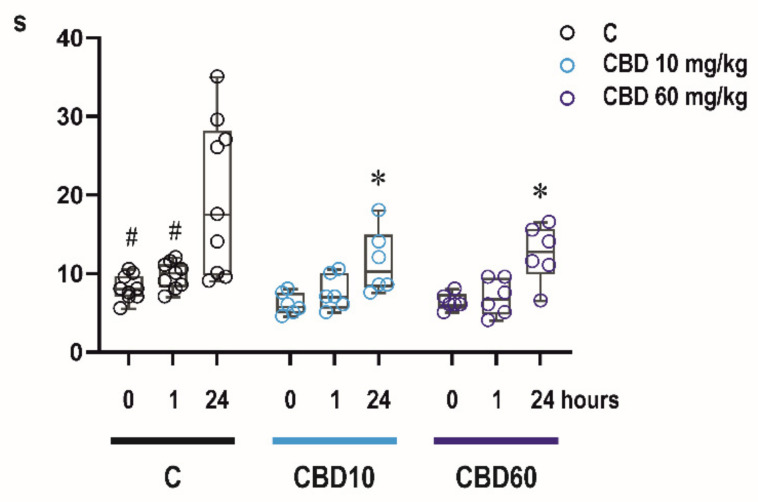
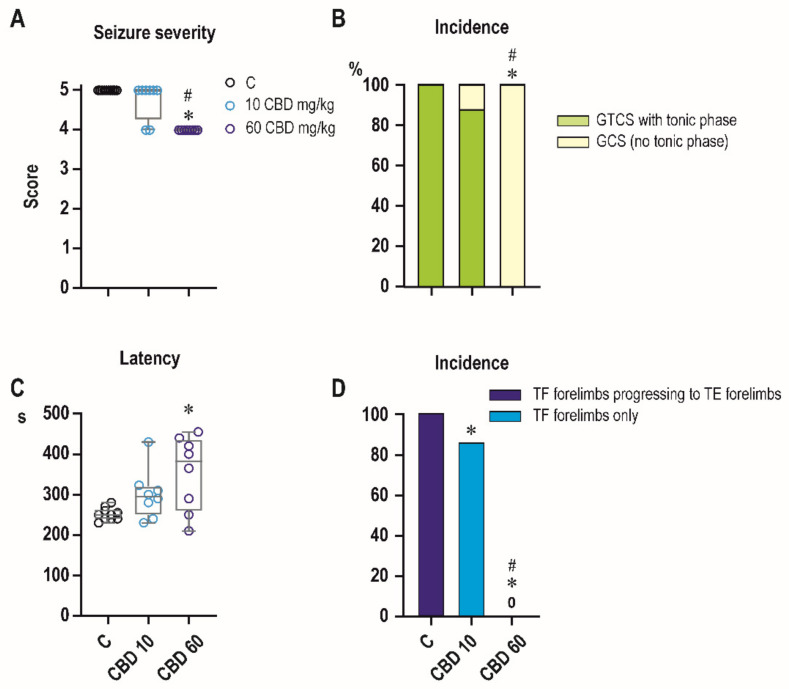
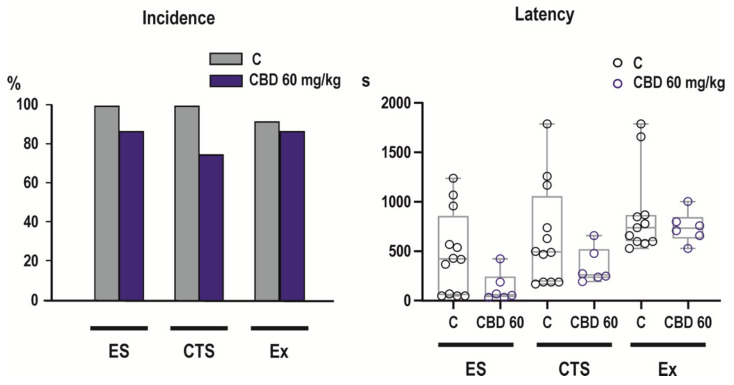
In spite of use of cannabidiol (CBD), a non-psychoactive cannabinoid, in pediatric patients with epilepsy, preclinical studies on its effects in immature animals are very limited. In the present study we investigated anti-seizure activity of CBD (10 and 60 mg/kg administered intraperitoneally) in two models of chemically induced seizures in infantile (12-days old) rats. Seizures were induced either with pentylenetetrazol (PTZ) or N-methyl-D-aspartate (NMDA). In parallel, brain and plasma levels of CBD and possible motor adverse effects were assessed in the righting reflex and the bar holding tests. CBD was ineffective against NMDA-induced seizures, but in a dose 60 mg/kg abolished the tonic phase of PTZ-induced generalized seizures. Plasma and brain levels of CBD were determined up to 24 h after administration. Peak CBD levels in the brain (996 ± 128 and 5689 ± 150 ng/g after the 10- and 60-mg/kg doses, respectively) were reached 1-2 h after administration and were still detectable 24 h later (120 ± 12 and 904 ± 63 ng/g, respectively). None of the doses negatively affected motor performance within 1 h after administration, but CBD in both doses blocked improvement in the bar holding test with repeated exposure to this task. Taken together, anti-seizure activity of CBD in infantile animals is dose and model dependent, and at therapeutic doses CBD does not cause motor impairment. The potential risk of CBD for motor learning seen in repeated motor tests has to be further examined.
尽管已将非精神活性大麻素大麻二酚(CBD)用于癫痫患儿,但关于其对未成熟动物影响的临床前研究非常有限。在本研究中,我们在两种化学诱导癫痫发作的模型中,研究了腹腔注射CBD(10和60mg/kg)对幼龄(12日龄)大鼠的抗癫痫活性。癫痫发作分别由戊四氮(PTZ)或N-甲基-D-天冬氨酸(NMDA)诱导。同时,在翻正反射和握杆试验中评估了CBD的脑和血浆水平以及可能的运动不良反应。CBD对NMDA诱导的癫痫发作无效,但60mg/kg的剂量可消除PTZ诱导的全身性癫痫发作的强直期。给药后长达24小时测定了CBD的血浆和脑水平。给药后1-2小时达到脑中CBD的峰值水平(10mg/kg和60mg/kg剂量后分别为996±128和5689±150ng/g),24小时后仍可检测到(分别为120±12和904±63ng/g)。给药后1小时内,各剂量均未对运动性能产生负面影响,但两种剂量的CBD在重复进行握杆试验时均阻碍了运动能力的改善。综上所述,CBD在幼龄动物中的抗癫痫活性具有剂量和模型依赖性,在治疗剂量下CBD不会导致运动障碍。在重复运动试验中观察到的CBD对运动学习的潜在风险有待进一步研究。