Wu Qiong, Berglund Anders E, MacAulay Robert J, Etame Arnold B
Department of Neuro-Oncology, H. Lee Moffitt Cancer Center and Research Institute, Tampa, FL 33612, USA.
Department of Biostatistics and Bioinformatics, H. Lee Moffitt Cancer Center and Research Institute, Tampa, FL 33612, USA.
Int J Mol Sci. 2021 Dec 28;23(1):297. doi: 10.3390/ijms23010297.
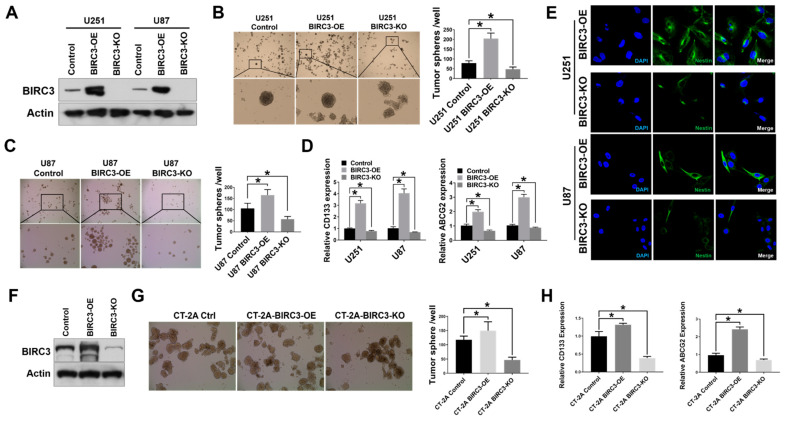
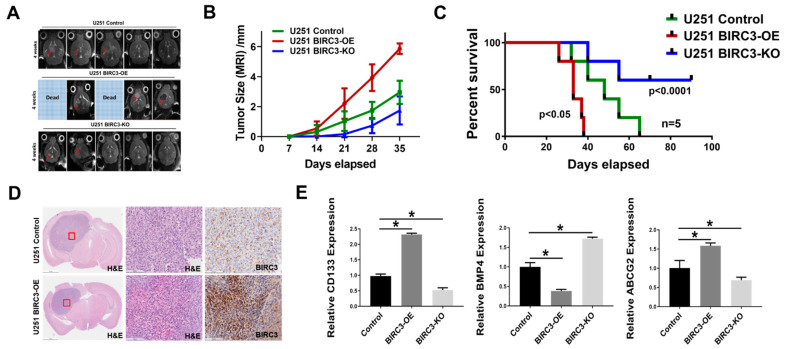
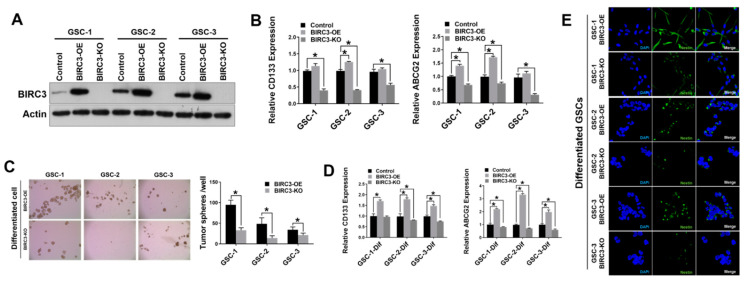
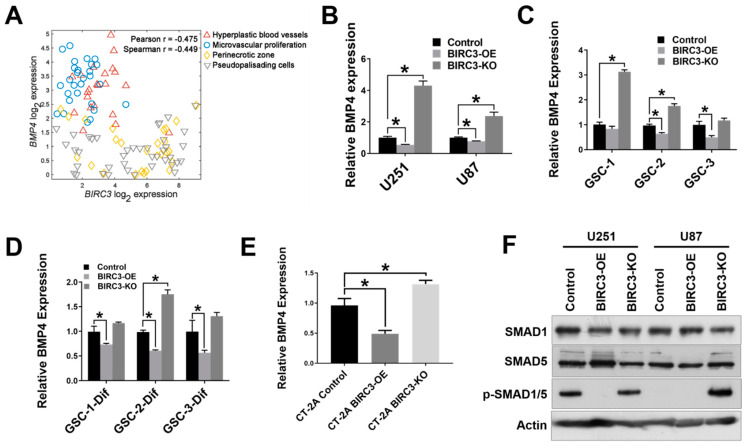
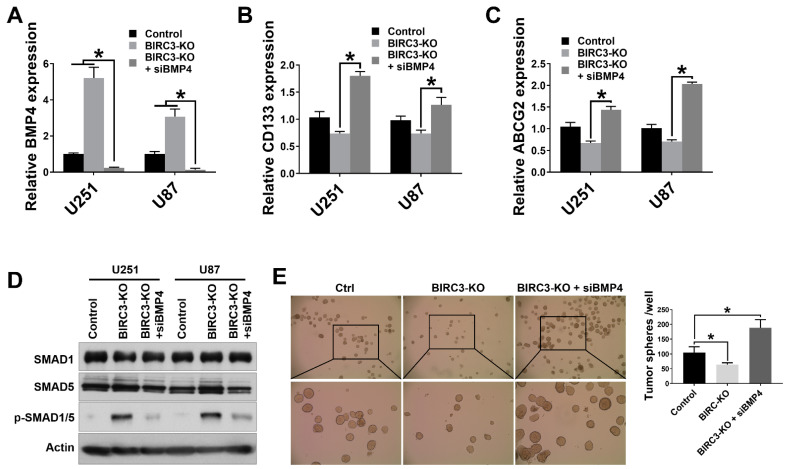
Stemness reprogramming remains a largely unaddressed principal cause of lethality in glioblastoma (GBM). It is therefore of utmost importance to identify and target mechanisms that are essential for GBM stemness and self-renewal. Previously, we implicated BIRC3 as an essential mediator of therapeutic resistance and survival adaptation in GBM. In this study, we present novel evidence that BIRC3 has an essential noncanonical role in GBM self-renewal and stemness reprogramming. We demonstrate that BIRC3 drives stemness reprogramming of human GBM cell lines, mouse GBM cell lines and patient-derived GBM stem cells (GSCs) through regulation of BMP4 signaling axis. Specifically, BIRC3 induces stemness reprogramming in GBM through downstream inactivation of BMP4 signaling. RNA-Seq interrogation of the stemness reprogramming hypoxic (pseudopalisading necrosis and perinecrosis) niche in GBM patient tissues further validated the high BIRC3/low BMP4 expression correlation. BIRC3 knockout upregulated BMP4 expression and prevented stemness reprogramming of GBM models. Furthermore, siRNA silencing of BMP4 restored stemness reprogramming of BIRC3 knockout in GBM models. In vivo silencing of BIRC3 suppressed tumor initiation and progression in GBM orthotopic intracranial xenografts. The stemness reprograming of both GSCs and non-GSCs populations highlights the impact of BIRC3 on intra-tumoral cellular heterogeneity GBM. Our study has identified a novel function of BIRC3 that can be targeted to reverse stemness programming of GBM.
干性重编程仍然是胶质母细胞瘤(GBM)致死率的一个主要未解决的关键原因。因此,识别并靶向对GBM干性和自我更新至关重要的机制至关重要。此前,我们发现BIRC3是GBM治疗耐药性和生存适应性的关键介质。在本研究中,我们提供了新的证据,表明BIRC3在GBM自我更新和干性重编程中具有重要的非经典作用。我们证明,BIRC3通过调节BMP4信号轴驱动人GBM细胞系、小鼠GBM细胞系和患者来源的GBM干细胞(GSCs)的干性重编程。具体而言,BIRC3通过BMP4信号的下游失活诱导GBM中的干性重编程。对GBM患者组织中干性重编程缺氧(假栅栏状坏死和周边坏死)微环境的RNA测序进一步验证了BIRC3高表达与BMP4低表达的相关性。BIRC3基因敲除上调了BMP4表达,并阻止了GBM模型的干性重编程。此外,BMP4的siRNA沉默恢复了GBM模型中BIRC3基因敲除后的干性重编程。在体内沉默BIRC3可抑制GBM原位颅内异种移植瘤的起始和进展。GSCs和非GSCs群体的干性重编程突出了BIRC3对GBM肿瘤内细胞异质性的影响。我们的研究确定了BIRC3的一种新功能,可将其作为靶点来逆转GBM的干性编程。