Authors' Affiliations: Hugo W. Moser Research Institute at Kennedy Krieger; Departments of Neurology, Neuroscience, Oncology, Neurosurgery, and Pathology, Johns Hopkins School of Medicine; Epidemiology, Johns Hopkins Bloomberg School of Public Health, Baltimore, Maryland; and Department of Biostatistics and Bioinformatics, Rollins School of Public Health, Emory University, Atlanta, GeorgiaAuthors' Affiliations: Hugo W. Moser Research Institute at Kennedy Krieger; Departments of Neurology, Neuroscience, Oncology, Neurosurgery, and Pathology, Johns Hopkins School of Medicine; Epidemiology, Johns Hopkins Bloomberg School of Public Health, Baltimore, Maryland; and Department of Biostatistics and Bioinformatics, Rollins School of Public Health, Emory University, Atlanta, Georgia.
Authors' Affiliations: Hugo W. Moser Research Institute at Kennedy Krieger; Departments of Neurology, Neuroscience, Oncology, Neurosurgery, and Pathology, Johns Hopkins School of Medicine; Epidemiology, Johns Hopkins Bloomberg School of Public Health, Baltimore, Maryland; and Department of Biostatistics and Bioinformatics, Rollins School of Public Health, Emory University, Atlanta, Georgia.
Cancer Res. 2014 Jun 1;74(11):3168-79. doi: 10.1158/0008-5472.CAN-13-2103. Epub 2014 Apr 7.
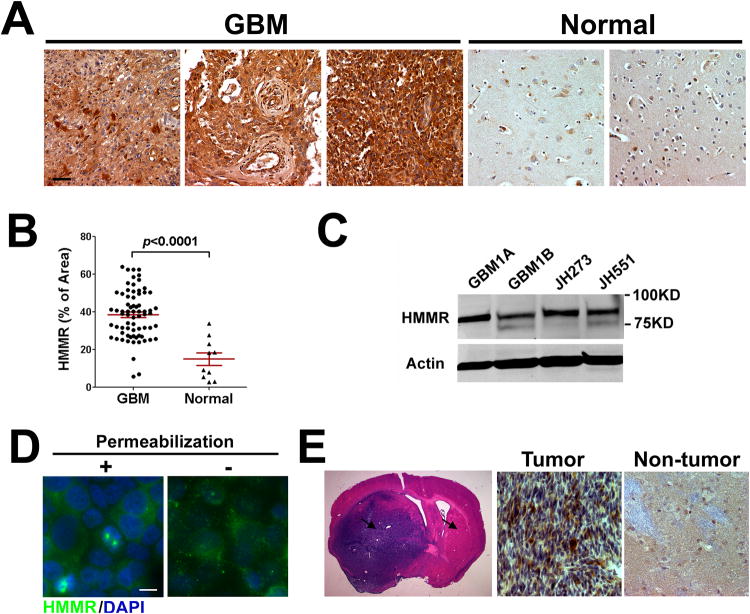
Glioblastoma (GBM) stem cells (GSC) are a subpopulation of tumor cells that display stem-like characteristics (stemness) and play unique roles in tumor propagation, therapeutic resistance, and tumor recurrence. Therapeutic targets in GSCs are a focus of increasing interest to improve GBM therapy. Here we report that the hyaluronan-mediated motility receptor (HMMR) is highly expressed in GBM tumors, where it supports the self-renewal and tumorigenic potential of GSCs. HMMR silencing impairs GSC self-renewal and inhibits the expression of GSC markers and regulators. Furthermore, HMMR silencing suppresses GSC-derived tumor growth and extends the survival of mice bearing GSC xenografts. Conversely, HMMR overexpression promotes GSC self-renewal and intracranial tumor propagation. In human GBM tumor specimens, HMMR expression is correlated positively with the expression of stemness-associated markers and regulators. Our findings identify HMMR as a candidate therapeutic target to GSCs as a GBM treatment strategy.
胶质母细胞瘤(GBM)干细胞(GSC)是肿瘤细胞的一个亚群,具有干细胞样特征(干性),在肿瘤增殖、治疗抵抗和肿瘤复发中发挥独特作用。GSC 中的治疗靶点是提高 GBM 治疗效果的研究重点。在这里,我们报告透明质酸介导的运动受体(HMMR)在 GBM 肿瘤中高度表达,它支持 GSC 的自我更新和肿瘤发生潜能。HMMR 沉默会损害 GSC 的自我更新,并抑制 GSC 标志物和调节因子的表达。此外,HMMR 沉默抑制 GSC 衍生的肿瘤生长并延长携带 GSC 异种移植物的小鼠的存活时间。相反,HMMR 过表达促进 GSC 的自我更新和颅内肿瘤的传播。在人类 GBM 肿瘤标本中,HMMR 的表达与干性相关标志物和调节因子的表达呈正相关。我们的研究结果将 HMMR 确定为 GBM 治疗策略中 GSC 的候选治疗靶点。