Key Laboratory of Aerospace Medicine of the Ministry of Education, School of Aerospace Medicine, Air Force Military Medical University, Xi'an 710032, China.
Int J Mol Sci. 2021 Dec 28;23(1):327. doi: 10.3390/ijms23010327.
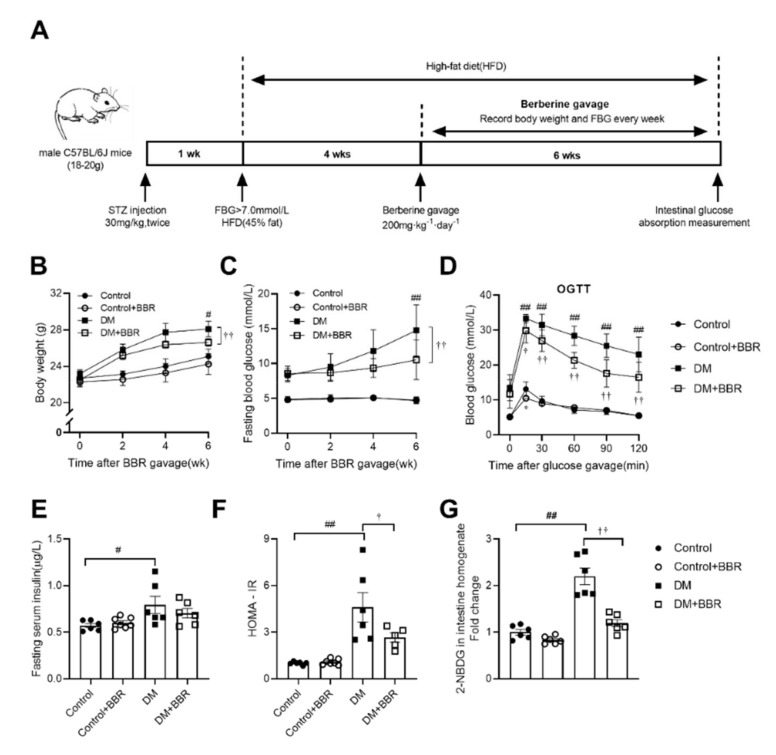
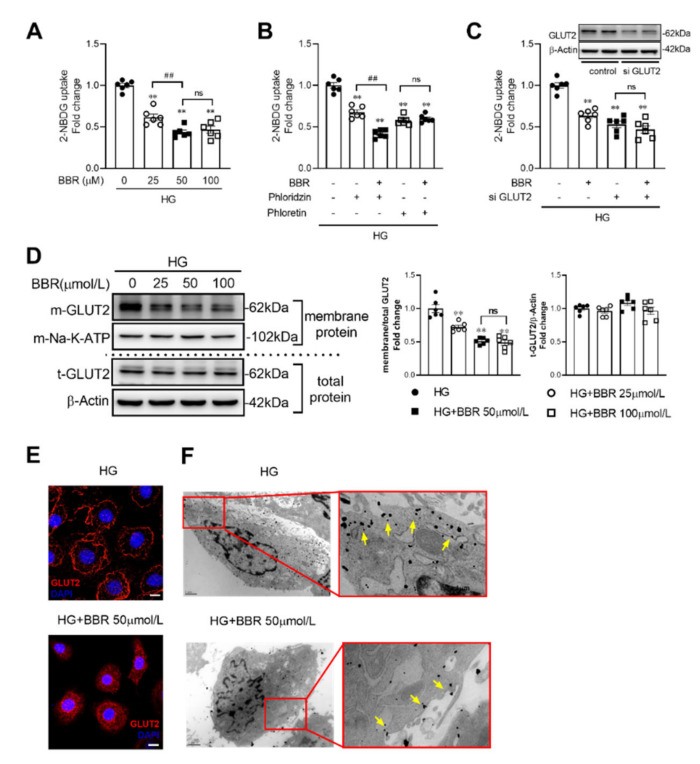
Postprandial hyperglycemia is an important causative factor of type 2 diabetes mellitus, and permanent localization of intestinal GLUT2 in the brush border membrane is an important reason of postprandial hyperglycemia. Berberine, a small molecule derived from Coptidis rhizome, has been found to be potent at lowering blood glucose, but how berberine lowers postprandial blood glucose is still elusive. Here, we investigated the effect of berberine on intestinal glucose transporter 2 (GLUT2) translocation and intestinal glucose absorption in type 2 diabetes mouse model. Type 2 diabetes was induced by feeding of a high-fat diet and injection of streptozotocin and diabetic mice were treated with berberine for 6 weeks. The effects of berberine on intestinal glucose transport and GLUT2 translocation were accessed in isolated intestines and intestinal epithelial cells (IEC-6), respectively. We found that berberine treatment improved glucose tolerance and systemic insulin sensitivity in diabetic mice. Furthermore, berberine decreased intestinal glucose transport and inhibited GLUT2 translocation from cytoplasm to brush border membrane in intestinal epithelial cells. Mechanistically, berberine inhibited intestinal insulin-like growth factor 1 (IGF-1R) phosphorylation and thus reduced localization of PLC-β2 in the membrane, leading to decreased GLUT2 translocation. These results suggest that berberine reduces intestinal glucose absorption through inhibiting IGF-1R-PLC-β2-GLUT2 signal pathway.
餐后高血糖是 2 型糖尿病的一个重要致病因素,而肠道 GLUT2 永久性定位于刷状缘膜是餐后高血糖的一个重要原因。小檗碱是从小檗属植物根茎中提取的一种小分子,已被发现具有很强的降血糖作用,但小檗碱如何降低餐后血糖仍不清楚。在这里,我们研究了小檗碱对 2 型糖尿病小鼠模型肠道葡萄糖转运体 2(GLUT2)易位和肠道葡萄糖吸收的影响。通过高脂饮食喂养和链脲佐菌素注射诱导 2 型糖尿病,并用小檗碱治疗糖尿病小鼠 6 周。分别在分离的肠和肠上皮细胞(IEC-6)中评估小檗碱对肠道葡萄糖转运和 GLUT2 易位的影响。我们发现小檗碱治疗可改善糖尿病小鼠的葡萄糖耐量和全身胰岛素敏感性。此外,小檗碱可降低肠内葡萄糖转运,并抑制肠上皮细胞中 GLUT2 从细胞质向刷状缘膜的易位。在机制上,小檗碱通过抑制肠道胰岛素样生长因子 1(IGF-1R)磷酸化,从而减少 PLC-β2 在膜中的定位,导致 GLUT2 易位减少。这些结果表明,小檗碱通过抑制 IGF-1R-PLC-β2-GLUT2 信号通路来减少肠道葡萄糖吸收。