Department of Applied Biology, College of Sciences, University of Sharjah, Sharjah 27272, United Arab Emirates.
Human Genetics & Stem Cells Research Group, Research Institute of Sciences & Engineering, University of Sharjah, Sharjah 27272, United Arab Emirates.
Int J Mol Sci. 2021 Dec 29;23(1):337. doi: 10.3390/ijms23010337.
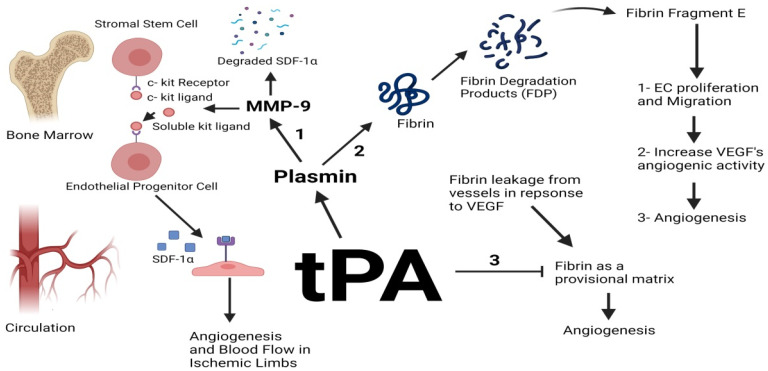
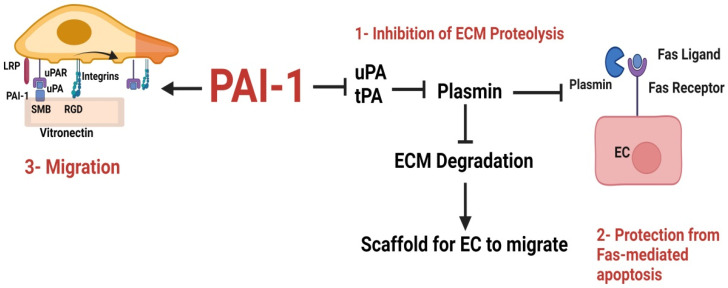
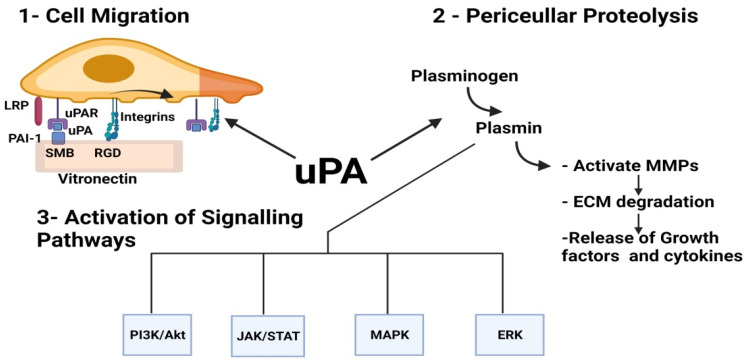
Angiogenesis is a process associated with the migration and proliferation of endothelial cells (EC) to form new blood vessels. It is involved in various physiological and pathophysiological conditions and is controlled by a wide range of proangiogenic and antiangiogenic molecules. The plasminogen activator-plasmin system plays a major role in the extracellular matrix remodeling process necessary for angiogenesis. Urokinase/tissue-type plasminogen activators (uPA/tPA) convert plasminogen into the active enzyme plasmin, which in turn activates matrix metalloproteinases and degrades the extracellular matrix releasing growth factors and proangiogenic molecules such as the vascular endothelial growth factor (VEGF-A). The plasminogen activator inhibitor-1 (PAI-1) is the main inhibitor of uPA and tPA, thereby an inhibitor of pericellular proteolysis and intravascular fibrinolysis, respectively. Paradoxically, PAI-1, which is expressed by EC during angiogenesis, is elevated in several cancers and is found to promote angiogenesis by regulating plasmin-mediated proteolysis and by promoting cellular migration through vitronectin. The urokinase-type plasminogen activator receptor (uPAR) also induces EC cellular migration during angiogenesis via interacting with signaling partners. Understanding the molecular functions of the plasminogen activator plasmin system and targeting angiogenesis via blocking serine proteases or their interactions with other molecules is one of the major therapeutic strategies scientists have been attracted to in controlling tumor growth and other pathological conditions characterized by neovascularization.
血管生成是一种与内皮细胞(EC)迁移和增殖形成新血管相关的过程。它涉及到各种生理和病理生理条件,并受到广泛的促血管生成和抗血管生成分子的控制。纤溶酶原激活物-纤溶酶系统在血管生成所需的细胞外基质重塑过程中起主要作用。尿激酶/组织型纤溶酶原激活物(uPA/tPA)将纤溶酶原转化为活性酶纤溶酶,纤溶酶又激活基质金属蛋白酶并降解细胞外基质,释放生长因子和促血管生成分子,如血管内皮生长因子(VEGF-A)。纤溶酶原激活物抑制剂-1(PAI-1)是 uPA 和 tPA 的主要抑制剂,因此分别是细胞周蛋白酶解和血管内纤维蛋白溶解的抑制剂。矛盾的是,在血管生成过程中由 EC 表达的 PAI-1 在几种癌症中升高,并通过调节纤溶酶介导的蛋白水解和通过与 vitronectin 一起促进细胞迁移来促进血管生成。尿激酶型纤溶酶原激活物受体(uPAR)也通过与信号伴侣相互作用诱导血管生成期间的 EC 细胞迁移。了解纤溶酶原激活物-纤溶酶系统的分子功能,并通过阻断丝氨酸蛋白酶或其与其他分子的相互作用来靶向血管生成,是科学家们吸引注意力的主要治疗策略之一,旨在控制肿瘤生长和其他以新生血管化为特征的病理状况。