Department of Public Health Sciences, Clemson University, Clemson, SC 29631, USA.
Department of Bioengineering, Clemson University, Clemson, SC 29631, USA.
Int J Environ Res Public Health. 2021 Dec 28;19(1):285. doi: 10.3390/ijerph19010285.
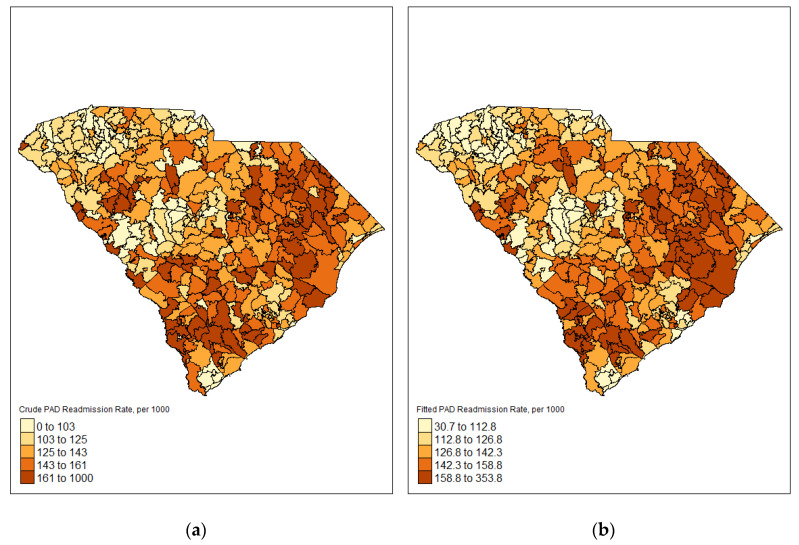
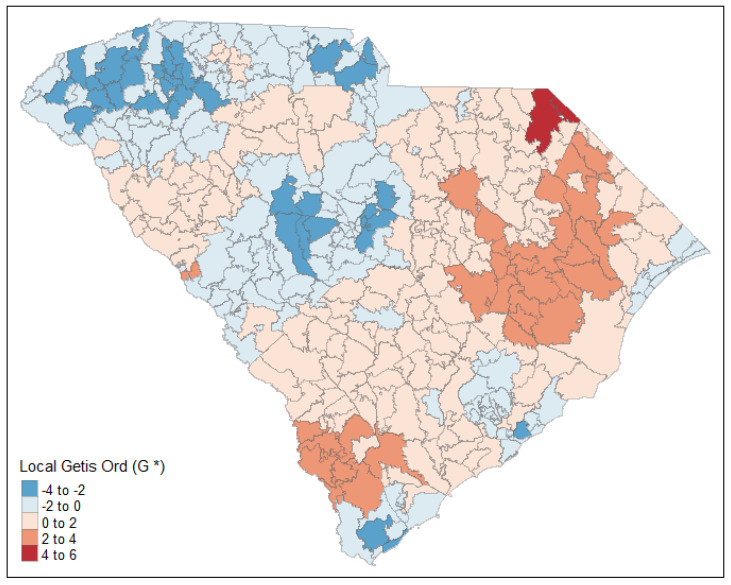
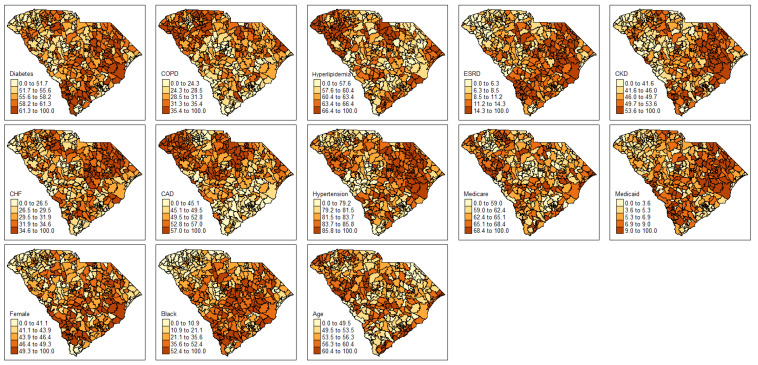
Readmissions constitute a major health care burden among peripheral artery disease (PAD) patients. This study aimed to 1) estimate the zip code tabulation area (ZCTA)-level prevalence of readmission among PAD patients and characterize the effect of covariates on readmissions; and (2) identify hotspots of PAD based on estimated prevalence of readmission. Thirty-day readmissions among PAD patients were identified from the South Carolina Revenue and Fiscal Affairs Office All Payers Database (2010-2018). Bayesian spatial hierarchical modeling was conducted to identify areas of high risk, while controlling for confounders. We mapped the estimated readmission rates and identified hotspots using local Getis Ord (G*) statistics. Of the 232,731 individuals admitted to a hospital or outpatient surgery facility with PAD diagnosis, 30,366 (13.1%) experienced an unplanned readmission to a hospital within 30 days. Fitted readmission rates ranged from 35.3 per 1000 patients to 370.7 per 1000 patients and the risk of having a readmission was significantly associated with the percentage of patients who are 65 and older (0.992, 95%CI: 0.985-0.999), have Medicare insurance (1.013, 1.005-1.020), and have hypertension (1.014, 1.005-1.023). Geographic analysis found significant variation in readmission rates across the state and identified priority areas for targeted interventions to reduce readmissions.
再入院是外周动脉疾病(PAD)患者的主要医疗负担。本研究旨在:1)估计 PAD 患者的邮政编码区(ZCTA)再入院率,并描述协变量对再入院的影响;2)基于再入院估计率识别 PAD 的热点地区。从南卡罗来纳州收入和财政事务办公室所有支付者数据库(2010-2018 年)中确定了 PAD 患者的 30 天再入院情况。采用贝叶斯空间层次模型来识别高风险区域,同时控制混杂因素。我们绘制了估计的再入院率图,并使用局部 Getis Ord(G*)统计数据确定了热点地区。在 232731 名因 PAD 诊断而住院或门诊手术的患者中,有 30366 名(13.1%)在 30 天内计划外再次入院。拟合的再入院率范围从每 1000 名患者 35.3 例到每 1000 名患者 370.7 例,再入院的风险与 65 岁及以上患者的比例(0.992,95%CI:0.985-0.999)、拥有医疗保险(1.013,1.005-1.020)和患有高血压(1.014,1.005-1.023)显著相关。地理分析发现全州范围内再入院率存在显著差异,并确定了重点干预以减少再入院的优先领域。