Departamento de Enfermería Farmacología y Fisioterapia, Facultad de Medicina y Enfermería, Universidad de Córdoba, 14004 Córdoba, Spain.
Metabolism and Investigation Unit, Maimonides Biomedical Research Institute of Cordoba (IMIBIC), Reina Sofia University Hospital, University of Cordoba, 14004 Córdoba, Spain.
Int J Environ Res Public Health. 2022 Jan 1;19(1):471. doi: 10.3390/ijerph19010471.
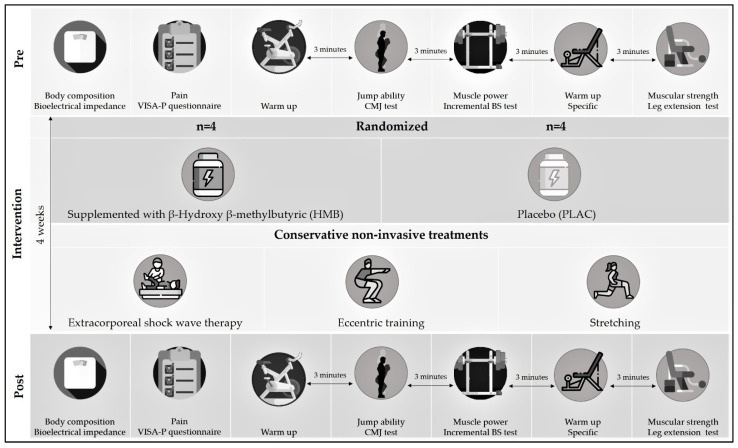
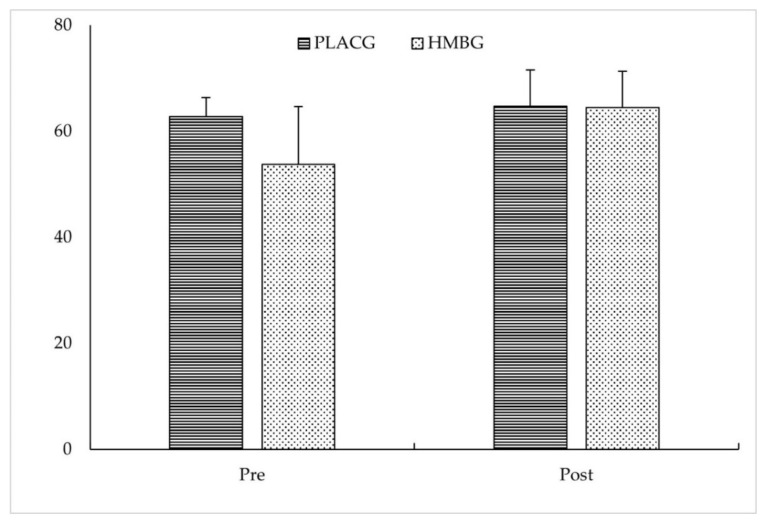
The aim of the present study was to analyze the effect of conservative non-invasive treatments based on eccentric training, stretching and extracorporeal shock wave therapy (ESWT) supplemented with β-Hydroxy β-methylbutyric (HMB) or placebo (PLAC) on body composition, pain and muscular function (jump ability, muscular power and muscular strength) in athletes with patellar tendinopathy (PT). In a double-blind randomized trial, 8 athletes (4 males and 4 females) performed a physical rehabilitation for 4 weeks. They were randomly divided into two experimental groups (two males and two females in each one) that ingested HMB (HMBG) or PLAC (PLACG). In pre- and post-intervention were assessed body composition, pain, countermovement jump (CMJ), back-squat (BS) for analyzing peak power (W) (PP), load (kg) associated to PP (PP) and mean velocity (m/s) (PP) in addition to a 5-RM leg extension tests. An interaction intervention·supplementation ( = 0.049; Ƞ = 0.774) was observed in the height reached in the CMJ as an intervention effect in PPPP detected for the HMBG ( = 0.049). In addition, an enhancement in PPKG ( = 0.028; Ƞ = 0.842) was detected in the intervention, but not in PPMV, as an increase in the intervention in the 5-RM test ( = 0.001; Ƞ = 0.981) was observed. No changes were noted on body composition or pain ( > 0.05). The combination of eccentric training with stretching and ESWT increased concentric muscular power and strength after 4 weeks without changes in body lean mass or pain. In addition, HMB supplementation could enhance the power muscular performance in athletes with PT, optimizing the intervention adaptions.
本研究旨在分析基于离心训练、伸展和体外冲击波疗法(ESWT)的保守非侵入性治疗,辅以 β-羟基-β-甲基丁酸(HMB)或安慰剂(PLAC)对髌腱病(PT)运动员的身体成分、疼痛和肌肉功能(跳跃能力、肌肉力量和肌肉力量)的影响。在一项双盲随机试验中,8 名运动员(4 名男性和 4 名女性)进行了为期 4 周的身体康复。他们被随机分为两组(每组 2 名男性和 2 名女性),分别服用 HMB(HMBG)或 PLAC(PLACG)。在干预前后评估了身体成分、疼痛、反向跳跃(CMJ)、深蹲(BS)以分析峰值功率(W)(PP)、与 PP 相关的负荷(kg)(PP)和平均速度(m/s)(PP),以及 5-RM 腿部伸展测试。在 CMJ 中达到的高度观察到干预-补充的相互作用( = 0.049; Ƞ = 0.774),作为 HMBG 的干预效果( = 0.049)检测到 PPP 升高。此外,在干预中检测到 PPKG( = 0.028; Ƞ = 0.842)增强,但在 PPMV 中没有增强,因为在 5-RM 测试中观察到干预的增加( = 0.001; Ƞ = 0.981)。身体成分或疼痛无变化( > 0.05)。在 4 周后,离心训练与伸展和 ESWT 的结合增加了向心肌肉力量和力量,而身体瘦质量或疼痛没有变化。此外,HMB 补充可以增强 PT 运动员的肌肉力量表现,优化干预适应。