Exercise and Performance Nutrition Laboratory, School of Health Sciences, College of Science, Technology, and Health, Lindenwood University, St. Charles, MO 63301, USA.
Nutrients. 2021 Dec 28;14(1):124. doi: 10.3390/nu14010124.
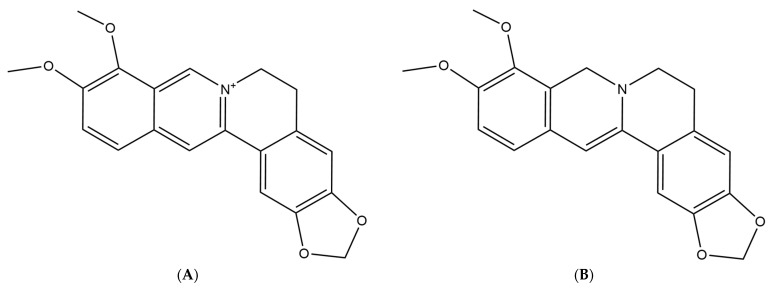
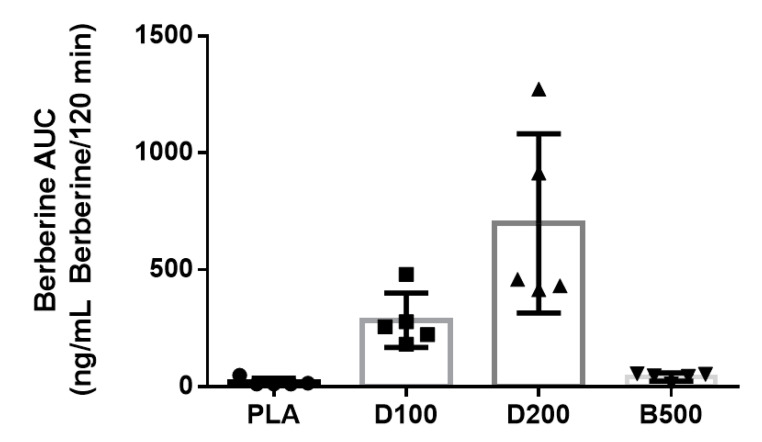
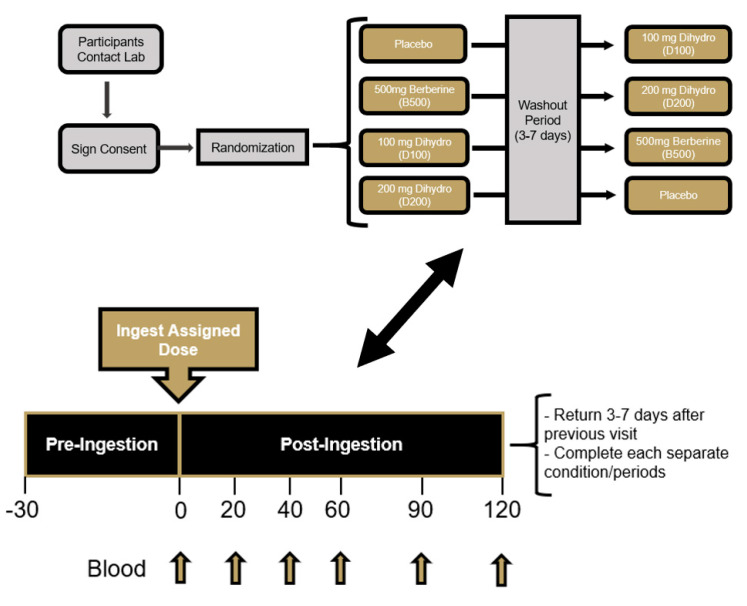
Berberine is a natural alkaloid used to improve glycemia but displays poor bioavailability and increased rates of gastrointestinal distress at higher doses. Recently, dihydroberberine has been developed to combat these challenges. This study was designed to determine the rate and extent to which berberine appeared in human plasma after oral ingestion of a 500 mg dose of berberine (B500) or 100 mg and 200 mg doses of dihydroberberine (D100 and D200). In a randomized, double-blind, crossover fashion, five males (26 ± 2.6 years; 184.2 ± 11.6 cm; 91.8 ± 10.1 kg; 17.1 ± 3.5% fat) completed a four-dose supplementation protocol of placebo (PLA), B500, D100, and D200. The day prior to their scheduled visit, participants ingested three separate doses with breakfast, lunch, and dinner. Participants fasted overnight (8-10 h) and consumed their fourth dose with a standardized test meal (30 g glucose solution, 3 slices white bread) after arrival. Venous blood samples were collected 0, 20, 40, 60, 90, and 120 minutes (min) after ingestion and analyzed for BBR, glucose, and insulin. Peak concentration (C) and area under the curve (AUC) were calculated for all variables. Baseline berberine levels were different between groups ( = 0.006), with pairwise comparisons indicating that baseline levels of PLA and B500 were different than D100. Berberine C tended to be different ( = 0.06) between all conditions. Specifically, the observed C for D100 (3.76 ± 1.4 ng/mL) was different than PLA (0.22 ± 0.18 ng/mL, = 0.005) and B500 (0.4 ± 0.17 ng/mL, = 0.005). C for D200 (12.0 ± 10.1 ng/mL) tended ( = 0.06) to be different than B500. No difference in C was found between D100 and D200 ( = 0.11). Significant differences in berberine AUC were found between D100 (284.4 ± 115.9 ng/mL × 120 min) and PLA (20.2 ± 16.2 ng/mL × 120 min, = 0.007) and between D100 and B500 (42.3 ± 17.6 ng/mL × 120 min, = 0.04). Significant differences in D100 BBR AUC (284.4 ± 115.9 ng/mL×120 min) were found between PLA (20.2 ± 16.2 ng/mL × 120 min, = 0.042) and B500 (42.3 ± 17.6 ng/mL × 120 min, = 0.045). Berberine AUC values between D100 and D200 tended ( = 0.073) to be different. No significant differences in the levels of glucose ( = 0.97) and insulin ( = 0.24) were observed across the study protocol. These results provide preliminary evidence that four doses of a 100 mg dose of dihydroberberine and 200 mg dose of dihydroberberine produce significantly greater concentrations of plasma berberine across of two-hour measurement window when compared to a 500 mg dose of berberine or a placebo. The lack of observed changes in glucose and insulin were likely due to the short duration of supplementation and insulin responsive nature of study participants. Follow-up efficacy studies on glucose and insulin changes should be completed to assess the impact of berberine and dihydroberberine supplementation in overweight, glucose intolerant populations.
小檗碱是一种天然生物碱,用于改善血糖,但在较高剂量下显示生物利用度差和胃肠道不适增加的趋势。最近,二氢小檗碱已被开发出来以应对这些挑战。本研究旨在确定口服 500 毫克剂量小檗碱(B500)或 100 毫克和 200 毫克剂量二氢小檗碱(D100 和 D200)后,小檗碱在人体血浆中的出现速度和程度。采用随机、双盲、交叉设计,5 名男性(26 ± 2.6 岁;184.2 ± 11.6 厘米;91.8 ± 10.1 千克;17.1 ± 3.5%脂肪)完成了四种补充剂方案的安慰剂(PLA)、B500、D100 和 D200 的补充。在预定访问的前一天,参与者在早餐、午餐和晚餐时分别服用三剂。参与者禁食过夜(8-10 小时),到达后服用第四剂,并与标准测试餐(30 克葡萄糖溶液、3 片白面包)一起服用。在摄入后 0、20、40、60、90 和 120 分钟(min)采集静脉血样,并分析 BBR、葡萄糖和胰岛素。计算所有变量的峰浓度(C)和曲线下面积(AUC)。各组间基线小檗碱水平不同( = 0.006),两两比较表明 PLA 和 B500 的基线水平与 D100 不同。小檗碱 C 趋于不同( = 0.06)。具体而言,D100 的观察到的 C(3.76 ± 1.4 ng/mL)与 PLA(0.22 ± 0.18 ng/mL, = 0.005)和 B500(0.4 ± 0.17 ng/mL, = 0.005)不同。D200 的 C(12.0 ± 10.1 ng/mL)趋于( = 0.06)与 B500 不同。D100 和 D200 之间的 C 没有差异( = 0.11)。在 D100 与 PLA(20.2 ± 16.2 ng/mL×120 min, = 0.007)和 D100 与 B500(42.3 ± 17.6 ng/mL×120 min, = 0.04)之间发现了显著的小檗碱 AUC 差异。在 D100 BBR AUC(284.4 ± 115.9 ng/mL×120 min)与 PLA(20.2 ± 16.2 ng/mL×120 min, = 0.042)和 B500(42.3 ± 17.6 ng/mL×120 min, = 0.045)之间发现了显著差异。D100 和 D200 之间的小檗碱 AUC 值趋于( = 0.073)不同。研究方案中未观察到葡萄糖( = 0.97)和胰岛素( = 0.24)水平的显著差异。这些结果提供了初步证据,表明与 500 毫克剂量的小檗碱或安慰剂相比,四剂 100 毫克剂量的二氢小檗碱和 200 毫克剂量的二氢小檗碱在两小时测量窗口内可产生明显更高的血浆小檗碱浓度。葡萄糖和胰岛素没有观察到变化可能是由于补充剂的持续时间短和研究参与者的胰岛素反应性。应完成葡萄糖和胰岛素变化的后续疗效研究,以评估超重、葡萄糖不耐受人群中小檗碱和二氢小檗碱补充的影响。