Kim Hyung Jun, Chung Jong-Won, Bang Oh Young, Cho Yeon Hee, Lim Yun Jeong, Hwang Jaechun, Seo Woo-Keun, Kim Gyeong-Moon, Kim Hee-Jin, Ahn Myung-Ju
Department of Neurology, Seoul Hospital, College of Medicine, Ewha Woman's University, Seoul 07804, Korea.
Department of Neurology, Samsung Medical Center, School of Medicine, Sungkyunkwan University, Seoul 06351, Korea.
J Clin Med. 2021 Dec 27;11(1):123. doi: 10.3390/jcm11010123.
The optimal strategy for stroke prevention in cancer patients is unknown. We compared the underlying mechanisms of coagulopathy and the effects of anticoagulants in patients with active cancer and atrial fibrillation (AF).
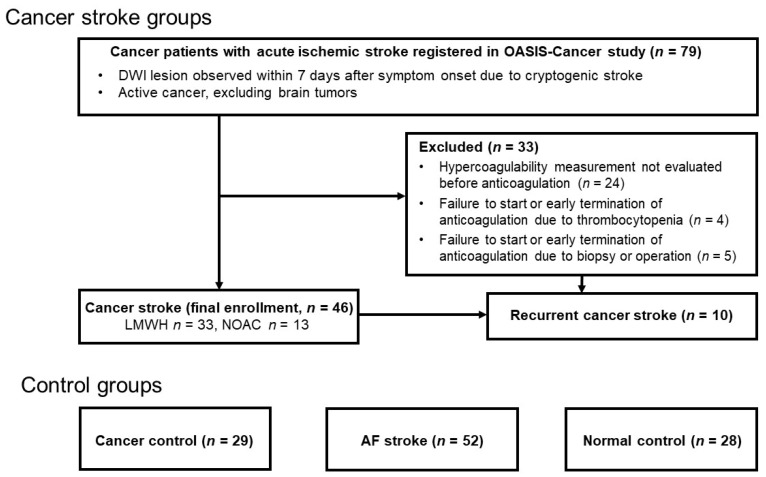
We retrospectively enrolled 46 consecutive patients with embolic stroke of unknown source and active cancer (cancer stroke). We consecutively screened patients with cancer patients without stroke ( = 29), AF stroke ( = 52), and healthy subjects ( = 28), which served as controls. Patients with cancer stroke were treated with either enoxaparin (a low-molecular-weight heparin) or a factor Xa inhibitor, and those with AF stroke were treated with factor Xa inhibitors. D-dimer, factor Xa, and circulating cell-free DNA (cfDNA), a marker of neutrophil extracellular traposis, were measured at both before and after anticoagulation.
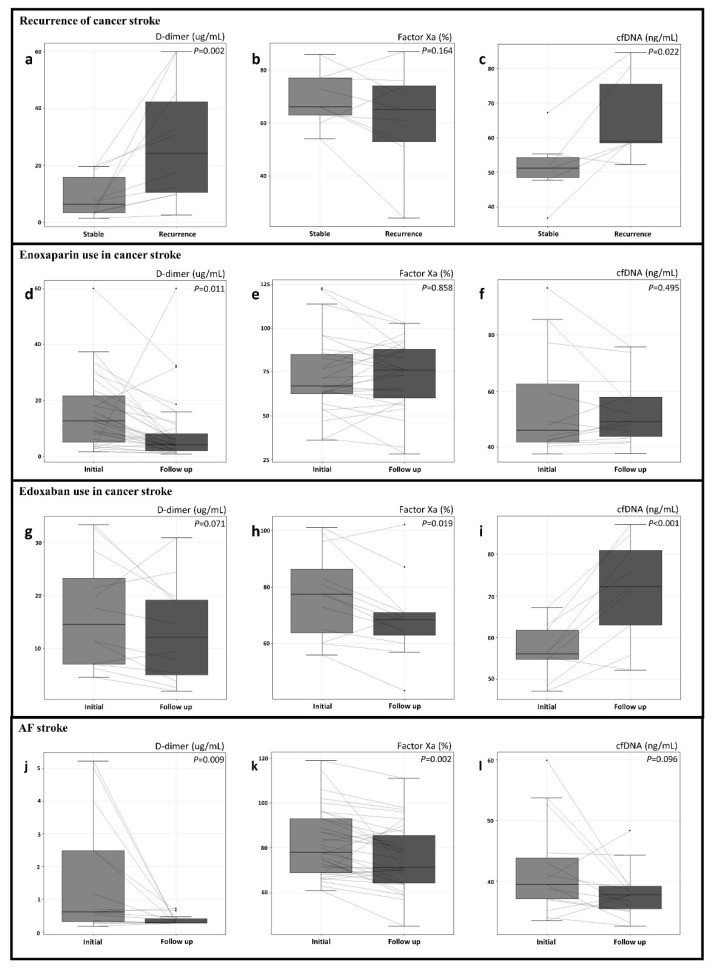
In AF stroke, factor Xa activity and cfDNA and D-dimer levels were decreased by treatment with factor Xa inhibitors. In contrast, in cancer stroke, factor Xa activity was decreased, D-dimer levels were unchanged, and cfDNA levels were increased by treatment with factor Xa inhibitors. In cancer stroke patients treated with enoxaparin, D-dimer levels were decreased ( = 0.011) and cfDNA levels were unchanged.
The anticoagulation effects of factor Xa inhibitors differed between cancer stroke and AF stroke.
癌症患者预防中风的最佳策略尚不清楚。我们比较了活动性癌症合并心房颤动(AF)患者凝血病的潜在机制及抗凝剂的作用。
我们回顾性纳入了46例连续的不明来源栓塞性中风且患有活动性癌症的患者(癌症中风患者)。我们连续筛选了无中风的癌症患者(n = 29)、AF中风患者(n = 52)和健康受试者(n = 28)作为对照。癌症中风患者接受依诺肝素(一种低分子肝素)或Xa因子抑制剂治疗,AF中风患者接受Xa因子抑制剂治疗。在抗凝前后测量D - 二聚体、Xa因子和循环游离DNA(cfDNA,中性粒细胞胞外诱捕的标志物)。
在AF中风中,Xa因子抑制剂治疗可降低Xa因子活性、cfDNA和D - 二聚体水平。相比之下,在癌症中风中,Xa因子抑制剂治疗可降低Xa因子活性,D - 二聚体水平不变,cfDNA水平升高。在接受依诺肝素治疗的癌症中风患者中,D - 二聚体水平降低(P = 0.011),cfDNA水平不变。
Xa因子抑制剂在癌症中风和AF中风中的抗凝作用不同。