Department of Orthopaedics, Mater Olbia Hospital, Olbia, Italy.
Università Cattolica del Sacro Cuore, Rome, Italy.
BMC Musculoskelet Disord. 2022 Jan 10;22(Suppl 2):1061. doi: 10.1186/s12891-021-04953-8.
Short-stem Hip Arthroplasty (SHA) are increasingly implanted in recent years thanks to their potential advantage in preserving metaphyseal bone-stock. Among them, the NANOS® short-stem implant demonstrated satisfactory results to short and mid-term. The purpose of this retrospective study was to evaluate the clinical and radiographic outcome of the Nanos® short stem at a minimum follow-up of 10 years.
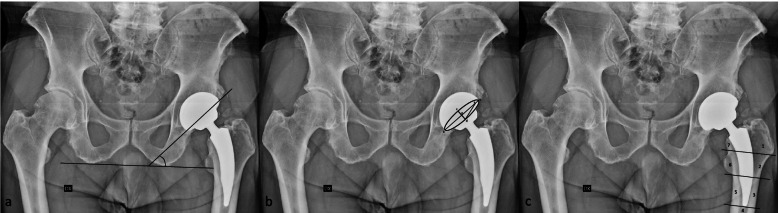
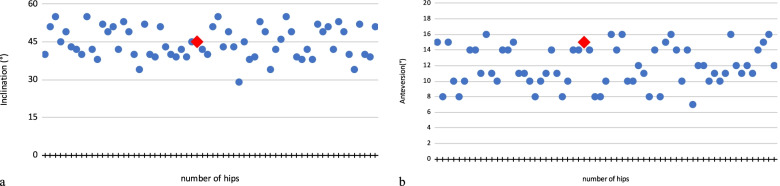
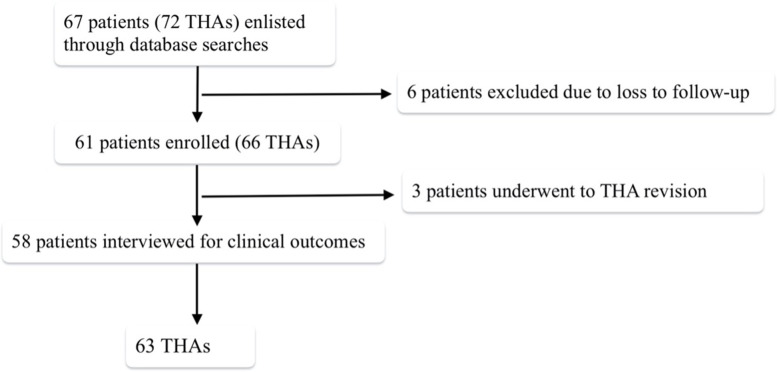
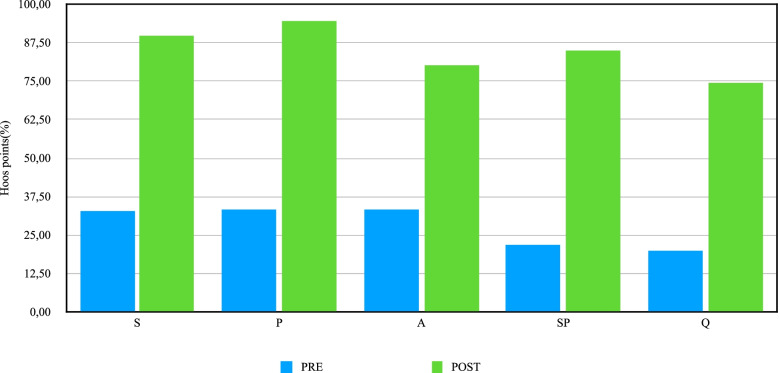
Sixty-seven patients aged 53 ± 20 years were enlisted in the study, for a total of 72 hips. Primary outcomes were survivorship of the implant and clinical outcome measured using the Hip disability and Osteoarthritis Outcome scores (HOOS) and the Short Form Survey (SF12) questionnaire. The secondary outcome was a radiological evaluation calculating the inclination and the anteversion angle of the acetabular cup for each implant and investigating osteolysis, heterotopic ossifications and stem position.
We observed a 95.5% stem survivorship. The complication rate was 7.6% and three implants underwent revision because of an aseptic loosening, an infection and a periprosthetic fracture due to trauma. Among 58 patients (63 hips) evaluated in an outpatient visit 10-16 years after surgery, improvement in clinically relevant scores comparing with baseline was observed: HOOS score increased after surgery in all its subcategories (from 32.25 ± 14.07% up to 91.91 ± 9.13%) as well as SF12 which increased by more than 18 percentage points. On clinical assessment, the range of motion (ROM) was restored at follow-up, 1 patient (1.7%) showed a squeaking hip and 2 (3.4%) reported leg-length discrepancy. Neutral stem positioning was achieved in 58 hips and heterotopic ossifications occurred in 10 hips (16%).
The current study reports good clinical and radiological outcomes following NANOS® short-stem hip implant at minimum 10 years-follow-up. Since the high rate of stem survivorship, the low complication rate demonstrated and the overall patient satisfaction, our results suggest NANOS® neck-preserving prostheses should be considered as a valid alternative to standard implants.
由于短柄髋关节置换术(SHA)在保留干骺端骨量方面具有潜在优势,近年来越来越多地被植入。其中,NANOS®短柄植入物在短期和中期取得了令人满意的效果。本回顾性研究的目的是评估 Nanos®短柄在至少 10 年随访时的临床和影像学结果。
本研究共纳入 67 名年龄 53±20 岁的患者,共 72 髋。主要观察指标为假体存活率和使用髋关节残疾和骨关节炎结果评分(HOOS)和简化健康调查量表(SF12)问卷评估的临床结果。次要观察指标为髋臼杯的倾斜角和前倾角的影像学评估,以及对骨溶解、异位骨化和柄位置的调查。
我们观察到 95.5%的柄存活率。并发症发生率为 7.6%,3 个假体因无菌性松动、感染和创伤性假体周围骨折而翻修。在术后 10-16 年进行门诊随访的 58 名患者(63 髋)中,与基线相比,临床相关评分均有所改善:HOOS 评分在所有亚组(从 32.25±14.07%增加到 91.91±9.13%)和 SF12 均有所增加,增加了 18 个百分点以上。在临床评估中,在随访时恢复了关节活动度(ROM),1 名患者(1.7%)出现髋关节弹响,2 名患者(3.4%)报告下肢长度差异。58 个髋关节实现了中立柄位,10 个髋关节出现异位骨化(16%)。
本研究报告了 NANOS®短柄髋关节植入物在至少 10 年随访时的良好临床和影像学结果。由于高柄存活率、低并发症发生率和总体患者满意度,我们的结果表明 NANOS®保留颈假体应被视为标准植入物的有效替代物。