Pediatric Rheumatology Unit, Schneider Children's Medical Center of Israel, Petach Tikva, Israel.
Sackler Faculty of Medicine, Tel Aviv University, Tel Aviv, Israel.
Orphanet J Rare Dis. 2022 Jan 10;17(1):15. doi: 10.1186/s13023-021-02155-y.
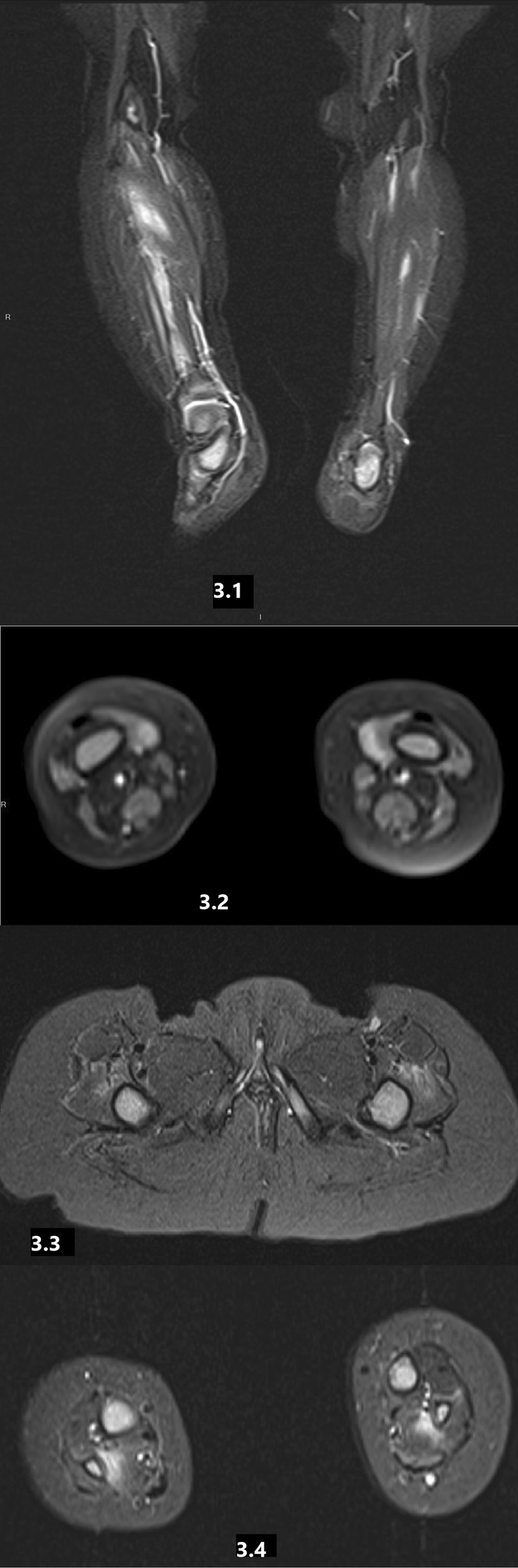
Protracted febrile myalgia syndrome (PFMS) is a rare complication of Familial Mediterranean fever (FMF). The diagnosis is based on clinical symptoms and is often challenging, especially when PFMS is the initial manifestation of FMF. The aim of this report was to describe the magnetic resonance imaging (MRI) findings in pediatric patients with PFMS.
There were three girls and two boys ranging in age from 6 months to 16 years, all of Mediterranean ancestry. Three had high-grade fever, and all had elevated inflammatory markers. MRI of the extremities yielded findings suggestive of myositis, which together with the clinical picture, normal CPK levels, and supporting family history of FMF, suggested the diagnosis of PFMS. Out of most common MEFV mutations tested, one patient was homozygous for M694V mutation, three were heterozygous for M694V mutation, and one was compound heterozygous for the M694V and V726A mutations.
MRI may serve as an auxiliary diagnostic tool in PFMS.
迁延性发热性肌痛综合征(PFMS)是家族性地中海热(FMF)的罕见并发症。该诊断基于临床症状,通常具有挑战性,尤其是在 PFMS 是 FMF 的初始表现时。本报告的目的是描述儿科 PFMS 患者的磁共振成像(MRI)表现。
有 3 名女孩和 2 名男孩,年龄在 6 个月至 16 岁之间,均来自地中海地区。3 人有高热,所有患者的炎症标志物均升高。四肢 MRI 检查结果提示肌炎,结合临床表现、正常肌酸磷酸激酶(CPK)水平以及支持 FMF 的家族史,提示诊断为 PFMS。在测试的最常见 MEFV 突变中,1 名患者为 M694V 突变纯合子,3 名患者为 M694V 突变杂合子,1 名患者为 M694V 和 V726A 突变复合杂合子。
MRI 可作为 PFMS 的辅助诊断工具。