• 文献检索
  • 文档翻译
  • 深度研究
  • 学术资讯
  • Suppr Zotero 插件Zotero 插件
  • 邀请有礼
  • 套餐&价格
  • 历史记录
应用&插件
Suppr Zotero 插件Zotero 插件浏览器插件Mac 客户端Windows 客户端微信小程序
定价
高级版会员购买积分包购买API积分包
服务
文献检索文档翻译深度研究API 文档MCP 服务
关于我们
关于 Suppr公司介绍联系我们用户协议隐私条款
关注我们

Suppr 超能文献

核心技术专利:CN118964589B侵权必究
粤ICP备2023148730 号-1Suppr @ 2026

文献检索

告别复杂PubMed语法,用中文像聊天一样搜索,搜遍4000万医学文献。AI智能推荐,让科研检索更轻松。

立即免费搜索

文件翻译

保留排版,准确专业,支持PDF/Word/PPT等文件格式,支持 12+语言互译。

免费翻译文档

深度研究

AI帮你快速写综述,25分钟生成高质量综述,智能提取关键信息,辅助科研写作。

立即免费体验

全球范围内关于自私富人不平等假说的证据。

Global evidence on the selfish rich inequality hypothesis.

机构信息

Institute for International Economic Studies, Stockholm University, 106 91 Stockholm, Sweden.

FAIR-Centre for Experimental Research on Fairness, Inequality and Rationality, Norwegian School of Economics, 5045 Bergen, Norway.

出版信息

Proc Natl Acad Sci U S A. 2022 Jan 18;119(3). doi: 10.1073/pnas.2109690119.

DOI:10.1073/pnas.2109690119
PMID:35012981
原文链接:https://pmc.ncbi.nlm.nih.gov/articles/PMC8784141/
Abstract

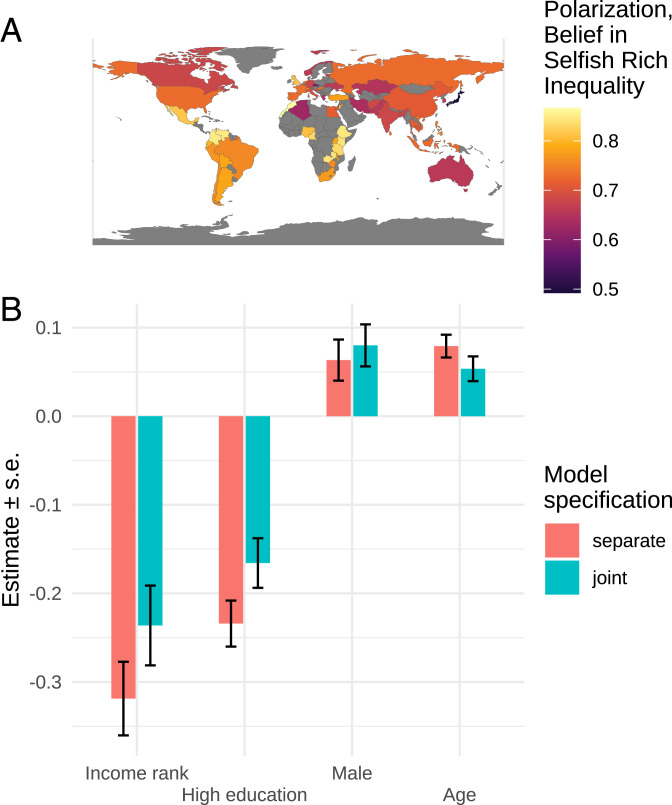
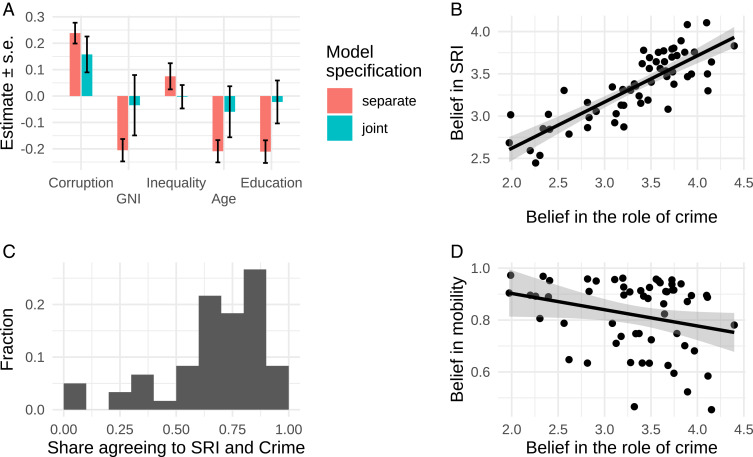
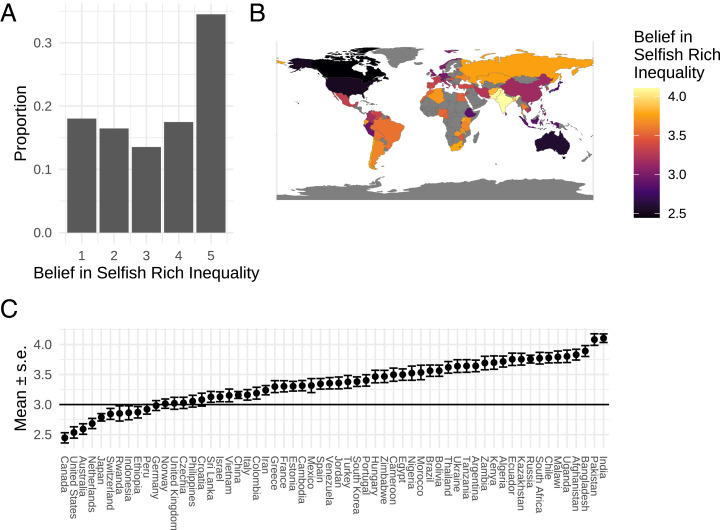
We report on a study of whether people believe that the rich are richer than the poor because they have been more selfish in life, using data from more than 26,000 individuals in 60 countries. The findings show a strong belief in the selfish rich inequality hypothesis at the global level; in the majority of countries, the mode is to strongly agree with it. However, we also identify important between- and within-country variation. We find that the belief in selfish rich inequality is much stronger in countries with extensive corruption and weak institutions and less strong among people who are higher in the income distribution in their society. Finally, we show that the belief in selfish rich inequality is predictive of people's policy views on inequality and redistribution: It is significantly positively associated with agreeing that inequality in their country is unfair, and it is significantly positively associated with agreeing that the government should aim to reduce inequality. These relationships are highly significant both across and within countries and robust to including country-level or individual-level controls and using Lasso-selected regressors. Thus, the data provide compelling evidence of people believing that the rich are richer because they have been more selfish in life and perceiving selfish behavior as creating unfair inequality and justifying equalizing policies.

摘要

我们报告了一项关于人们是否认为富人比穷人更富有,是因为他们在生活中更自私的研究,该研究使用了来自 60 个国家的 26000 多人的数据。研究结果表明,在全球范围内,人们强烈相信自私的富人不平等假设;在大多数国家,这种模式是强烈同意。然而,我们也发现了重要的国家间和国家内的差异。我们发现,在腐败和制度薄弱的国家,对自私的富人不平等的信念更强,而在社会收入分配较高的人群中,这种信念则较弱。最后,我们表明,对自私的富人不平等的信念可以预测人们对不平等和再分配的政策观点:它与认为自己国家的不平等不公平的观点显著正相关,也与认为政府应该致力于减少不平等的观点显著正相关。这些关系在国家间和国家内都具有高度显著性,并且在包括国家层面或个人层面的控制变量和使用套索选择回归变量时仍然稳健。因此,这些数据有力地证明了人们相信富人更富有,是因为他们在生活中更自私,并且将自私行为视为造成不公平不平等的原因,并认为平等化政策是合理的。
https://cdn.ncbi.nlm.nih.gov/pmc/blobs/e12a/8784141/0ecbf81e0b2a/pnas.2109690119fig03.jpg
https://cdn.ncbi.nlm.nih.gov/pmc/blobs/e12a/8784141/ef99b99e7f58/pnas.2109690119fig01.jpg
https://cdn.ncbi.nlm.nih.gov/pmc/blobs/e12a/8784141/7319b5ad59e4/pnas.2109690119fig02.jpg
https://cdn.ncbi.nlm.nih.gov/pmc/blobs/e12a/8784141/0ecbf81e0b2a/pnas.2109690119fig03.jpg
https://cdn.ncbi.nlm.nih.gov/pmc/blobs/e12a/8784141/ef99b99e7f58/pnas.2109690119fig01.jpg
https://cdn.ncbi.nlm.nih.gov/pmc/blobs/e12a/8784141/7319b5ad59e4/pnas.2109690119fig02.jpg
https://cdn.ncbi.nlm.nih.gov/pmc/blobs/e12a/8784141/0ecbf81e0b2a/pnas.2109690119fig03.jpg

相似文献

1
Global evidence on the selfish rich inequality hypothesis.全球范围内关于自私富人不平等假说的证据。
Proc Natl Acad Sci U S A. 2022 Jan 18;119(3). doi: 10.1073/pnas.2109690119.
2
Why are some countries rich and others poor? development and validation of the attributions for Cross-Country Inequality Scale (ACIS).为什么有些国家富裕,而有些国家贫穷?跨国不平等归因量表(ACIS)的编制与验证。
PLoS One. 2024 Feb 27;19(2):e0298222. doi: 10.1371/journal.pone.0298222. eCollection 2024.
3
Inequality aversion predicts support for public and private redistribution.不平等厌恶感预测了对公共和私人再分配的支持。
Proc Natl Acad Sci U S A. 2024 Sep 24;121(39):e2401445121. doi: 10.1073/pnas.2401445121. Epub 2024 Sep 17.
4
How Fair is Economic Inequality? Belief in a Just World and the Legitimation of Economic Disparities in 27 European Countries.经济不平等有多公平?27个欧洲国家对公正世界的信念与经济差距的合法化
Pers Soc Psychol Bull. 2022 Mar;48(3):382-395. doi: 10.1177/01461672211002366. Epub 2021 Apr 15.
5
People are more tolerant of inequality when it is expressed in terms of individuals rather than groups at the top.当不平等以个人而不是顶层群体的形式表现出来时,人们更容易容忍它。
Proc Natl Acad Sci U S A. 2021 Oct 26;118(43). doi: 10.1073/pnas.2100430118.
6
Inequality and redistribution behavior in a give-or-take game.在有来有往博弈中的不平等和再分配行为。
Proc Natl Acad Sci U S A. 2018 Apr 3;115(14):3611-3616. doi: 10.1073/pnas.1720457115. Epub 2018 Mar 19.
7
Public support for social security in 66 countries: Prosperity, inequality, and household income as interactive causes.66 个国家的社会保障公众支持度:繁荣、不平等和家庭收入的互动原因。
Br J Sociol. 2021 Dec;72(5):1347-1377. doi: 10.1111/1468-4446.12842. Epub 2021 Mar 11.
8
Attitudes towards redistribution and the interplay between perceptions and beliefs about inequality.对再分配的态度以及对不平等的看法和信念之间的相互作用。
Br J Soc Psychol. 2020 Jan;59(1):111-136. doi: 10.1111/bjso.12326. Epub 2019 Apr 12.
9
Do wealth and inequality associate with health in a small-scale subsistence society?在小规模的自给自足社会中,财富和不平等与健康有关吗?
Elife. 2021 May 14;10:e59437. doi: 10.7554/eLife.59437.
10
Inequality and Social Rank: Income Increases Buy More Life Satisfaction in More Equal Countries.不平等与社会阶层:收入增加在更为平等的国家带来更多的生活满意度。
Pers Soc Psychol Bull. 2021 Apr;47(4):519-539. doi: 10.1177/0146167220923853. Epub 2020 May 29.

引用本文的文献

1
Competing fairness ideals underlie wealth inequality across decision contexts.相互竞争的公平理念是不同决策背景下财富不平等现象的根源。
Sci Rep. 2024 Dec 30;14(1):31882. doi: 10.1038/s41598-024-83361-z.
2
Inequality aversion predicts support for public and private redistribution.不平等厌恶感预测了对公共和私人再分配的支持。
Proc Natl Acad Sci U S A. 2024 Sep 24;121(39):e2401445121. doi: 10.1073/pnas.2401445121. Epub 2024 Sep 17.
3
Why are some countries rich and others poor? development and validation of the attributions for Cross-Country Inequality Scale (ACIS).

本文引用的文献

1
Higher socioeconomic status does not predict decreased prosocial behavior in a field experiment.高社会经济地位并不能预测现场实验中亲社会行为的减少。
Nat Commun. 2021 Jul 12;12(1):4266. doi: 10.1038/s41467-021-24519-5.
2
No evidence that economic inequality moderates the effect of income on generosity.没有证据表明经济不平等会缓和收入对慷慨程度的影响。
Proc Natl Acad Sci U S A. 2019 May 14;116(20):9790-9795. doi: 10.1073/pnas.1807942116. Epub 2019 Apr 29.
3
The Selfishness Questionnaire: Egocentric, Adaptive, and Pathological Forms of Selfishness.
为什么有些国家富裕,而有些国家贫穷?跨国不平等归因量表(ACIS)的编制与验证。
PLoS One. 2024 Feb 27;19(2):e0298222. doi: 10.1371/journal.pone.0298222. eCollection 2024.
《自私问卷》:自我中心、适应和病态的自私形式。
J Pers Assess. 2019 Sep-Oct;101(5):503-514. doi: 10.1080/00223891.2018.1455692. Epub 2018 Apr 19.
4
Ambivalent stereotypes link to peace, conflict, and inequality across 38 nations.矛盾的刻板印象与38个国家的和平、冲突及不平等相关联。
Proc Natl Acad Sci U S A. 2017 Jan 24;114(4):669-674. doi: 10.1073/pnas.1611874114. Epub 2017 Jan 9.
5
Intrinsic honesty and the prevalence of rule violations across societies.内在诚实与社会中违规行为的普遍性。
Nature. 2016 Mar 24;531(7595):496-9. doi: 10.1038/nature17160. Epub 2016 Mar 9.
6
Giving behavior of millionaires.百万富翁的捐赠行为。
Proc Natl Acad Sci U S A. 2015 Aug 25;112(34):10641-4. doi: 10.1073/pnas.1507949112. Epub 2015 Aug 10.
7
Social Class and (Un)Ethical Behavior: A Framework, With Evidence From a Large Population Sample.社会阶层与(非)道德行为:一个框架,以及来自大样本人群的证据。
Perspect Psychol Sci. 2013 Sep;8(5):487-97. doi: 10.1177/1745691613491272.
8
Higher social class predicts increased unethical behavior.社会阶层越高,越有可能做出不道德的行为。
Proc Natl Acad Sci U S A. 2012 Mar 13;109(11):4086-91. doi: 10.1073/pnas.1118373109. Epub 2012 Feb 27.
9
Class and compassion: socioeconomic factors predict responses to suffering.阶级和同情:社会经济因素预测对苦难的反应。
Emotion. 2012 Jun;12(3):449-59. doi: 10.1037/a0026508. Epub 2011 Dec 12.
10
Having less, giving more: the influence of social class on prosocial behavior.拥有更少,给予更多:社会阶层对亲社会行为的影响。
J Pers Soc Psychol. 2010 Nov;99(5):771-84. doi: 10.1037/a0020092.