Department of Earth Sciences, University College London, London, UK.
Centre for Astrobiology (CAB, CSIC-INTA), Madrid, Spain.
Nat Commun. 2022 Jan 10;13(1):148. doi: 10.1038/s41467-021-27812-5.
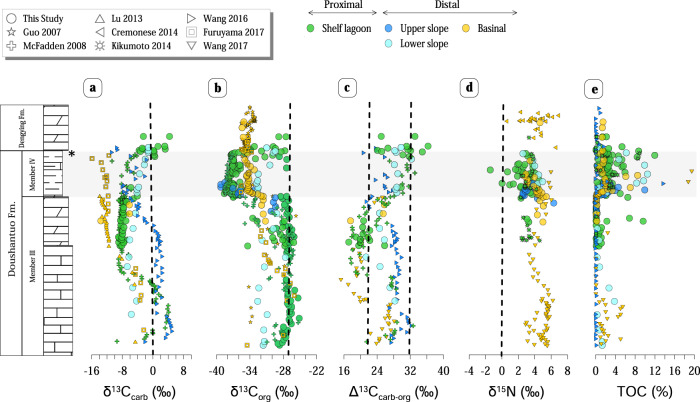
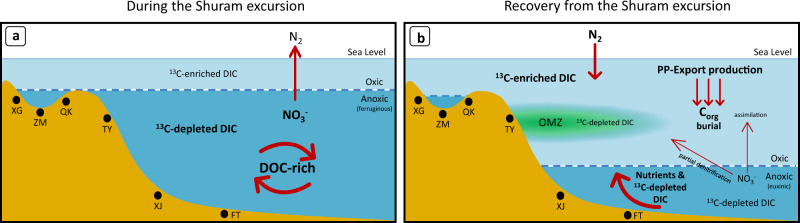
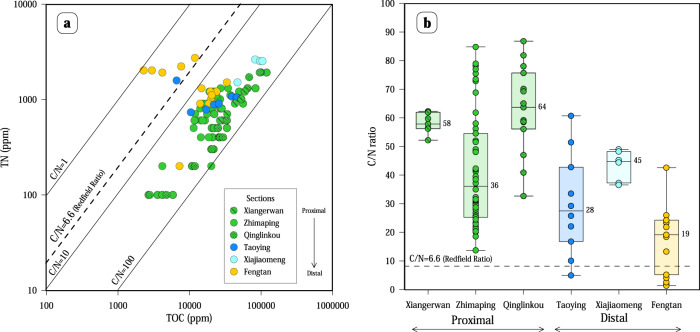
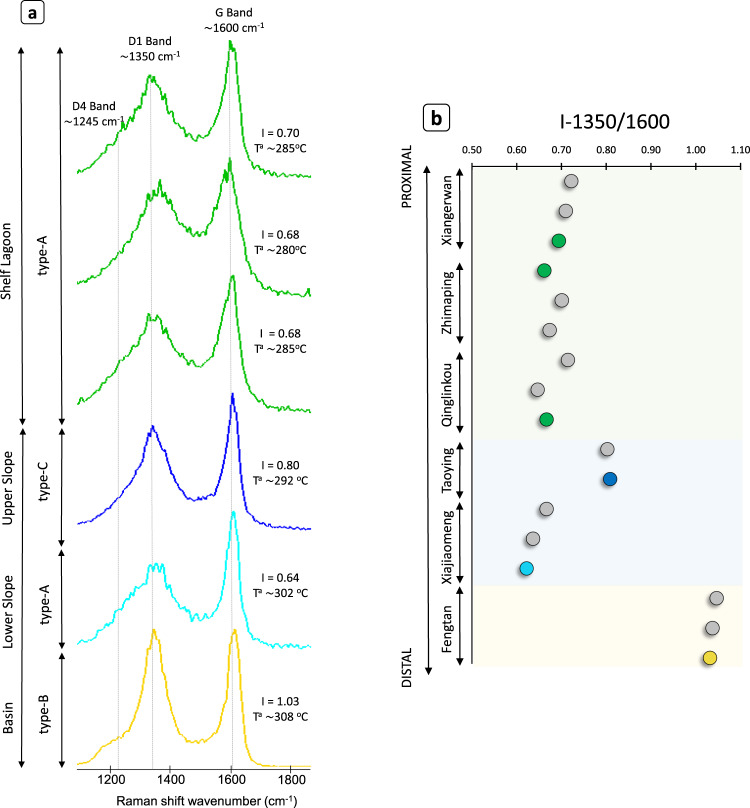
Member IV of the Ediacaran Doushantuo Formation records the recovery from the most negative carbon isotope excursion in Earth history. However, the main biogeochemical controls that ultimately drove this recovery have yet to be elucidated. Here, we report new carbon and nitrogen isotope and concentration data from the Nanhua Basin (South China), where δC values of carbonates (δC) rise from - 7‰ to -1‰ and δN values decrease from +5.4‰ to +2.3‰. These trends are proposed to arise from a new equilibrium in the C and N cycles where primary production overcomes secondary production as the main source of organic matter in sediments. The enhanced primary production is supported by the coexisting Raman spectral data, which reveal a systematic difference in kerogen structure between depositional environments. Our new observations point to the variable dominance of distinct microbial communities in the late Ediacaran ecosystems, and suggest that blooms of oxygenic phototrophs modulated the recovery from the most negative δC excursion in Earth history.
埃迪卡拉纪陡山沱组的成员 IV 记录了地球历史上最负碳同位素偏移的恢复。然而,最终驱动这种恢复的主要生物地球化学控制因素尚未阐明。在这里,我们报告了来自南华盆地(中国南方)的新的碳和氮同位素及浓度数据,其中碳酸盐的 δC 值从-7‰上升到-1‰,δN 值从+5.4‰下降到+2.3‰。这些趋势被认为是由于 C 和 N 循环中的新平衡,其中初级生产克服了二次生产,成为沉积物中有机质的主要来源。共存的拉曼光谱数据支持了这种增强的初级生产,该数据揭示了沉积环境中干酪根结构的系统差异。我们的新观测结果表明,在晚埃迪卡拉纪生态系统中,不同微生物群落的优势地位是可变的,并表明产氧光合生物的大量繁殖调节了地球历史上最负的 δC 偏移的恢复。