Ben Moftah Moayed, Eswayah Asma
Department of Medicinal and Pharmaceutical Chemistry, Faculty of Pharmacy, University of Tripoli, Tripoli, Libya.
Health Sci Rev (Oxf). 2022 Mar;2:100011. doi: 10.1016/j.hsr.2021.100011. Epub 2022 Jan 6.
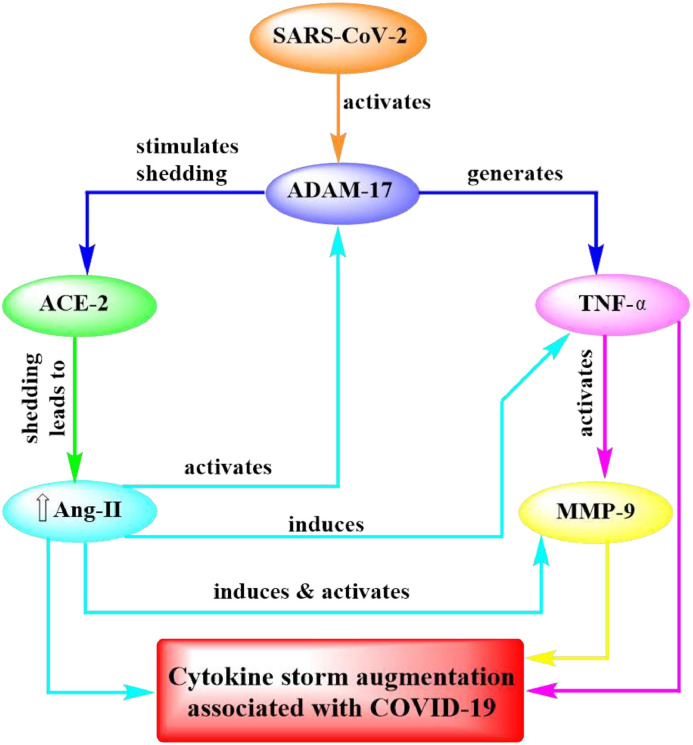
Severe acute respiratory syndrome coronavirus 2 (SARS-CoV-2), through its ability to induce cytokine release syndrome, can set up a generalized inflammatory response together with activating multiple inflammatory pathways, which contributes to a dramatic increase in the number of mortalities and morbidities worldwide. Reportedly, the manipulative nature of coronavirus disease 2019 (COVID-19), which targets the immune system, often focuses on specific inflammation-related pathways, usually confined to interleukins and tumor necrosis factor-α (TNF-α), with a great emphasis on therapeutic approaches targeting the inhibition of these inflammatory mediators. The involvement of a disintegrin and metalloprotease 17 (ADAM-17) and matrix metalloproteinase-9 (MMP-9) in the pathogenesis of COVID-19, through their ability to potentiate the cytokine storm during an episode of SARS-CoV-2 infection, often goes unnoticed. In this review, the intricate relationship between ADAM-17 and MMP-9 together with angiotensin-converting enzyme 2 (ACE-2) as the main target for SARS-CoV-2 is highlighted in detail through a compilation of evidence-based literature; thus, we shed light on a proposed inflammatory pathway that COVID-19 may exploit to provoke an inflammatory response of a complex nature. Conclusively, our proposed mechanism acts as a means to developing a therapeutic approach aimed at modulating the intricate communication between ADAM-17 and MMP-9, where a great emphasis on the role of ACE-2 shedding and subsequent elevation in angiotensin II (Ang-II) levels is crucial to understanding the awry inflammatory response in patients with COVID-19. From this concept, designing a therapeutic strategy targeting multiple inflammatory mediators and enzymes simultaneously is another approach to unravel this global pandemic.
严重急性呼吸综合征冠状病毒2(SARS-CoV-2)能够诱发细胞因子释放综合征,引发全身性炎症反应并激活多种炎症途径,这导致全球范围内的死亡率和发病率急剧上升。据报道,2019冠状病毒病(COVID-19)具有针对免疫系统的操控性,通常聚焦于特定的炎症相关途径,主要局限于白细胞介素和肿瘤坏死因子-α(TNF-α),并高度重视针对抑制这些炎症介质的治疗方法。而解整合素和金属蛋白酶17(ADAM-17)以及基质金属蛋白酶-9(MMP-9)在COVID-19发病机制中的作用,因其在SARS-CoV-2感染期间增强细胞因子风暴的能力,常常被忽视。在本综述中,通过汇编基于证据的文献,详细阐述了ADAM-17、MMP-9与作为SARS-CoV-2主要靶点的血管紧张素转换酶2(ACE-2)之间的复杂关系;因此,我们揭示了一条COVID-19可能利用来引发复杂炎症反应的炎症途径。总之,我们提出的机制有助于开发一种旨在调节ADAM-17与MMP-9之间复杂相互作用的治疗方法,其中高度重视ACE-2的裂解以及随后血管紧张素II(Ang-II)水平的升高对于理解COVID-19患者异常炎症反应至关重要。基于这一概念,设计一种同时针对多种炎症介质和酶的治疗策略是应对这一全球大流行的另一种方法。