Leprosy Laboratory, Oswaldo Cruz Institute, Fiocruz, Rio de Janeiro, Brazil.
Post-Graduate Program in Neurology, Federal University of the State of Rio de Janeiro, Rio de Janeiro, Brazil.
PLoS Negl Trop Dis. 2022 Jan 11;16(1):e0010070. doi: 10.1371/journal.pntd.0010070. eCollection 2022 Jan.
Pure Neural Leprosy (PNL) is a rare clinical form of leprosy in which patients do not present with the classical skin lesions but have a high burden of the disability associated with the disease. Clinical characteristics and follow up of patients in PNL are still poorly described in the literature.
This paper aims to describe the clinical, electrophysiological and histopathological characteristics of PNL patients, as well as their evolution after multidrug therapy (MDT).
Fifty-two PNL patients were selected. Clinical, nerve conduction studies (NCS), histopathological and anti-PGL-1serology were evaluated. Patients were also assessed monthly during the MDT. At the end of the MDT, all of the patients had a new neurological examination and 44 were submitted to another NCS.
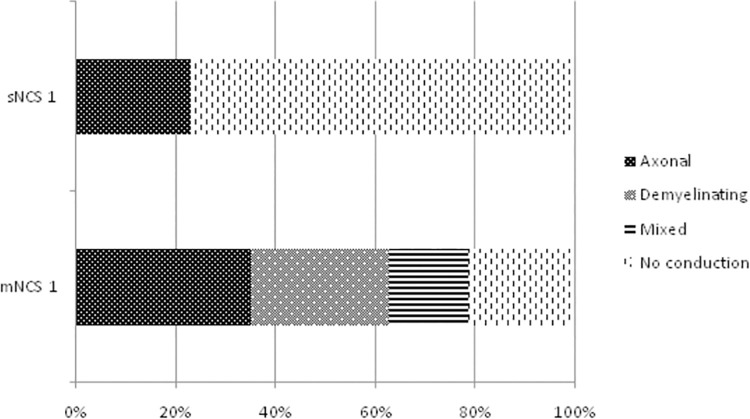
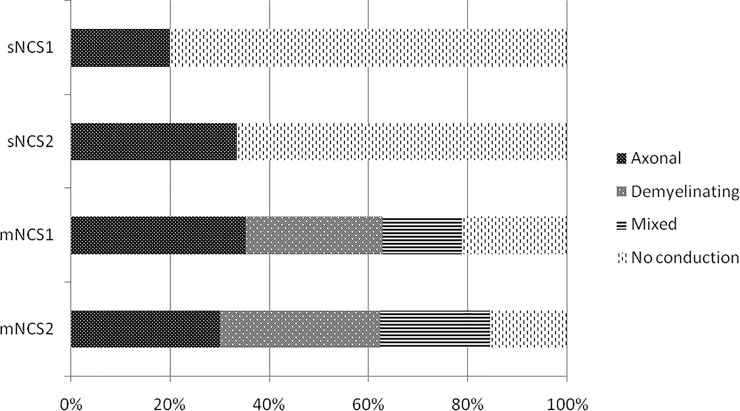
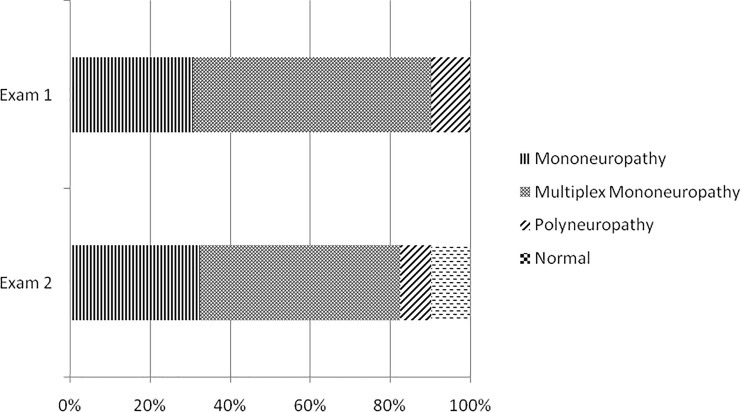
Paresthesia was the complaint most frequently reported by patients, and in the neurological examination the most common pattern observed was impairment in sensory and motor examination and a mononeuropathy multiplex. Painful nerve enlargement, a classical symptom of leprosy neuropathy, was observed in a minority of patients and in the motor NCS axonal injuries, alone or in combination with demyelinating features, were the most commonly observed. 88% of the patients did not present any leprosy reaction during MDT. There was no statistically significant difference between the neurological examinations, nor the NCS pattern, performed before and after the MDT.
The classical hallmarks of leprosy neuropathy are not always present in PNL making the diagnosis even more challenging. Nerve biopsy is an important tool for PNL diagnosis as it may guide therapeutic decisions. This paper highlights unique characteristics of PNL in the spectrum of leprosy in an attempt to facilitate the diagnosis and management of these patients.
纯神经炎麻风(PNL)是麻风病的一种罕见临床形式,患者没有出现典型的皮肤损伤,但存在与疾病相关的较高残疾负担。PNL 患者的临床特征和随访在文献中仍描述不足。
本文旨在描述 PNL 患者的临床、电生理学和组织病理学特征,以及他们在多药治疗(MDT)后的演变。
选择了 52 名 PNL 患者。评估了临床、神经传导研究(NCS)、组织病理学和抗 PGL-1 血清学。患者在 MDT 期间也每月进行评估。MDT 结束时,所有患者都接受了新的神经系统检查,其中 44 名患者接受了另一次 NCS。
感觉异常是患者最常报告的症状,在神经系统检查中,最常见的模式是感觉和运动检查受损以及多发性单神经病。少数患者出现痛性神经肿大,这是麻风神经病的一个经典症状,而在运动 NCS 中,单独或联合脱髓鞘特征观察到的是轴索损伤。88%的患者在 MDT 期间没有出现任何麻风反应。MDT 前后的神经系统检查和 NCS 模式均无统计学差异。
PNL 并不总是存在麻风病神经病的典型标志,这使得诊断更加具有挑战性。神经活检是 PNL 诊断的重要工具,因为它可以指导治疗决策。本文强调了 PNL 在麻风病谱中的独特特征,试图促进这些患者的诊断和管理。