RTI International, Research Triangle Park, NC, USA.
Datametrics Associates Ltd., Abuja, Nigeria.
J Nutr. 2022 May 5;152(5):1316-1326. doi: 10.1093/jn/nxab450.
Although most health facilities in urban Nigeria are privately owned, interventions to promote optimal breastfeeding practices in private facilities have not previously been implemented.
We tested the impact of a breastfeeding promotion intervention on early initiation of breastfeeding and exclusive breastfeeding among clients of private facilities in Lagos, Nigeria.
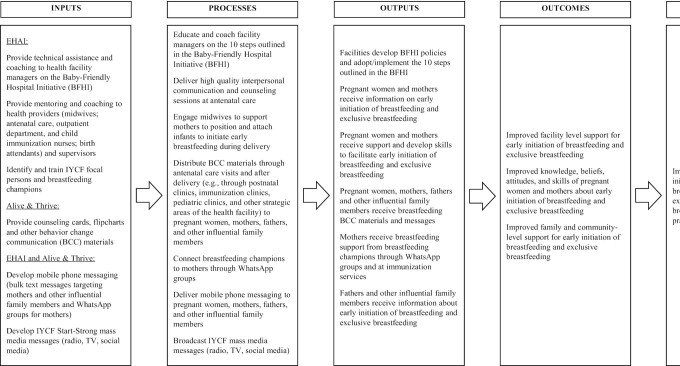
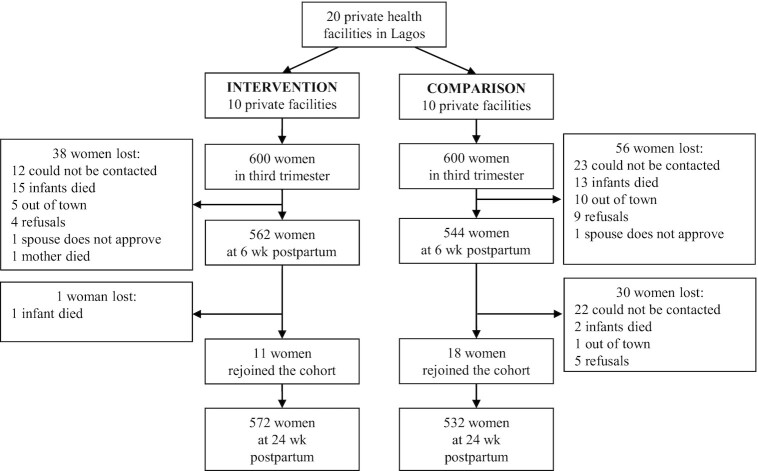
The intervention included training for health-care providers on the Baby-Friendly Hospital Initiative and breastfeeding counseling skills, provision of interpersonal communication and support to women at facilities and on WhatsApp, distribution of behavior change communication materials, and mobile phone and mass media messaging. We used logistic regression models adjusted for clustering to measure intervention impact in a cohort of women (n = 1200) at 10 intervention and 10 comparison facilities interviewed during their third trimester and at 6 and 24 weeks postpartum.
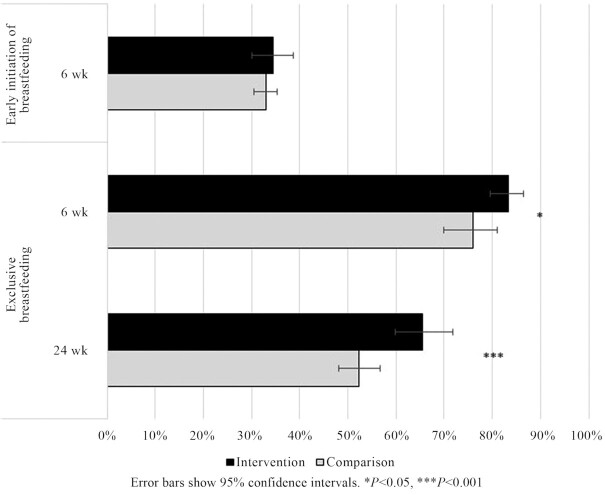
The intervention significantly increased the percentage of infants who were exclusively breastfed at 6 weeks (83% intervention; 76% comparison; P = 0.02) and 24 weeks (66% intervention; 52% comparison; P < 0.001), but had no impact on early initiation of breastfeeding (35% intervention; 33% comparison; P = 0.65). Among infants who were exclusively breastfed at 6 weeks, the odds of continued exclusive breastfeeding at 24 weeks were higher in the intervention arm than in the comparison arm (OR, 1.6; 95% CI: 1.2-2.1). Infants had increased odds of being exclusively breastfed at 6 weeks if their mothers discussed breastfeeding with a private health provider (OR, 2.3; 95% CI: 1.5-3.4), received text or WhatsApp messages about breastfeeding (OR, 1.7; 95% CI: 1.0-2.7), or heard breastfeeding radio spots (OR, 4.2; 95% CI: 1.2-14.7). Infants had increased odds of exclusive breastfeeding at 24 weeks if their mothers participated in a WhatsApp breastfeeding support group (OR, 1.5; 95% CI: 1.0-2.2).
A breastfeeding intervention in private health facilities in Lagos increased exclusive breastfeeding. Implementation of breastfeeding interventions in private facilities could extend the reach of breastfeeding promotion programs in urban Nigeria. This trial was registered at clinicaltrials.gov as NCT04835051.
尽管尼日利亚城市中的大多数卫生机构都是私营的,但以前从未实施过干预措施来促进私营机构中最佳母乳喂养实践。
我们检验了一项母乳喂养促进干预措施对拉各斯尼日利亚私营机构客户中早期母乳喂养和纯母乳喂养的影响。
该干预措施包括对卫生保健提供者进行关于爱婴医院倡议和母乳喂养咨询技能的培训、为设施内和 WhatsApp 上的妇女提供人际沟通和支持、分发行为改变沟通材料、以及手机和大众媒体信息传递。我们使用了调整了聚类的逻辑回归模型来衡量一项在 10 家干预和 10 家对照设施中的 1200 名妇女队列中的干预效果,这些妇女在怀孕的第三个三个月、产后 6 周和 24 周接受了访谈。
该干预措施显著提高了 6 周时纯母乳喂养的婴儿比例(干预组 83%;对照组 76%;P=0.02)和 24 周时纯母乳喂养的婴儿比例(干预组 66%;对照组 52%;P<0.001),但对早期母乳喂养没有影响(干预组 35%;对照组 33%;P=0.65)。在 6 周时纯母乳喂养的婴儿中,如果他们的母亲与私人卫生提供者讨论过母乳喂养(优势比,1.6;95%置信区间:1.2-2.1),收到过关于母乳喂养的短信或 WhatsApp 消息(优势比,1.7;95%置信区间:1.0-2.7),或听过母乳喂养广播节目(优势比,4.2;95%置信区间:1.2-14.7),那么他们在 24 周时继续纯母乳喂养的可能性更高。如果他们的母亲参加了 WhatsApp 母乳喂养支持小组(优势比,1.5;95%置信区间:1.0-2.2),那么他们在 24 周时纯母乳喂养的可能性更高。
在拉各斯的私营卫生机构中实施母乳喂养干预措施增加了纯母乳喂养率。在私营机构中实施母乳喂养干预措施可以扩大城市尼日利亚母乳喂养促进计划的覆盖范围。这项试验在 clinicaltrials.gov 上注册为 NCT04835051。