Institutional Committee for the Improvement of Clinical Practice Adequacy, Consorci Corporació Sanitària Parc Taulí, Parc Taulí 1, 08208, Sabadell, Catalonia, Spain.
Health Services Research on Chronic Patients Network (REDISSEC), Sabadell, Spain.
BMC Geriatr. 2022 Jan 11;22(1):44. doi: 10.1186/s12877-021-02715-8.
The objectives of the present analyses are to estimate the frequency of potentially inappropriate prescribing (PIP) at admission according to STOPP/START criteria version 2 in older patients hospitalised due to chronic disease exacerbation as well as to identify risk factors associated to the most frequent active principles as potentially inappropriate medications (PIMs).
A multicentre, prospective cohort study including older patients (≥65) hospitalized due to chronic disease exacerbation at the internal medicine or geriatric services of 5 hospitals in Spain between September 2016 and December 2018 was conducted. Demographic and clinical data was collected, and a medication review process using STOPP/START criteria version 2 was performed, considering both PIMs and potential prescribing omissions (PPOs). Primary outcome was defined as the presence of any most frequent principles as PIMs, and secondary outcomes were the frequency of any PIM and PPO. Descriptive and bivariate analyses were conducted on all outcomes and multilevel logistic regression analysis, stratified by participating centre, was performed on the primary outcome.
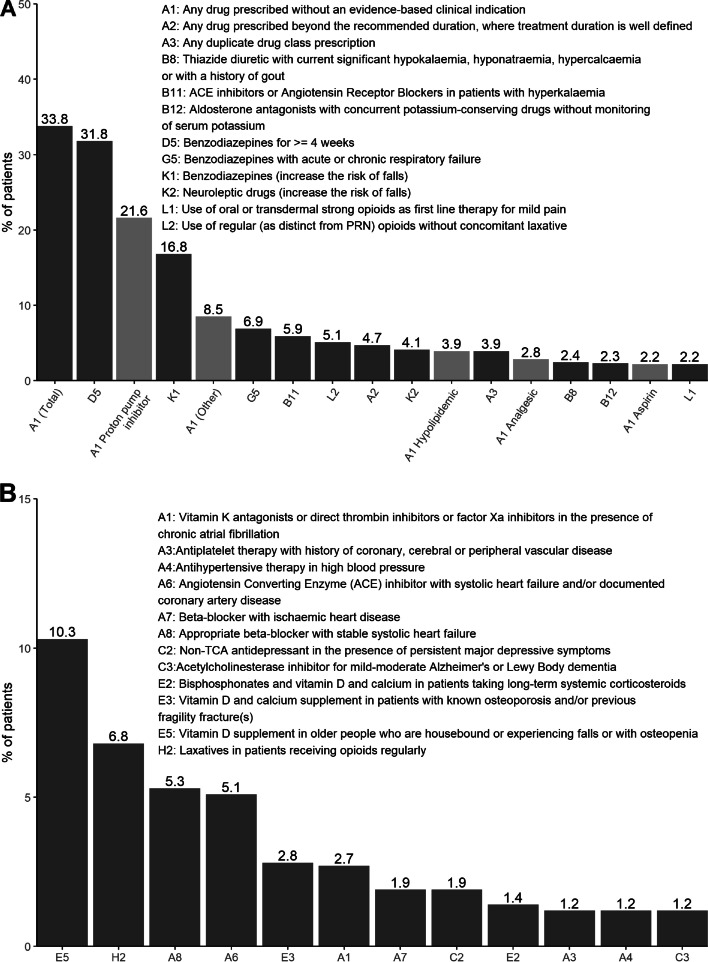
A total of 740 patients were included (mean age 84.1, 53.2% females), 93.8% of them presenting polypharmacy, with a median of 10 chronic prescriptions. Among all, 603 (81.5%) patients presented at least one PIP, 542 (73.2%) any PIM and 263 (35.5%) any PPO. Drugs prescribed without an evidence-based clinical indication were the most frequent PIM (33.8% of patients); vitamin D supplement in older people who are housebound or experiencing falls or with osteopenia was the most frequent PPO (10.3%). The most frequent active principles as PIMs were proton pump inhibitors (PPIs) and benzodiazepines (BZDs), present in 345 (46.6%) patients. This outcome was found significantly associated with age, polypharmacy and essential tremor in an explanatory model with 71% AUC.
PIMs at admission are highly prevalent in these patients, especially those involving PPIs or BZDs, which affected almost half of the patients. Therefore, these drugs may be considered as the starting point for medication review and deprescription.
NCT02830425.
本分析的目的是根据 STOPP/START 标准 2 版估算因慢性病恶化而住院的老年患者入院时潜在不适当处方(PIP)的频率,并确定与最常见活性药物相关的危险因素作为潜在不适当药物(PIM)。
进行了一项多中心、前瞻性队列研究,纳入了 2016 年 9 月至 2018 年 12 月期间西班牙 5 家医院内科或老年科因慢性病恶化住院的年龄≥65 岁的老年患者。收集人口统计学和临床数据,并使用 STOPP/START 标准 2 版进行药物审查过程,同时考虑 PIM 和潜在处方遗漏(PPO)。主要结局定义为存在任何最常见的 PIM 原则,次要结局为任何 PIM 和 PPO 的频率。对所有结局进行描述性和双变量分析,并对主要结局进行分层多水平逻辑回归分析。
共纳入 740 例患者(平均年龄 84.1 岁,53.2%为女性),其中 93.8%为多药治疗,中位数为 10 种慢性病处方。其中,603 例(81.5%)患者至少存在一种 PIP,542 例(73.2%)患者存在任何 PIM,263 例(35.5%)患者存在任何 PPO。没有基于临床证据的药物是最常见的 PIM(33.8%的患者);维生素 D 补充剂用于那些足不出户、经常跌倒或患有骨质疏松症的老年人是最常见的 PPO(10.3%)。最常见的 PIM 活性药物是质子泵抑制剂(PPIs)和苯二氮䓬类药物(BZDs),有 345 例(46.6%)患者使用。在一个解释模型中,该结果与年龄、多药治疗和特发性震颤显著相关,AUC 为 71%。
这些患者入院时 PIM 非常普遍,尤其是涉及 PPI 或 BZD 的 PIM,几乎影响了一半的患者。因此,这些药物可能被视为药物审查和减少用药的起点。
NCT02830425。