Zheng D Diane, Loewenstein David A, Christ Sharon L, Feaster Daniel J, Lam Byron L, McCollister Kathryn E, Curiel-Cid Rosie E, Lee David J
Department of Psychiatry and Behavioral Science, Center for Cognitive Neurosciences & Aging, University of Miami Miller School of Medicine, Miami, Florida, United States of America.
Department of Public Health Sciences, University of Miami Miller School of Medicine, Miami, Florida, United States of America.
PLoS One. 2021 Jan 20;16(1):e0245053. doi: 10.1371/journal.pone.0245053. eCollection 2021.
Understanding patterns of multimorbidity in the US older adult population and their relationship with mortality is important for reducing healthcare utilization and improving health. Previous investigations measured multimorbidity as counts of conditions rather than specific combination of conditions.
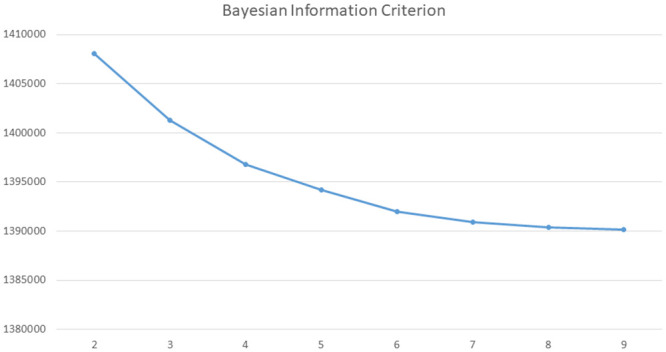
This cross-sectional study with longitudinal mortality follow-up employed latent class analysis (LCA) to develop clinically meaningful subgroups of participants aged 50 and older with different combinations of 13 chronic conditions from the National Health Interview Survey 2002-2014. Mortality linkage with National Death Index was performed through December 2015 for 166,126 participants. Survival analyses were conducted to assess the relationships between LCA classes and all-cause mortality and cause specific mortalities.
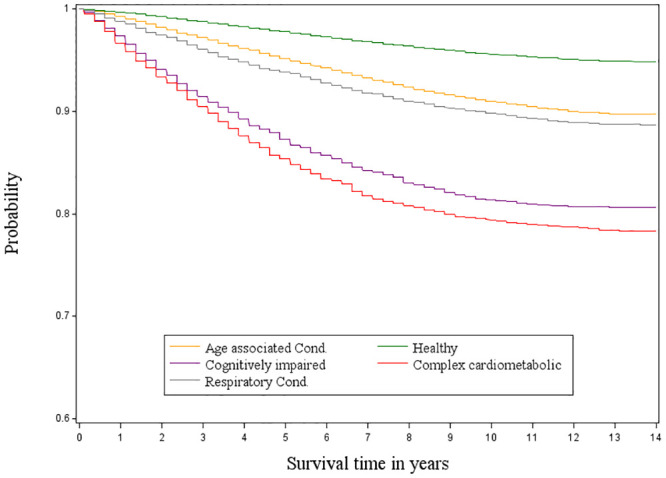
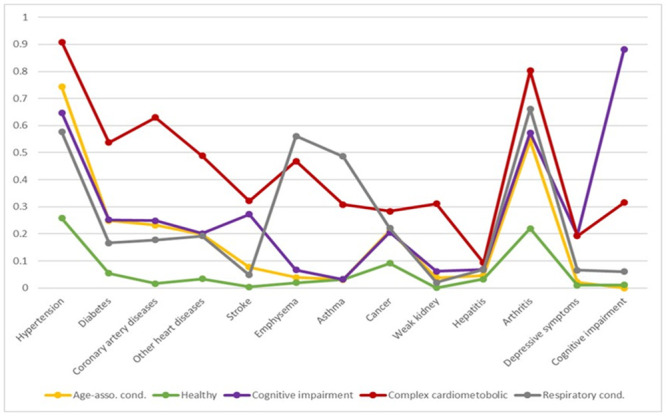
LCA identified five multimorbidity groups with primary characteristics: "healthy" (51.5%), "age-associated chronic conditions" (33.6%), "respiratory conditions" (7.3%), "cognitively impaired" (4.3%) and "complex cardiometabolic" (3.2%). Covariate-adjusted survival analysis indicated "complex cardiometabolic" class had the highest mortality with a Hazard Ratio (HR) of 5.30, 99.5% CI [4.52, 6.22]; followed by "cognitively impaired" class (3.34 [2.93, 3.81]); "respiratory condition" class (2.14 [1.87, 2.46]); and "age-associated chronic conditions" class (1.81 [1.66, 1.98]). Patterns of multimorbidity classes were strongly associated with the primary underlying cause of death. The "cognitively impaired" class reported similar number of conditions compared to the "respiratory condition" class but had significantly higher mortality (3.8 vs 3.7 conditions, HR = 1.56 [1.32, 1.85]).
We demonstrated that LCA method is effective in classifying clinically meaningful multimorbidity subgroup. Specific combinations of conditions including cognitive impairment and depressive symptoms have a substantial detrimental impact on the mortality of older adults. The numbers of chronic conditions experienced by older adults is not always proportional to mortality risk. Our findings provide valuable information for identifying high risk older adults with multimorbidity to facilitate early intervention to treat chronic conditions and reduce mortality.
了解美国老年人群的多重疾病模式及其与死亡率的关系对于减少医疗保健利用和改善健康状况至关重要。以往的调查将多重疾病衡量为疾病的数量而非特定的疾病组合。
这项具有纵向死亡率随访的横断面研究采用潜在类别分析(LCA),从2002 - 2014年国家健康访谈调查中确定年龄在50岁及以上、患有13种慢性病不同组合的参与者的具有临床意义的亚组。通过与国家死亡指数进行死亡率关联,对166,126名参与者随访至2015年12月。进行生存分析以评估LCA类别与全因死亡率和特定病因死亡率之间的关系。
LCA确定了五个多重疾病组,其主要特征为:“健康”(51.5%)、“与年龄相关的慢性疾病”(33.6%)、“呼吸系统疾病”(7.3%)、“认知障碍”(4.3%)和“复杂心脏代谢疾病”(3.2%)。协变量调整后的生存分析表明,“复杂心脏代谢疾病”组死亡率最高,风险比(HR)为5.30,99.5%置信区间[4.52, 6.22];其次是“认知障碍”组(3.34 [2.93, 3.81]);“呼吸系统疾病”组(2.14 [1.87, 2.46]);以及“与年龄相关的慢性疾病”组(1.81 [1.66, 1.98])。多重疾病类别的模式与主要潜在死因密切相关。“认知障碍”组报告的疾病数量与“呼吸系统疾病”组相似,但死亡率显著更高(分别为3.8种与3.7种疾病,HR = 1.56 [1.32, 1.85])。
我们证明LCA方法在对具有临床意义的多重疾病亚组进行分类方面是有效的。包括认知障碍和抑郁症状在内的特定疾病组合对老年人的死亡率有重大不利影响。老年人经历的慢性病数量并不总是与死亡风险成正比。我们的研究结果为识别患有多重疾病的高危老年人提供了有价值的信息,以促进对慢性病的早期干预并降低死亡率。