Department of Urology, Tongji Hospital, Tongji Medical College, Huazhong University of Science and Technology, Wuhan, China.
BMC Med Genomics. 2022 Jan 11;15(1):7. doi: 10.1186/s12920-022-01157-4.
Kidney stone disease (KSD) is a multifactorial disease involving both environmental and genetic factors, whose pathogenesis remains unclear. This study aims to explore the hub genes related to stone formation that could serve as potential therapeutic targets.
Based on the GSE73680 dataset with 62 samples, differentially expressed genes (DEGs) between Randall's plaque (RP) tissues and normal tissues were screened and weighted gene co-expression network analysis (WGCNA) was applied to identify key modules associated with KSD. Gene Ontology (GO) and Kyoto Encyclopedia of Genes and Genomes (KEGG) enrichment analysis were performed to explore the biological functions. The protein-protein interaction (PPI) network was constructed to identify hub genes. Meanwhile, CIBERSORT and ssGSEA analysis were used to estimate the infiltration level of the immune cells. The correlations between hub genes and immune infiltration levels were also investigated. Finally, the top hub gene was selected for further GSEA analysis.
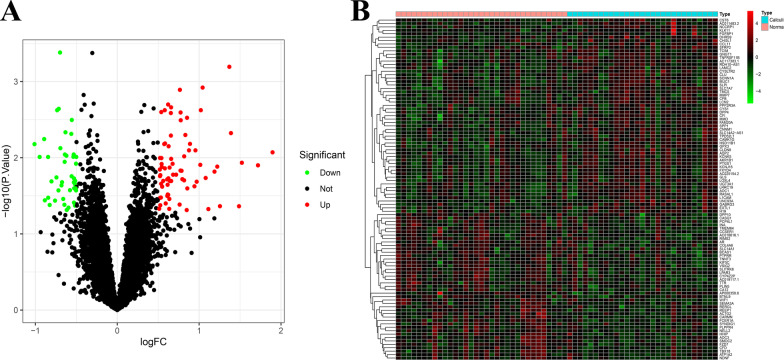
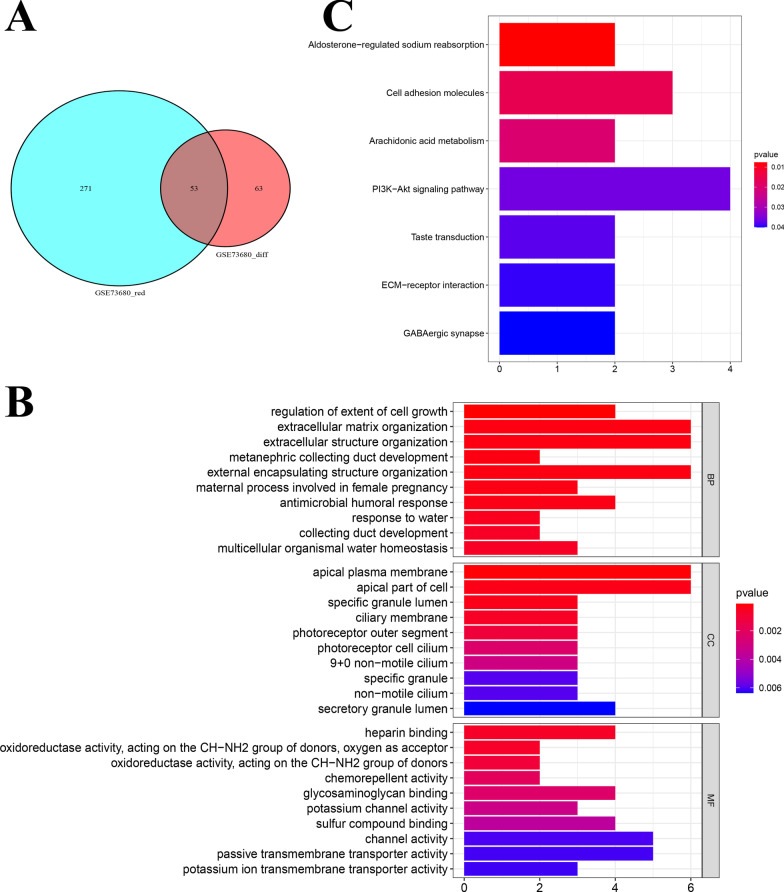
A total of 116 DEGs, including 73 up-regulated and 43 down-regulated genes, were screened in the dataset. The red module was identified as the key module correlated with KSD. 53 genes were obtained for functional enrichment analysis by taking the intersection of DEGs and genes in the red module. GO analysis showed that these genes were mainly involved in extracellular matrix organization (ECM) and extracellular structure organization, and others. KEGG analysis revealed that the pathways of aldosterone-regulated sodium reabsorption, cell adhesion molecules, arachidonic acid (AA) metabolism, and ECM-receptor interaction were enriched. Through PPI network construction, 30 hub genes were identified. CIBERSORT analysis revealed a significantly increased proportion of M0 macrophages, while ssGSEA revealed no significant differences. Among these hub genes, SPP1, LCN2, MMP7, MUC1, SCNN1A, CLU, SLP1, LAMC2, and CYSLTR2 were positively correlated with macrophages infiltration. GSEA analysis found that positive regulation of JNK activity was enriched in RP tissues with high SPP1 expression, while negative regulation of IL-1β production was enriched in the low-SPP1 subgroup.
There are 30 hub genes associated with KSD, among which SPP1 is the top hub gene with the most extensive links with other hub genes. SPP1 might play a pivotal role in the pathogenesis of KSD, which is expected to become a potential therapeutic target, while its interaction with macrophages in KSD needs further investigation.
肾结石病(KSD)是一种涉及环境和遗传因素的多因素疾病,其发病机制尚不清楚。本研究旨在探讨与结石形成相关的关键基因,这些基因可能成为潜在的治疗靶点。
基于包含 62 个样本的 GSE73680 数据集,筛选出 Randall 斑块(RP)组织与正常组织之间的差异表达基因(DEGs),并应用加权基因共表达网络分析(WGCNA)识别与 KSD 相关的关键模块。进行基因本体论(GO)和京都基因与基因组百科全书(KEGG)富集分析以探讨生物学功能。构建蛋白质-蛋白质相互作用(PPI)网络以识别枢纽基因。同时,使用 CIBERSORT 和 ssGSEA 分析估计免疫细胞的浸润水平。还研究了枢纽基因与免疫浸润水平之间的相关性。最后,选择顶级枢纽基因进行进一步的 GSEA 分析。
在数据集中共筛选出 116 个差异表达基因,包括 73 个上调基因和 43 个下调基因。红色模块被鉴定为与 KSD 相关的关键模块。通过取 DEGs 和红色模块中的基因的交集,获得了 53 个用于功能富集分析的基因。GO 分析表明,这些基因主要参与细胞外基质组织(ECM)和细胞外结构组织等。KEGG 分析表明,醛固酮调节的钠重吸收、细胞黏附分子、花生四烯酸(AA)代谢和 ECM 受体相互作用途径富集。通过 PPI 网络构建,确定了 30 个枢纽基因。CIBERSORT 分析显示 M0 巨噬细胞的比例显著增加,而 ssGSEA 则没有显著差异。在这些枢纽基因中,SPP1、LCN2、MMP7、MUC1、SCNN1A、CLU、SLP1、LAMC2 和 CYSLTR2 与巨噬细胞浸润呈正相关。GSEA 分析发现,在 SPP1 高表达的 RP 组织中,JNK 活性的正调控被富集,而在 SPP1 低表达的亚组中,IL-1β 产生的负调控被富集。
与 KSD 相关的 30 个枢纽基因,其中 SPP1 是与其他枢纽基因联系最广泛的顶级枢纽基因。SPP1 可能在 KSD 的发病机制中起关键作用,有望成为潜在的治疗靶点,但其在 KSD 中与巨噬细胞的相互作用需要进一步研究。