Li Jason, Wells James, Yang Chenli, Wang Xiaodan, Lin Yihan, Lyu You, Li Yan
Austin College, Sherman, Texas, USA.
Department of Physiology, Tulane University, New Orleans, Louisiana, USA.
Health Equity. 2021 Dec 13;5(1):834-839. doi: 10.1089/heq.2021.0079. eCollection 2021.
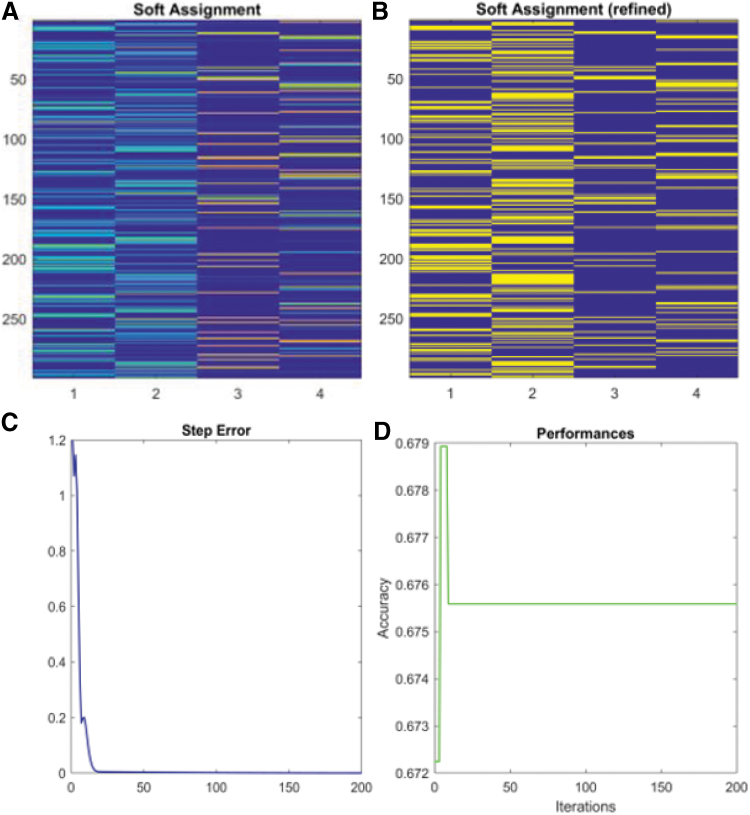
Undocumented immigrants (UIs) in the United States are less likely to be able to afford health insurance. As a result, UIs often lack family doctors and are rarely involved in annual screening programs, which makes estimating their health status remarkably challenging. This is especially true if the laboratory results from limited screening programs fail to provide sufficient clinical information. To address this issue, we have developed a machine learning model based on the non-negative matrix factorization technique. The data set we used for model training and testing was obtained from the 2004 cost-free hepatitis B screening program at the Omni Health Center located in Plano, Texas. Total 300 people were involved, with 199 identified as UIs. People in the UIs group have higher cholesterol (219.6 mg/dL, =0.038) and triglycerides (173.2 mg/dL, =0.03) level. They also have a lower hepatitis B vaccination rate (38%, =0.0247). No significant difference in hepatitis B was found (=0.8823). Using 16 individual clinical measurements as training features, our newly developed model has a 67.56% accuracy in predicting the ratio of cholesterol to high-density lipoprotein; in addition, this newly developed model performs 9.1% better than a comparable multiclass logistic regression model. Elderly UIs have poorer health status compared with permanent residents and citizens in the United States. Our newly developed machine learning model demonstrates a powerful support tool for designing health intervention programs that target UIs in the United States.
美国的无证移民(UIs)更无力负担医疗保险。因此,无证移民往往没有家庭医生,也很少参与年度筛查项目,这使得评估他们的健康状况极具挑战性。如果有限筛查项目的实验室结果未能提供足够的临床信息,情况尤其如此。为解决这一问题,我们基于非负矩阵分解技术开发了一种机器学习模型。我们用于模型训练和测试的数据集来自位于得克萨斯州普莱诺的奥姆尼健康中心2004年的免费乙肝筛查项目。总共有300人参与,其中199人被确定为无证移民。无证移民组的人胆固醇水平(219.6毫克/分升,P = 0.038)和甘油三酯水平(173.2毫克/分升,P = 0.03)更高。他们的乙肝疫苗接种率也更低(38%,P = 0.0247)。在乙肝方面未发现显著差异(P = 0.8823)。以16项个体临床测量值作为训练特征,我们新开发的模型在预测胆固醇与高密度脂蛋白的比率方面准确率为67.56%;此外,这个新开发的模型比类似的多类逻辑回归模型表现好9.1%。与美国的永久居民和公民相比,老年无证移民的健康状况更差。我们新开发的机器学习模型为设计针对美国无证移民的健康干预项目提供了一个有力的支持工具。