Adjepong Mary, Amoah-Agyei Felicity, Du Chen, Wang Wenyan, Fenton Jenifer I, Tucker Robin M
Department of Biochemistry and Biotechnology, Kwame Nkrumah University of Science and Technology, Kumasi, Private Mail Bag, Ghana.
Department of Food Science and Human Nutrition, Michigan State University, 469 Wilson Rd., East Lansing, MI 48824, USA.
J Affect Disord Rep. 2022 Jan;7:100306. doi: 10.1016/j.jadr.2021.100306. Epub 2022 Jan 5.
Stress and mental health outcomes are negatively correlated among university students throughout the world. Reports of differences in stress perception by gender exist, but there is limited data on students from sub-Saharan African countries. This study describes the burden of perceived and financial stress; characterizes mood and degree of anxiety symptoms; examines stress coping mechanisms, including resilience and repetitive negative thinking (RNT); and explores how students at a Ghanaian university believed the COVID-19 pandemic affected these measures.
Students ( = 129) were recruited from the Kwame Nkrumah University of Science and Technology, Kumasi, Ghana from October 2020 - January 2021. Validated surveys were used. Participants were asked "Are your answers to the questions affected by the COVID-19 pandemic?"
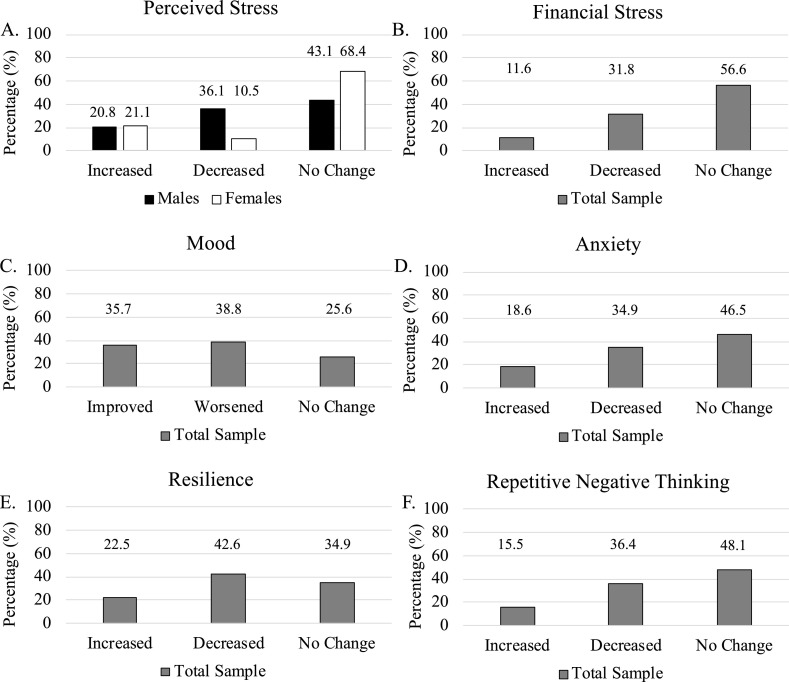
No differences in mean scores were observed between genders. For female students, financial stress was positively associated with RNT ( = 0.009), negative mood ( = 0.002), and anxiety ( < 0.001). Males were more likely to report decreased stress during the pandemic ( = 0.002), but there was no difference in mental health outcomes by perceived stress (PS) change category among males. Effects of the pandemic on mental health outcomes were mixed, but substantial proportions of students reported improvements or no change in financial stress, mood, anxiety, and RNT.
Students from one university particiapted in this cross-sectional survey.
This study adds to the understanding of how higher education students are experiencing stress and are coping with the uncertainties of the COVID-19 pandemic in Ghana.
全球大学生的压力与心理健康结果呈负相关。虽然存在关于性别在压力感知方面差异的报告,但来自撒哈拉以南非洲国家学生的数据有限。本研究描述了感知压力和经济压力的负担;刻画情绪和焦虑症状程度;研究压力应对机制,包括心理韧性和重复性消极思维(RNT);并探讨加纳一所大学的学生认为新冠疫情如何影响这些指标。
2020年10月至2021年1月期间,从加纳库马西的夸梅·恩克鲁玛科技大学招募了129名学生。使用经过验证的调查问卷。参与者被问及“你对这些问题的回答是否受到新冠疫情的影响?”
未观察到性别之间平均得分的差异。对于女学生,经济压力与重复性消极思维(r = 0.009)、消极情绪(r = 0.002)和焦虑(r < 0.001)呈正相关。男性更有可能报告在疫情期间压力减轻(r = 0.002),但按感知压力(PS)变化类别划分,男性的心理健康结果没有差异。疫情对心理健康结果的影响喜忧参半,但相当比例的学生报告经济压力、情绪、焦虑和重复性消极思维有所改善或没有变化。
来自一所大学的学生参与了这项横断面调查。
本研究增进了对加纳高等教育学生如何体验压力以及应对新冠疫情不确定性的理解。