Myopia Clinic, Sankara Nethralaya, Unit of Medical Research Foundation, Chennai, India.
School of Medicine, Faculty of Health, Deakin University, Geelong, Victoria, Australia.
Ophthalmic Physiol Opt. 2022 Mar;42(2):345-357. doi: 10.1111/opo.12943. Epub 2022 Jan 12.
To report the baseline prevalence of myopia among school children in Tamil Nadu, South India from a prospective cohort study.
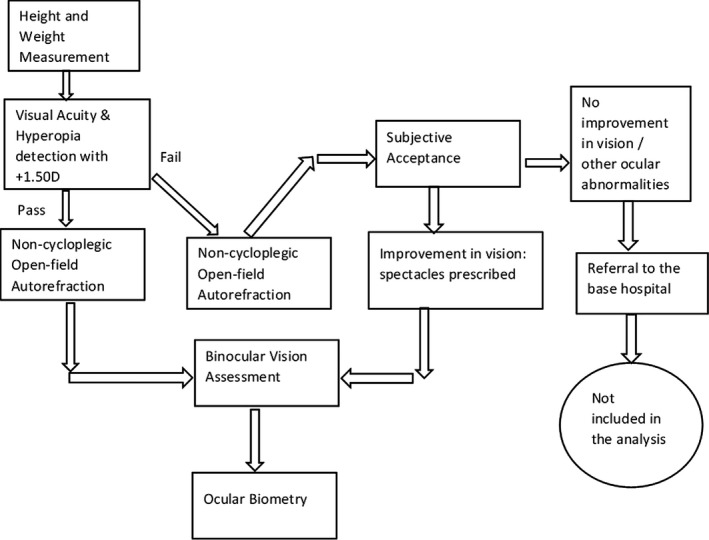
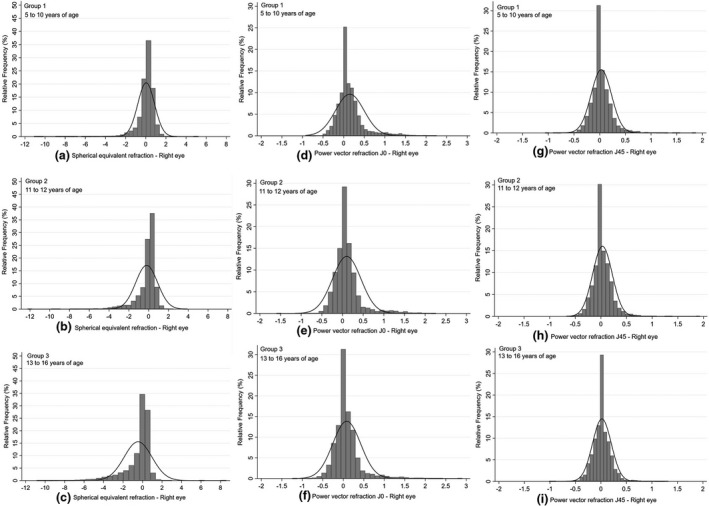
Children between the ages of 5 and 16 years from 11 schools in two districts of Tamil Nadu underwent vision screening. All children underwent visual acuity assessment using a Pocket Vision Screener followed by non-cycloplegic open-field autorefraction (Grand Seiko WAM-5500). Myopia was defined as a spherical equivalent (SE) refraction of ≤-0.75 D and high myopia was defined as SE ≤ -6.00 D. Distribution of refraction, biometry and factors associated with prevalence of myopia were the outcome measures.
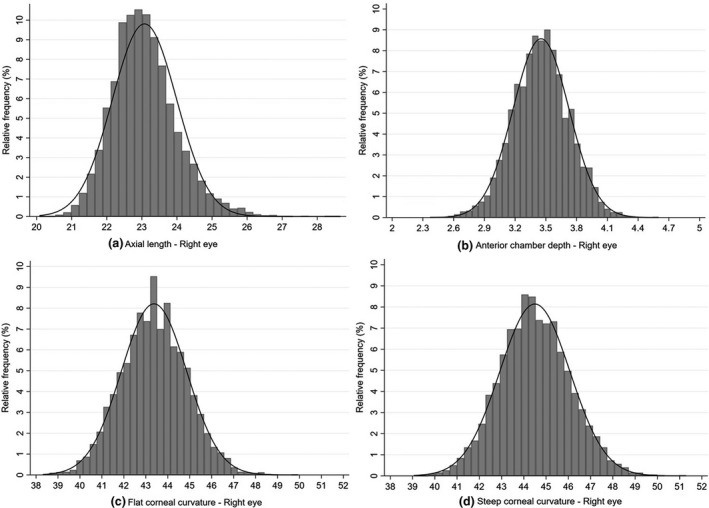
A total of 14,699 children completed vision screening, with 2% (357) of them having ocular abnormalities other than refractive errors or poor vision despite spectacle correction. The remaining 14,342 children (7557 boys; 52.69%) had a mean age of 10.2 (Standard Deviation [SD] 2.8) years. A total of 2502 had myopia in at least one eye, a prevalence of 17.5% (95% CI: 14.7-20.5%), and 74 (0.5%; 95% CI: 0.3-0.9%) had high myopia. Myopia prevalence increased with age (p < 0.001), but sex was not associated with myopia prevalence (p = 0.24). Mean axial length (AL; 23.08 (SD = 0.91) mm) and mean anterior chamber depth (ACD; 3.45 (SD = 0.27) mm) positively correlated with age (p < 0.001). The mean flat (K1; 43.37 (SD = 1.49) D) and steep (K2; 44.50 (SD = 1.58) D) corneal curvatures showed negative correlation with age (p = 0.02 and p < 0.001, respectively). In the multivariable logistic regression, older age and urban school location had higher odds for prevalence of myopia.
The baseline prevalence of myopia among 5- to 16-year-old children in South India is larger than that found in previous studies, indicating that myopia is becoming a major public health problem in this country.
报告来自印度南部泰米尔纳德邦一项前瞻性队列研究中,学童近视的基线患病率。
来自泰米尔纳德邦两个区 11 所学校的 5 至 16 岁儿童进行了视力筛查。所有儿童均使用 Pocket Vision Screener 进行视力评估,然后进行非睫状肌散瞳开放式自动验光(Grand Seiko WAM-5500)。近视定义为等效球镜(SE)屈光度≤-0.75D,高度近视定义为 SE ≤-6.00D。折射分布、生物测量和与近视患病率相关的因素是本研究的结局指标。
共有 14699 名儿童完成了视力筛查,其中 2%(357 名)的儿童除屈光不正或视力差外,还有其他眼部异常,尽管经过眼镜矫正。其余 14342 名儿童(7557 名男孩;52.69%)的平均年龄为 10.2(标准差[SD] 2.8)岁。共有 2502 名儿童至少一只眼近视,患病率为 17.5%(95%可信区间:14.7-20.5%),74 名(0.5%;95%可信区间:0.3-0.9%)患有高度近视。近视患病率随年龄增长而增加(p<0.001),但性别与近视患病率无关(p=0.24)。平均眼轴(AL;23.08(SD=0.91)mm)和平均前房深度(ACD;3.45(SD=0.27)mm)与年龄呈正相关(p<0.001)。平均平坦角膜曲率(K1;43.37(SD=1.49)D)和陡峭角膜曲率(K2;44.50(SD=1.58)D)与年龄呈负相关(p=0.02 和 p<0.001)。在多变量逻辑回归中,年龄较大和城市学校地点的近视患病率更高。
印度南部 5 至 16 岁儿童近视的基线患病率大于以往研究发现的患病率,表明近视正在成为该国一个主要的公共卫生问题。