Department of Veterinary Diagnostic and Production Animal Medicine, College of Veterinary Medicine, Iowa State Universitygrid.34421.30, Ames, Iowa, USA.
Virus and Prion Research Unit, National Animal Disease Center, USDA-ARS, Ames, Iowa, USA.
mSphere. 2022 Feb 23;7(1):e0080921. doi: 10.1128/msphere.00809-21. Epub 2022 Jan 12.
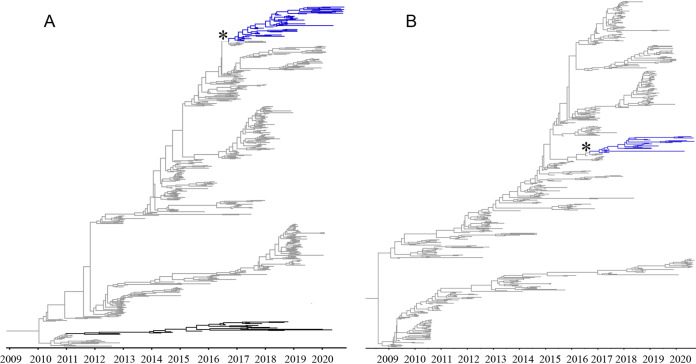
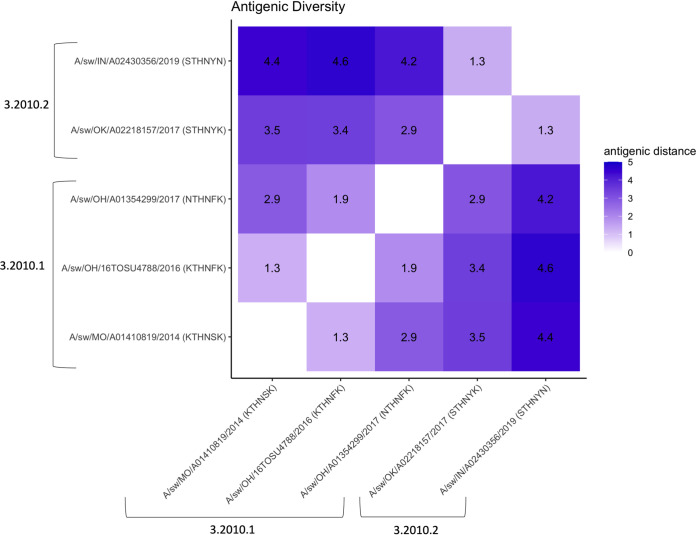
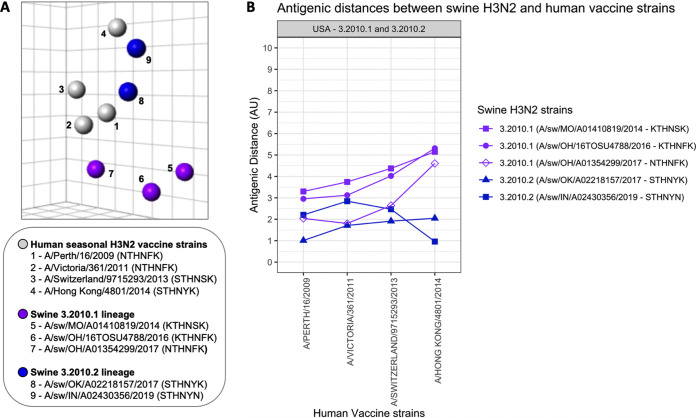
In 2017, the Iowa State University Veterinary Diagnostic Laboratory detected a reverse-zoonotic transmission of a human seasonal H3 influenza A virus into swine (IAV-S) in Oklahoma. Pairwise comparison between the recently characterized human seasonal H3 IAV-S (H3.2010.2) hemagglutinin (HA) sequences detected in swine and the most similar 2016-2017 human seasonal H3 revealed 99.9% nucleotide identity. To elucidate the origin of H3.2010.2 IAV-S, 45 HA and 27 neuraminidase (NA) sequences from 2017 to 2020 as well as 11 whole-genome sequences (WGS) were genetically characterized. Time to most recent common human ancestor was estimated between August and September 2016. The N2 NA was of human origin in all but one strain from diagnostic submissions with NA sequences, and the internal gene segments from WGS consisted of matrix genes originating from the 2009 pandemic H1N1 and another 5 internal genes of triple reassortant swine origin (TTTTPT). Pigs experimentally infected with H3.2010.2 demonstrated efficient nasal shedding and replication in the lungs, mild pneumonia, and minimal microscopic lung lesions and transmitted the virus to indirect contact swine. Antigenically, H3.2010.2 viruses were closer to a human seasonal vaccine strain, A/Hong Kong/4801/2014, than to the H3.2010.1 human seasonal H3 viruses detected in swine in 2012. This was the second sustained transmission of a human seasonal IAV into swine from the 2010 decade after H3.2010.1. Monitoring the spillover and detection of novel IAV from humans to swine may help vaccine antigen selection and could impact pandemic preparedness. H3.2010.2 is a new phylogenetic clade of H3N2 circulating in swine that became established after the spillover of a human seasonal H3N2 from the 2016-2017 influenza season. The novel H3.2010.2 transmitted and adapted to the swine host and demonstrated reassortment with internal genes from strains endemic to pigs, but it maintained human-like HA and NA. It is genetically and antigenically distinct from the H3.2010.1 H3N2 introduced earlier in the 2010 decade. Human seasonal IAV spillovers into swine become established in the population through adaptation and sustained transmission and contribute to the genetic and antigenic diversity of IAV circulating in swine. Continued IAV surveillance is necessary to detect emergence of novel strains in swine and assist with vaccine antigen selection to improve the ability to prevent respiratory disease in swine as well as the risk of zoonotic transmission.
2017 年,爱荷华州立大学兽医诊断实验室在俄克拉荷马州检测到一种人季节性 H3 甲型流感病毒(IAV-S)的反向人畜共患病传播。最近对猪中检测到的人季节性 H3 IAV-S(H3.2010.2)血凝素(HA)序列与 2016-2017 年最相似的序列进行了成对比较,发现核苷酸同一性为 99.9%。为了阐明 H3.2010.2 IAV-S 的起源,对 2017 年至 2020 年的 45 个 HA 和 27 个神经氨酸酶(NA)序列以及 11 个全基因组序列(WGS)进行了遗传特征分析。估计最近共同的人类祖先时间在 2016 年 8 月至 9 月之间。除了来自诊断提交的具有 NA 序列的一株外,所有 N2 NA 均来自人类,而来自 WGS 的内部基因片段由源自 2009 年大流行 H1N1 的基质基因和另外 5 个三重重配猪起源的内部基因(TTTTPT)组成。用 H3.2010.2 实验感染的猪在肺部表现出有效的鼻腔脱落和复制,轻度肺炎和最小的显微镜下肺损伤,并将病毒传播给间接接触的猪。在抗原性方面,H3.2010.2 病毒与人类季节性疫苗株 A/Hong Kong/4801/2014 更为接近,而不是与 2012 年在猪中检测到的人季节性 H3.2010.1 病毒更为接近。这是继 H3.2010.1 之后,人类季节性 IAV 从 21 世纪 10 年代第二次持续传播到猪中。监测人类到猪的新型 IAV 的溢出和检测可能有助于疫苗抗原选择,并可能影响大流行准备。H3.2010.2 是一种新的 H3N2 进化枝,在 2016-2017 流感季节人类季节性 H3N2 溢出后,在猪中传播。新型 H3.2010.2 传播并适应了猪宿主,并与猪中流行的内部基因发生了重配,但仍保持了类似人类的 HA 和 NA。它在遗传和抗原上与 21 世纪 10 年代早期引入的 H3.2010.1 H3N2 不同。人类季节性 IAV 溢出到猪中,通过适应和持续传播在猪群中建立起来,并有助于猪中流行的 IAV 的遗传和抗原多样性。需要继续进行 IAV 监测,以检测猪中新菌株的出现,并协助疫苗抗原选择,以提高预防猪呼吸道疾病以及人畜共患传播风险的能力。